

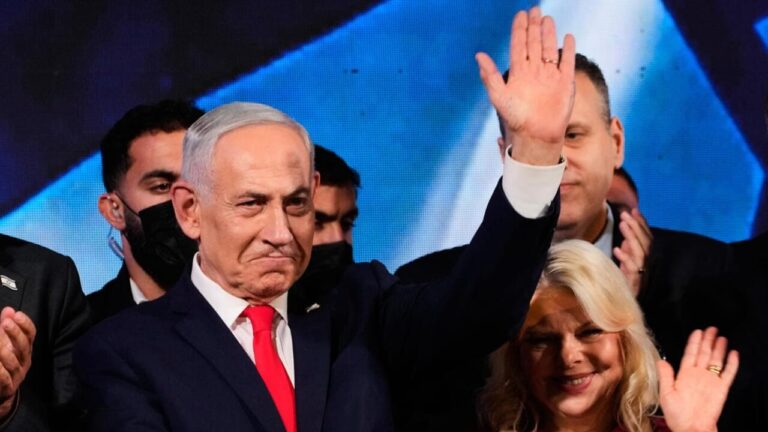
The only certainty is that Israel did not want to get rid of Netanyahu
The political end of Bibi Netanyahu, his electoral defeat that many in recent years believed they could celebrate with the Israeli elections on 27 October 2026, has been postponed. At a later date. It will be the only certainty once the counting is over, it was the only certainty as we moved from the first exit polls of the evening to the first real votes, moreover with a rather noticeable slowness.
Last, late this evening, will be the votes of the soldiers, the sick and the prisoners, and they are not few, but one thing was already certain on the night of the counting: Netanyahu is not dead, politically and, more importantly, the Israeli vote with the highest turnout in the last thirty years, at 77.7%, to which a massive participation of Palestinian citizens of Israel contributes, certifies that “the people” did not want to move on.
Likud always the first party
Netanyahu will most likely not have the majority to govern, but his Likud, his old right-wing party, continues to be the leading party. The bloc of his heterogeneous opponents led by the neo-politician Gadi Eisenkot, all together, will not even have a relative majority and, speaking of “inexperience”, it is quite impressive to think back to the enthusiasm with which Eisenkot himself commented on the first exit polls, after the polls had just closed. In the middle, there is the great result of the Arab parties, accredited with 18 seats, which are around 15% of parliamentarians: a representation which for the first time really resembles the percentage of Palestinian citizens, which are over 20%. A fact to take into account, for many reasons, and also because in all likelihood it is precisely this participation that denied Netanyahu the possibility of winning once again, significantly increasing the real electoral base.
While waiting for the latest counts, this scenario is therefore consolidating: the right-wing and far-right bloc, led by Netanyahu and which includes all the various national religious extremists that we have come to know in recent years, could ultimately find itself ahead of the opponents of four or five parliamentarians, without however having the majority to form the government autonomously. The centre-right-centre-centre-left bloc that opposed him would indeed be a few seats behind. Netanyahu’s bloc and in particular his party, the historic right-wing Likud party, have lost a few percentage points compared to the elections four years ago, and we would be talking about a defeat if these elections did not take place after these years of government and tragedies and if the voters who trusted him are, numerically, approximately the same.
In fact, in 2022, a year after being elected prime minister for the umpteenth time, Netanyahu led the country in the most sensational defeat in the history of Israeli intelligence – 7 October 2023, the day on which 1,200 Israeli civilians were massacred and another thousand kidnapped – and immediately afterwards, by his decision and under his leadership, the destruction and devastation of Gaza began, with over 70 thousand deaths, women ee smaller among these to tens of thousands. In addition to the ethical and political aberration, which would obviously be enough, Israel has achieved that no more rockets are fired from the rubble of Gaza, and little else.
Hezbollah and Trump
He decapitated Hezbollah in Lebanon but then pushed Trump into getting bogged down, with global consequences for everyone’s lives, including ours, in a dead-end war with Iran. Finally, certainly a detail, but not an irrelevant one, this Netanyahu government has devastated Israel’s reputation in the world, making even large sections of the population and intellectual class who had never been a priori hostile harshly critical.
It is by remembering all this that it is necessary to measure and weigh the results that arrive. The decline of the Likud and the resistance of the hardest extremist parties such as Ben Gvir’s Otzmah Yeudith build a clear picture: Israeli society as a whole did not want to change course, and did not want to give the confidence needed to the moderate and compactly Zionist bloc of those who were running to govern as an alternative to Netanyahu.
It did not reward Netanyahu, thanks and perhaps above all thanks to the impressive turnout of the minority of Palestinian citizens of Israel, whose vote flowed towards the Arab parties, and which therefore may have diluted the proportions of Netanyahu’s victory, but will hardly contribute to an alternative government, except in the case of a turning point which is currently truly unpredictable. Easier, in the current state of affairs, is that Netanyahu is tasked with trying to form a government, as the candidate of the first party and the first “coalition” – the quotation marks are a must, in a proportionalist country to the core, like Israel – to try to get the votes he will lack, in parliament, from the more conservative supporters of the bloc that opposed him, starting from the Ysrael Beitenu of the Russians led by Avigdor Liebermann or even Naftali Bennett.
What Netanyahu’s non-defeat says
We will understand what will happen once the count is over and above all when negotiations for the new government begin. To think about a real change of direction and perspective, we would need the courage and imagination it takes to imagine Arab parties in government. Not only integrated, but more decisive than ever, given the numbers, together with the anti-Bibi blockade. Easier to believe in some formula of national unity, or in a Netanyahu who manages to fish among his opponents. Or, after a few attempts and a lame government, we will return to voting soon for yet another referendum on him.
One thing is certain and clear from now on: while the world was moved by Naza, Israel stood still, frozen in its infinite October 7th, in that spiral of anger and fear represented without mediation by the Fauda series. Netanyahu’s non-defeat also says this, perhaps above all this. The problem, of course, is all ahead. A dramatic past and an immobile future, if not in war, which have a point of conjunction: his name is Bibi Netanyahu.