

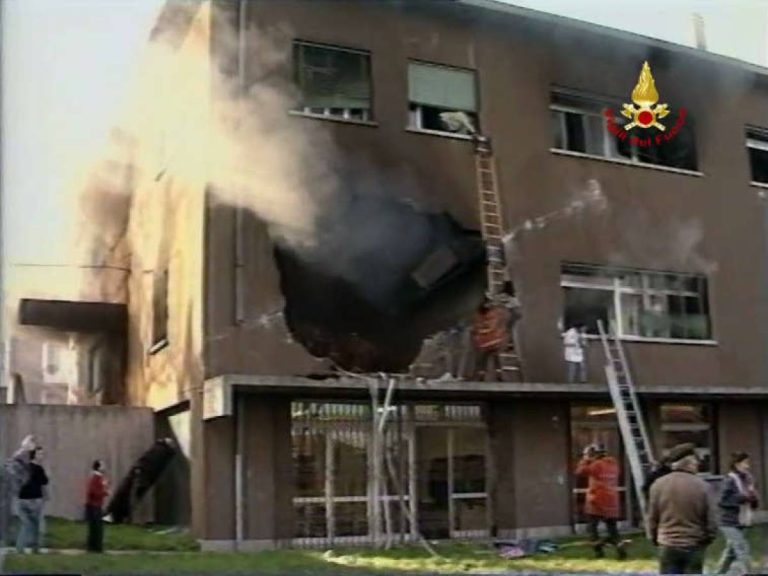
On 6 December 1990 in Casalecchio di Reno, Bologna, a tragic accident in which 12 young students of theTECHNICAL INSTITUTE Salvemini And another 88, among students and teachers were injured, some seriously. That cold December morning, an Aermacchi MB-326 of the Italian Air Force in failure, lost control and crashed precisely against the school, hitting the classroom of class 2 ° A.
The dynamics and causes of the crash
On the morning of 6 October 1990, at 9:48 am, from the airport from Verona-Villafranca airport, he took off a Aermacchi MB 326a training for training. The plane, piloted by the 24 -year -old second lieutenant Bruno Viviani, was to carry out a calibration mission of the defense systems, which provided for the overflow above Borgoforte and Rovigo. But at 10:22 Viviani realized that something was wrong: the engine showed Technical problemsforcing the pilot to ask to land in the nearest airport, namely that of Ferrara. But the track was too short, so at 10:23 Viviani contacted the control tower of the Bologna airport, communicating the emergency and asking to land.
But it’s too late. At 10:31 the pilot communicated that the aircraft was on fire, and that the engine had stopped working. Viviani launched himself with the parachute outside the aircraft and landed in Ceretolo, a hamlet of Casalecchio di Reno, without reporting serious damage, apart from three broken vertebrae. But if Viviani came out unscathed by the accident, many others were less fortunate than him.
By now out of control and on fire, the Aermacchi crashed into the classroom of the 2nd A of the Gaetano Salvemini Institute of Casalecchio di Reno, killing 12 of the 16 on the shot students Present in the classroom that morning, all between 14 and 16 years old, and seriously injuring 4, in addition to the teacher Cristina Germani. Due to the crashthe kerosene present in the tanks of the aircraft came out, causing a fire Inside the hit and trapping several people on the upper floor, who found themselves in the flames without a way out.
The first to go to the place of the disaster to give rescue to students and teachers, were some residents, who worked to help the trapped survivors in the school to drop from the windows. In the meantime, the firefighters arrived, who coordinated with the rescue team, removed the flames and brought the wounded to the hospital. Fortunately, a student, Federica Tacconi, whose shouts were heard by the rescuers at the end of the recovery operations, was fortunately found alive.
The process and the guilty of the disaster
The Public Prosecutor of Bologna opened a judicial proceedings For the aircraft pilot, Bruno Viviani, for Colonel Eugenio Brega, and for Lieutenant Colonel Roberto Corsini, officer of the control tower of the Verona-Villafranca airport, all three on charges of Plurimous manslaughter and air disaster. The accusation claimed that Viviani, once he realized the emergency, would have had to bring the plane to the east, or at the height of the Adriatic Sea and here ejectures himself, in order to avoid inhabited centers. The prosecutor accused the other two officers of having provided Viviani incorrect instructions on how to manage the emergency and in 1995 the three soldiers were sentenced to two years and six months of imprisonment.
But in 1997, in the second instance, the Bologna Court of Appeal overturned the sentence, fulfilling the defendants, as “the fact does not constitute a crime”. Finally, in 1998, the Court of Cassation of Rome also rejected the latest appeals of the relatives of the victims, attributing the accident to one tragic fatality.
Following the tragedy, the families of the victims 4 four associations with the aim of remembering the accident and promoting Solidarity events for victims and initiatives in favor of city safety. In 1997 the associations unified in a single association called the Association of Victims of Salvemini – 6 December 1990.
The building that housed the Salvemini Institute was reopened in 2001, no longer as a school, but as a house of solidarity “Alexander Dubček”, which hosted several solidarity associations and the local civil protection nucleus. The classroom hit by the Ermacchi was called “Memory Chamber”, inside which a sculpture depicting 12 stylized seagulls in flight was installed, a symbol of the 12 young victims of the tragedy.