

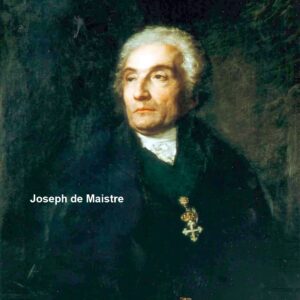
The young Alfredo Cattabiani chose Joseph de Maistre as the theme for the degree thesis at the University of Turin, but the decision was seen as an affront. During the discussion, Norberto Bobbio, a counter -backmaker, performed a blatant gesture: he grabbed the work, threw him on the ground and declared that he did not want to comment on the ideas of a “slavery theorist”. The episode, frequently mentioned, is paradigmatic because it symbolizes the hostility that for decades has characterized an author considered marginal.
Although appreciable for consistency and rigor, its philosophy is in fact always perceived as anachronistic. However, reducing de corn to a purely reactive figure would be a mistake, and not only because his thought transcends the elementary opposition to changes in his time.
Although he was a ferocious critic of the Enlightenment, he does not hesitate to direct criticism also towards the Catholic world, denouncing their weaknesses and internal contradictions. If therefore, boldly by rhetorical excesses, his thought can reveal a particular ability to grasp the different shades of the modern, as highlighted in the essay The Pope Which represents the most mature point of his production and which, with the curation of Jacques Lovie and Joannès Chetail, is now re -proposed by the Luni editions.
It is out of doubt that the fundamental change in his approach takes place with the facts of 1789: «For a long time we have not understood the revolution of which we witness; For a long time we took it for an event. They were wrong: it is an era. ” The revolution represents a war declared against the traditional order, with the aim of annihilating the Church and the Papacy. From his point of view, the intention is instead to restore the papal primacy, which in the Middle Ages had guaranteed a model of Europe that he already feels in crisis from the first signs of the Protestant reform.
But to demolish the image of a thinker wrapped in this gray aura, a life marked by extraordinary events should be sufficient. Raised in a cultured environment, it is said that his mother falls asleep by reciting the verses of Racine. High grade Freemason, he attended the Jesuit schools, who defended with great ardor even after the dissolution of the order. In addition to knowing English, the Portuguese, the Spaniard and the Latin perfectly, also delighted with the Greek, the German, the Russian and the Hebrew. An exceptional linguistic erudition that was an essential tool for comparison with a wide range of philosophical and cultural traditions.
The events related to the French Revolution forced him to exile for over twenty years, living first in Aosta, then Lausanne and finally in St. Petersburg, where he remained from 1802 to 1817. Vittorio Emanuele I appointed him full -pensive minister at the Russian court, an assignment that allowed him to play a leading role in diplomatic relations. In St. Petersburg he became a reference figure for many, also of the Tsar Alessandro I. After firmly supporting the cause of the Jesuits, however, he fell out of disgrace with the Tsar and returned to Italy in 1817, where he continued to hold institutional roles at the Sabauda court.
The Popepublished in 1819, just before his death but conceived and drawn up in the Russian years, he manages to highlight all the philosophical, religious and political reverbs of his thought. Immediate editorial success, with over fifty reprints during the nineteenth century, also shows its general appreciation
Not only does he defend the figure of the Pope as a spiritual guide of the Church, but redefines the role of regulator of the society’s moral and legal order, capable of guaranteeing the unity and continuity of civilization. De Maistre then reflects on the relationship between Church and State, claiming that, since the revolution had broken the natural order established by God, the Pope’s intervention was legitimate to restore it. But there is something more: as a supreme and infallible power, the Pope would have been the only judge capable of preventing monarchies from deviating from their original course and degenerating into tyrannides. His analysis implied that papal power was not absolute, but subject to divine law and the provisions established by Christ for the Church. Although the Pope had an indisputable authority in the field of faith, this power was not to extend to the political sphere, excluding earthly issues from his jurisdiction. However, the Pope could intervene to prevent these issues from degenerating. In this sense, it is conceived as a sort of high mediator between the human and the divine, always in harmony with the will of God, since De Corn argues that the connection between God and man must originate from the divine and not from human needs. It is a overturned approach with respect to the most recent trends, both internal and limited to the Catholic world, which see in compliance with the times, fashions and customs a central value. And perhaps this is precisely this that annoys its critics!