

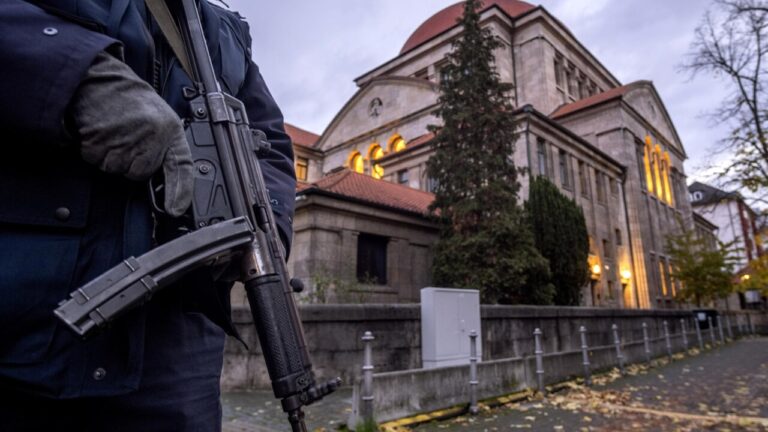
Iran is reportedly implementing a sort of “tension strategy” to sow chaos in Europe. The smoking gun isn’t there at the moment, but investigators and intelligence services believe that Tehran’s involvement in a series of attacks that have occurred since the United States and Israel began the new war in the Middle East is plausible, even probable.
A long series of attacks
The Guardian talks about at least 17 episodes, including attempted fires against synagogues, meeting places, an Iranian television station in London (which however supports opposition to the Ayatollah regime) and a branch of the Bank of America in Paris. A first wave of attacks was launched 10 days after the first raids and targeted places of worship of the Jewish community.
The facts, put in order. On March 9, an explosion destroys the window of the synagogue in Liège in Belgium. A few days later a fire broke out in another synagogue, but in Rotterdam, Holland. On March 14 in Amsterdam an explosion damaged a Jewish school in what the city’s mayor described as a deliberate attack against the Jewish community.
Belgium Synagogue blast
The alleged attackers behind Belgium synagogue blast have released a video of the attack
Links to IRGC are reportedly being investigated https://t.co/fB7M1uY9Pf pic.twitter.com/GDUuouJcKW
— Menachem Vorchheimer (@MenachemV) March 11, 2026
At a later stage it is the turn of the United Kingdom. In London, four ambulances belonging to the Jewish volunteer organization Hatzola are set on fire. An attempted arson was reported at the Kenton United Synagogue, in the north-west of the city, and then in nearby Finchley.
On April 15, an “incendiary container” was thrown into the parking lot of a building adjacent to the offices of Iran International, a news channel that opposes the Tehran regime. Paris is also hit. On March 28, French police foiled an arson attack in front of a Bank of America building, not far from the Champs-Élysées.
Recruitment
Small-scale episodes, which often end up in minor news articles, but which when put together suggest the existence of a more structured plan. Since the attacks began in the UK alone, 23 people have been arrested. The hypothesis of investigators, security officials, analysts and law enforcement agencies is that Iran is behind this low-intensity “hybrid war”.
According to the Guardian – which cites sources close to the dossiers – the strategy of Iranian secret services and Revolutionary Guard agents is to recruit teenagers through criminal intermediaries to destabilize European countries and attract media attention. The “lone wolves” would be convinced to carry out small acts of terrorism with promises of money, often a thousand euros or little more, but they would lack a strong ideological motive.
One of the minors involved in the attack on the Kenton United synagogue assured police that he had “no hatred towards Jews” and did not even know that it was a synagogue. “I honestly thought it was an empty building,” he reportedly told investigators. The 17-year-old arrested in Paris for the attempted fire at a Bank of America branch told police he was recruited through a Snapchat group where he usually received commissions for delivering drugs.
Police thwart suspected bomb attack outside a Bank of America building in Paris https://t.co/OLaprylLUb
— Sky News (@SkyNews) March 28, 2026
The French Interior Minister has little doubt that Tehran is behind it. “Typically, Iranian intelligence services operate this way: They use intermediaries, a series of subcontractors who are often common criminals, to conduct targeted actions against U.S. and Jewish community interests or against Iranian opposition figures.” While it is true that there is no definitive proof of direct Iranian involvement, investigators consider the similarity between the episodes, the choice of targets and the operational methods suspicious, which are reminiscent of previous operations attributed to Tehran. Furthermore, European secret services have been reporting for years the Iranian use of criminal networks as “proxies” for operations abroad, as already documented in other investigations.
Then there are other clues that lead to Iran. Some actions were claimed by a hitherto unknown acronym, Harakat Ashab al-Yamin al-Islamia (Hayi), which appeared for the first time on social channels linked to pro-Iranian militias in Iraq. According to Phillip Smyth, an expert on Shiite militias, the aim is not to cause massacres – the attacks so far have been calibrated to avoid casualties – but to sow chaos, causing “analysis paralysis” in Western security services and to obtain widespread media coverage. “If you generate enough media coverage, you can claim to have greater capabilities than you actually have…” Smyth highlighted. “It’s all part of a strategy to keep the situation confusing.”