

The three factors with which Ukraine is turning the war around (and the Normandy landings have something to do with it)
Something is happening in the war in Ukraine that recalls, with all the differences, a military lesson from the Second World War. In 1943, after the armistice, the Aegean islands under Italian control were attacked by the Germans like any other area held by the Royal Army, but here the British tried to intervene to prevent the enemy’s success, and used their elite forces; there then took place a series of fierce clashes between the Anglo-Italians and the Germans, especially on the islands of Rhodes, Leros and Coos. In the end, the Germans prevailed, essentially thanks to the fact that they exercised air superiority despite the absolute British naval supremacy. A few months later, in Normandy, the picture was reversed: at the time of the Allied landing, the Luftwaffe was almost absent and the Anglo-Americans controlled the sky.
History repeats itself
What had changed between the late summer of ’43 and the late spring of ’44, which had completely overturned the dominance of the air over the European continent? Simple: the new American P-51 Mustang and P-47 Thunderbolt fighters had arrived – in large numbers, alongside the new version of the British Spitfire (the Mk 9), which had combined a technological level at least equal to their German counterparts with an equally high pilot capability and a clear numerical superiority such as to push back the enemy’s air control area in depth, going so far as to contest control of the sky above Germany itself.
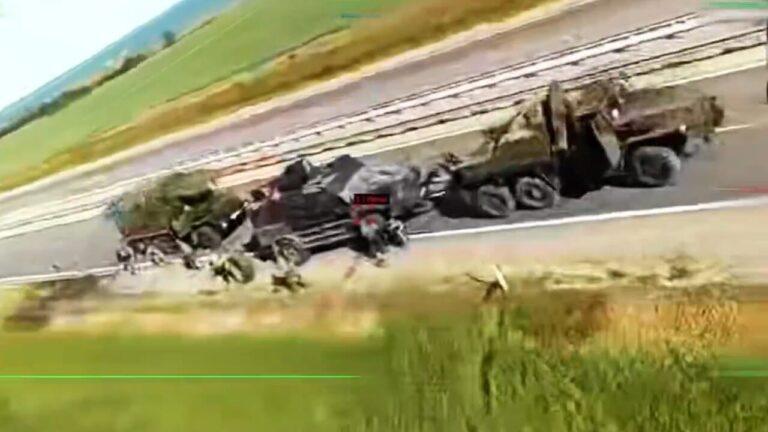
Today we no longer fight for air dominance with propeller fighters, but with drones. And in Ukraine the balance seems to have shifted, at least in some segments, in Kiev’s favor. There can be no question of absolute domination: Russia continues to produce and launch drones on a large scale, hitting cities, infrastructure and military targets. But Ukraine has strengthened its capacity for tactical use, in-depth attacks and above all medium-range strikes, between 30 and 180 kilometers behind the front line, against Russian radars, logistics, communications and defense systems.
The 3 secrets that are changing the war
To complete the analogy, the new Ukrainian short- and medium-range drones are the equivalent of the ’44 Mustangs and Thunderbolts. The difference isn’t just in the technology. An effective drone is not just a flying object with a camera and an explosive. We need a supply chain capable of producing it, modifying it quickly, adapting it to the enemy’s electronic countermeasures. And we need trained operators, commanders capable of integrating reconnaissance, intelligence and fire, teams capable of learning from the front in almost real time.
On this terrain, Ukraine has built a more flexible ecosystem: local startups, widespread production, Western support, specialized departments and a strong culture of adaptation. Russia, for its part, is not standing still. It has developed and mass-produced attack drones, many of them derived from the Iranian Shahed/Geran family, and continues to adapt tactics and technologies. This is also demonstrated by the internal defensive response: Moscow has authorized even banks and financial institutions to equip themselves with anti-drone systems, a sign that the in-depth Ukrainian attacks have become a structural problem.
Kiev did not win the drone war. But it has gained the initiative and advantage in some crucial areas: rapid innovation, widespread tactical use, medium-depth attacks and the ability to strike sensitive targets well beyond the front. If this trend continues, it could change the very way war is fought. But, as always in modern conflicts, any technological advantage lasts only until the enemy finds a way to adapt.