

In 2025, levels of carbon dioxide (CO₂) and other major greenhouse gases in the atmosphere have reached unprecedented concentrations, cementing further long-term temperature rise for the planet. The alarm is raised by the new report from the World Meteorological Organization (WMO), the UN agency that deals with weather and climate.
Greenhouse gas levels
According to the latest data, greenhouse gas concentrations in the atmosphere have reached new record levels in 2025, resulting in climate impacts that will persist for centuries to come. Levels of the three main greenhouse gases, carbon dioxide, methane and nitrous oxide, responsible for global warming, all reached never-before-seen thresholds last year.
The WMO Greenhouse Gas Bulletin reported that the global average concentration of CO₂ at the Earth’s surface in 2025 was 426.8 parts per million, or 153% of the pre-industrial reference level of 1750. Concentrations of methane and nitrous oxide, the second and third most important long-lived greenhouse gases linked to human activities, also reached a new record. When the WMO data was first published in 2004, the average annual CO₂ level was 377.5 ppm.
“New Record”
The bulletin arrives a few days before COP 31, an event to be held in Antalya, Turkey, from 9 to 20 November 2026, which aims to transform climate commitments into concrete actions. “The last 11 years have already been the hottest – we read in the report – and the trend is destined to continue”. A fear shared by WMO Deputy Secretary General Ko Barrett: “Another year, another new record. Greenhouse gases are trapping an unprecedented amount of heat in the atmosphere, providing energy for more extreme weather phenomena and the related risks to our economies and societies. The last 11 years have been the warmest on record and this trend is set to continue. CO₂ is very long-lived and will therefore influence the global climate not just for years, but for decades and even centuries.”
According to the bulletin, half of the total CO₂ emitted each year remains in the atmosphere, while the rest is absorbed by terrestrial ecosystems and oceans. The National Oceanic and Atmospheric Administration’s (NOAA) annual greenhouse gas index shows that from 1990 to 2025, radiative forcing, the warming effect on our climate caused by long-lived greenhouse gases, increased by 56%, with CO₂ accounting for about 81% of this increase.
CO2 rates tripled
CO₂ growth rates have tripled since the 1960s, accelerating from an average annual increase of 0.8 ppm to 2.4 ppm in the decade from 2011 to 2020. From 2024 to 2025, the global average CO₂ concentration increased by 2.8 ppm, higher than the 10-year average but slightly lower than the exceptional surge in 2023/2024.
“The more modest growth rate from 2024 to 2025 reflects the recovery of terrestrial carbon sinks and the reduction of carbon emissions from fires in 2025, following the strong El Niño of 2023/2024, which reduced the efficiency of the biosphere through greater drought, drier vegetation and a greater number of forest fires,” explained Oksana Tarasova, senior scientific officer at WMO. “However, an annual increase of 2.8 ppm still represents a substantial contribution to carbon inputs into the atmosphere from fossil fuel burning. We can expect concentrations to increase further in 2026 due to the burning of fossil fuels and the development of a powerful El Niño that will impact terrestrial carbon sinks, as occurred in 2023/2024. The risks of reduced CO₂ absorption capacity by the oceans are increasing in the context of climate change.”
Methane and nitrous oxide
Methane is responsible for around 16% of the long-term greenhouse effect on our climate, but has a much shorter lifespan than CO₂. About 35% of methane is emitted into the atmosphere from natural sources (e.g., wetlands) that are also climate-sensitive, while about 65% comes from anthropogenic sources such as livestock farming, rice cultivation, fossil fuel exploitation, landfills, and biomass burning.
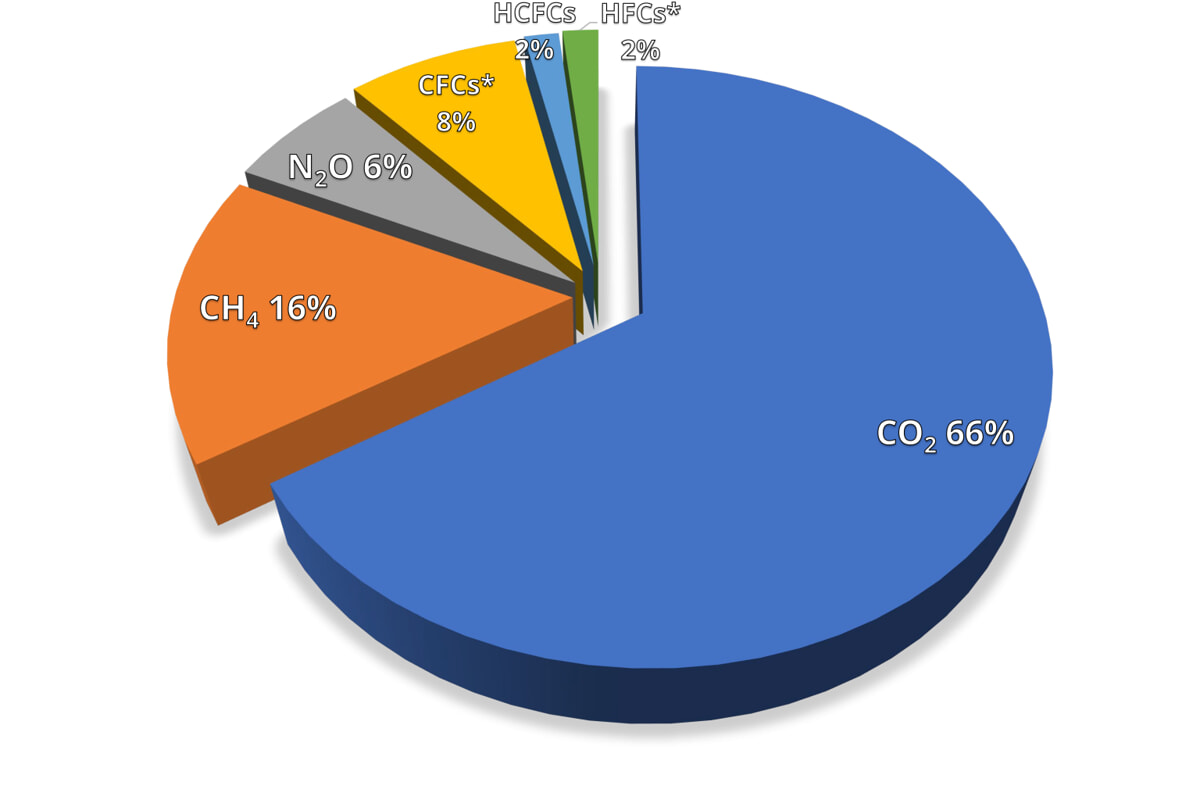
The global average methane concentration in 2025 was 1948 parts per billion (ppb), or 267% of the 1750 level.
Nitrous oxide is the third most important long-lived greenhouse gas and comes from both natural sources and human activities such as biomass burning, fertilizer use, and various industrial processes. The global average N₂O concentration reached 339.1 ppb in 2025, 126% higher than in 1750.
While various countries adopt measures to transform their energy systems with a view to decarbonisation, particular attention must be paid to two gases present in limited quantities but linked to the production and distribution of electricity: molecular hydrogen (H₂) and sulfur hexafluoride (SF₆), both on the increase. Both hydrogen leakage and the persistence of SF₆ constitute potential threats, capable of compromising the climate benefits of the energy transition.