

Military actions on the one hand, economic ones on the other. The US raises the bar and aims to isolate Tehran from the rest of the world by cutting all financial ties with other countries. It was the US Treasury Secretary, Scott Bessent, who first raised the veil on what was called “Operation Economic Outcast”. A few hours later, a State Department press release was released announcing “decisive action against numerous entities, individuals, and vessels that facilitate the Iranian regime’s destabilizing activities.” In fact, the US is targeting not only Iran, but also all those who in some way provide aid, including China.
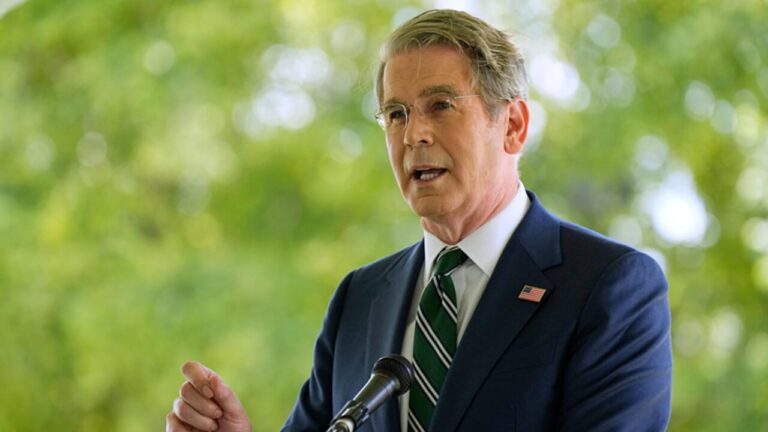
What Bessent said
Bessent threatened to impose sanctions on all countries that do business with Iran, including China. The aim is to “sever every economic lifeline” that supports the regime. However, Bessent explained that he wanted to give countries a “grace period” to adjust: “Why would I want to blow up the global financial system? We think it’s important to give people time to fix it, but they need to know that we will act very quickly and that we are serious.” The secretary added that he did not want to set a precise deadline, warning however: “We do not have infinite patience.”
America’s focus is on five sectors: digital assets, technology, gold, aviation and shipping. According to the Treasury, Washington has “mapped every node, every facilitator and every network” used by Tehran to smuggle oil and evade restrictions.
Bessent also anticipated an “important announcement” by the end of the week: a financial institution would be targeted.
Operation Economic Outcast unleashed. An unprecedented campaign to serve every remaining economic lifeline sustaining Iran.
America is entering the endgame with the single greatest financial offensive ever mounted against an adversary. pic.twitter.com/FpXuX4IEm0
— The White House (@WhiteHouse) August 24, 2026
The sanctions
The State Department then announced sanctions against “numerous entities, individuals and vessels” accused of “facilitating the destabilizing activities” of the Iranian government. These activities include “attacks against US forces and their allies in the region, the illegal purchase of weapons, cyber intrusions into US infrastructure, and the trafficking of energy products whose sale finances terrorism globally.”
The United States is targeting individuals and entities involved in the Iranian regime’s weapons procurement; cyber intrusions into US energy, defense, and health infrastructure; and the illicit oil shipments that fund terrorism across the Middle East. We call on the…
— Tommy Pigott (@statedeptspox) August 24, 2026
The sanctions are aimed “against Iranian military officers responsible for purchasing weapons and conducting attacks against the U.S. military and regional partners, Iran-based entities that gathered intelligence to attack U.S. forces and their allies, and a supply network that supplied Iran’s military and missile programs.”
According to a document detailing the sanctions published in parallel by the State Department, they include the commander of the Revolutionary Guard, Ahmad Vahidi; the commander of the Revolutionary Guard Aerospace Force, Hosein Majid Musavi Eftejari; the commander of the Jatam al Anbiya operational headquarters, Alí Abdolahi; the commander of the Iranian Army, Amir Hatami, and the spokesperson of the Ministry of Defense, Rezsa Talaei Nik. “The sanctions are also aimed at a regime-led cyber group responsible for extensive intrusions into US critical infrastructure,” adds US diplomacy, which in the document refers to the “Cyber-Electronic Command of the Iranian Revolutionary Guard.”
Furthermore, the measure concerns “a large group of transporters and agents who move Iranian oil, as well as petroleum and petrochemical products, through the United Arab Emirates, China, Singapore and Europe to finance the US-designated Islamic Revolutionary Guard Quds Force and other elements of the regime,” the statement adds.
There is then “an appeal to the international community to join” with Washington “in the task of holding these actors accountable for their actions”.
Iran’s response
Iran does not stand by and promises to retaliate against the expansion of US sanctions both on an economic level and, if necessary, “with actions against vital American interests and energy hubs”.
“We are fully ready for American sanctions – declared the Iranian Economy Minister, Ali Madanizadeh, on state television -. The enemies intend to launch an economic terrorist attack against us, but we also have our tools and we know how to play. Our defense is no longer just defensive: the enemies must expect an attack”.
Revolutionary Guards spokesman Hossein Mohebbi also threatened severe blows against vital US interests if Iranian infrastructure is threatened.
China: “We will defend our interests”
And China’s response was not long in coming. Lin Jian, spokesperson for the Foreign Ministry, made it official that “all necessary measures will be adopted to firmly defend one’s interests”.
“The maximum pressures exerted in the context of an economic war do not solve the problems at all. On the contrary, they further fuel tensions and conflicts, cause contagion effects, destabilize the world economic and financial order and harm the rights and legitimate interests of other countries”, underlined Lin Jian.