

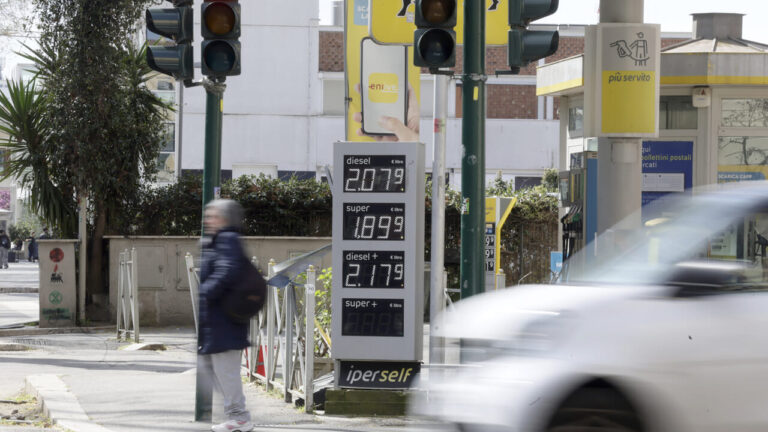
A few days ago, Wednesday 18 March, the Council of Ministers approved some measures to limit the increase in fuel prices caused by the war in the Middle East. Giorgia Meloni then presented the executive’s decisions in an interview with Tg1. There are three approved measures and they are operational from Thursday 19 March.
There is a reduction of 25 cents per liter for twenty days in excise duties on fuel, i.e. fixed amount taxes calculated on each liter of fuel sold. And then a tax credit on diesel for hauliers (i.e. a tax break that will allow them to pay less), and finally a rule against price speculation which provides for “a special control regime”.
In the evening Council of Ministers on high energy costs. The prime minister #Melons on our news he explains the measures to counter fuel speculation. Then, a few days before the vote on the #referendumsays: “Just reform, it is a unique opportunity to modernize the country”.#Tg1 A. Cardone pic.twitter.com/QvDXTXD58I
— Tg1 (@Tg1Rai) March 18, 2026
Despite the cut in excise duties decided by the government, it is still time for increases in fuel prices at the pump, driven by the rise in international oil prices. The latest data released by Staffetta Quotidiana, based on the average costs collected by the Price Observatory of the Ministry of Business and Made in Italy as of 22 March, on approximately twenty thousand plants, self-service petrol is sold at 1,719 euros per liter (+4 thousandths, companies 1,711, white pumps 1,733), and self-service diesel at 1,979 euros per liter (+11, companies 1,977, white pumps 1,984).
Looking at what is served, for petrol the average is 1.855 euros per liter (+2, companies 1.880, white pumps 1.806) and for diesel 2.111 euros per liter (+8, companies 2.141, white pumps 2.054). On the motorway network, self-service petrol is around 1.782 euros per liter (served 2.028), self-service diesel is around 2.045 euros per liter (served 2.295). How can you save a few euros on a full tank?
10 tips for saving on petrol
The National Consumers Union (UNC) has developed a handbook with ten practical tips to try to contain the impact of fuel increases on the wallet. The first piece of advice suggests not to “be satisfied with choosing a distributor that has prices lower than the regional average”, because it could still be the most expensive in your city, “given the extreme variability of prices charged from one area to another”.
The association therefore invites you to make every effort to find the absolute least expensive one. Citing the Antitrust, it is recalled that “a plant is effectively in competition only with plants located a few kilometers away”, and therefore “it could easily happen that the price in a given sub-area is different from the regional average, which would therefore constitute an indicator that is not representative of the local situation and, as such, of little use to the consumer”.
The second piece of advice mirrors the first. “Don’t go into the first petrol station that comes your way as soon as the petrol light comes on – suggests the UNC -, but always look for the lowest price in your area”.
The prices, the highway
To make the first two tips concrete, the association reminds you that it is possible to compare fuel prices using the Fuel Price Observer, even if it doesn’t work entirely as it should. For example, it is underlined that “it is not possible to search for the city of Rome or for the province of Milan, Naples and Turin because the maximum of 500 results is exceeded” and therefore “the results cannot be exported”. However, the search by geographical area is active, where you can enter region, province and municipality, and read the prices in ascending order. It is also possible to proceed with a search by route and motorway section. Alternatively, there are also various private applications to control costs.
And then it’s not true that one distributor is as good as another. Even in the same city, the differences between the most expensive and the cheapest petrol station can reach up to a euro per litre.
It is better to avoid running out of fuel on the motorway, where petrol stations always have higher prices, and therefore to fill up before starting the journey. If this is not possible, says the UNC, it is better to exit the highway, fill up the tank and then return again. Another trick to save money is to prefer white pumps, i.e. independent ones without famous signs, rather than those affiliated with large oil groups.
The smart petrol station attendants
It is always better to also choose to refuel at the self-service, without therefore being served by the operators of the refueling points, because the price in the second case is higher. And again, the National Consumer Union invites consumers to check “the correspondence between the prices displayed on the signs visible from the road and those actually charged that you find on the charging station, given that some petrol station attendants are clever, lure you with one price and then apply another”.
Penultimate advice: go slowly, as far as possible, because it allows you to consume less fuel. The UNC then asks you to report anomalous prices, failure to display the signs that should always be there by law and the display of incorrect prices: these are violations that lead to sanctions.