

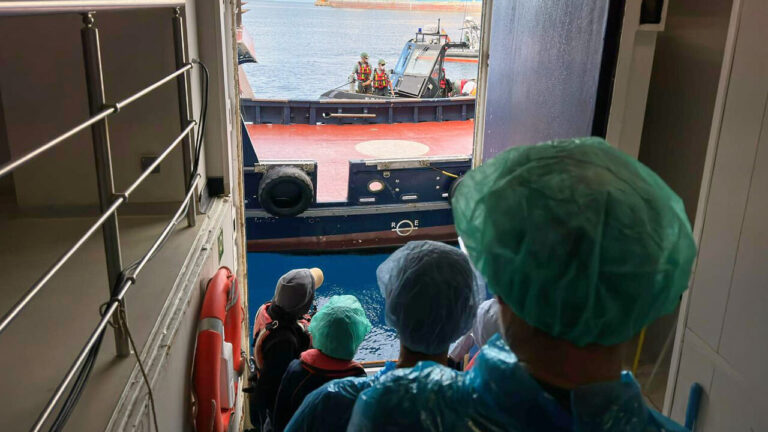
The Andes virus, the hantavirus strain involved in the outbreak on board the MV Hondius, can be contagious already in the early stages of the disease. This is also why the World Health Organization considers isolation measures to be justified for suspected cases and quarantine measures for high-risk contacts, particularly among ship passengers. “If we impose or recommend quarantine, it is because people can be contagious from the beginning of the disease,” said Olivier Le Polain, head of WHO’s Epidemiology and Analysis unit for response.
“It is therefore in the first days of the disease that contagiousness can be highest,” he underlined. “Due to the incubation period, we can expect new cases to appear in the next few days, or even next week. That is why we must remain vigilant and ensure that, as soon as the first signs and symptoms appear, people are identified, isolated and treated,” he added.
The hantavirus ‘hotbed’ ship forced to dock in port, the new fear for rats “that can swim”
The crisis on board the MV Hondius, which was scheduled to depart for the Netherlands this evening, has caused concern and brought back memories of the Covid pandemic. The WHO, however, claims that the situation is not comparable to that of 2020. Meanwhile, there is some good news: we are not in the presence of a “mutated” virus. This is confirmed by the first genetic snapshot of the virus isolated from the patient in Zurich, Switzerland, who traveled from Argentina to Europe aboard the cruise ship MV Hondius.
The sequence is very similar, approximately 99%, to those already detected in Argentina in the past. At first glance, this indicates that the virus would still retain its initial physiognomy, without having accumulated many mutations. This is good news, because it suggests that the virus is relatively stable: an element that could make it less complex to track infections and, if necessary, develop possible tools to combat it.
However, many open questions remain. One of the main ones concerns the exact times in which the infection occurs: knowing them would be decisive for organizing effective tracing and establishing the duration of the quarantine, but at the moment there are no definitive answers.
“It is reassuring to note that the most similar sequences come from the 2018-2019 epidemic in Argentina, suggesting that the virus remains part of a known viral lineage, rather than representing a highly divergent new strain,” he notes on the platform Science Media Centre the virologist Damien Tully, of the London School of Hygiene & Tropical Medicine. It is only one sequence, adds Tully, but “it provides the first detailed genetic snapshot of the strain responsible for the epidemic” and tells us an important fact: no profoundly different variants have appeared in recent years. This indicates that the virus responsible for the outbreak likely emerged from a relatively stable viral lineage, rather than from a recent mixing event between different hantaviruses. The virologist Piet Maes, from the University of Brussels, is along the same lines.
Meanwhile, isolation and quarantine measures are being prepared in the various countries involved.