

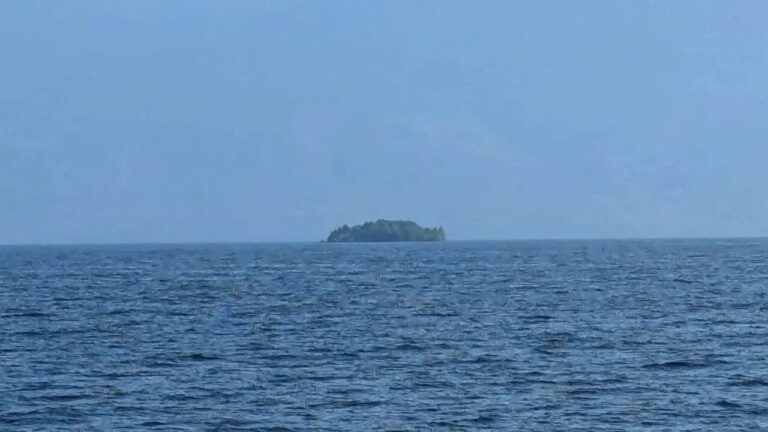
Many lakes have their small, or large, secrets. That of Loch Ness, for example, famous for the monster of the same name. And even our Lake Garda, in whose waters an elusive and good-natured creature is rumored to live, nicknamed Bennie by enthusiasts. But no one can boast a mystery of similar proportions to that of the Williston Basin: an entire floating island, over 140 meters long and covered in dense forest. What’s mysterious about it, you ask? The answer is simple: just a couple of months ago, the island did not exist, and after being spotted in late July, it disappeared again, only to reappear several weeks later, tens of kilometers away in the estuary of the Ospika River, a tributary of the Canadian reservoir. How is this possible? What is certain, for now, is that it is a floating island, which moves on the waters of the reservoir pushed by the currents. What its nature is and how it was formed, however, remains a mystery to this day.
The discovery
The first reports came from Rocky Avery, a resident of the area who documented the presence of what looked like a real portion of forest drifting on the lake, during a boat ride. The images taken in the reservoir, the seventh largest artificial reservoir in the world by volume, showed a complex formation with tall trees, shrubs and a microhabitat suitable for hosting birds and local fauna. Initially, photos released on social networks were greeted with skepticism, but analysis of a satellite image acquired on July 21, 2026 confirmed the existence of the floating land block.
After the first sighting, the forest mass suddenly moved, disappearing for several weeks. Its new location was identified on the following 31 August thanks to monitoring conducted by BC Hydro, the public company that manages the artificial reservoir. The island had not broken up, but had simply sailed northwest for about thirty kilometers over the course of two weeks, pushed by the lake’s internal currents and surface winds.
A mysterious origin
In the weeks that have passed since the discovery of the floating island, several experts have attempted to clarify its nature and possible origin, without however providing definitive answers. Bob Gammer, a spokesperson for BC Hydro, explained that the formation may have originated from a primary deposit of timber and woody debris that accumulated along the banks over several decades. The progressive decomposition of organic matter and the overlay of sediments allowed the vegetation to take root, creating a compact but floating layer over the underlying log structure.
The exceptional volume of water reached by the Williston Basin in the summer of 2026, the highest recorded in the last fourteen years, would eventually provide sufficient buoyancy to lift the entire block from the seabed or bank to which it was anchored. However, not all specialists agree on this reconstruction, underlining that the area is not subject to soil erosion phenomena, and that the collapse of the vegetation, although present, is not sufficient to imagine the formation of a “raft” of similar size and compactness. Currently, therefore, the origin of the floating island of Williston Lake still remains a mystery. Avery has assured that if he were to intercept the island again, he will try to film the lower part by immersing himself in the waters of the lake, to try to clarify its nature once and for all. We’ll see if he’s lucky.
View this post on Instagram