

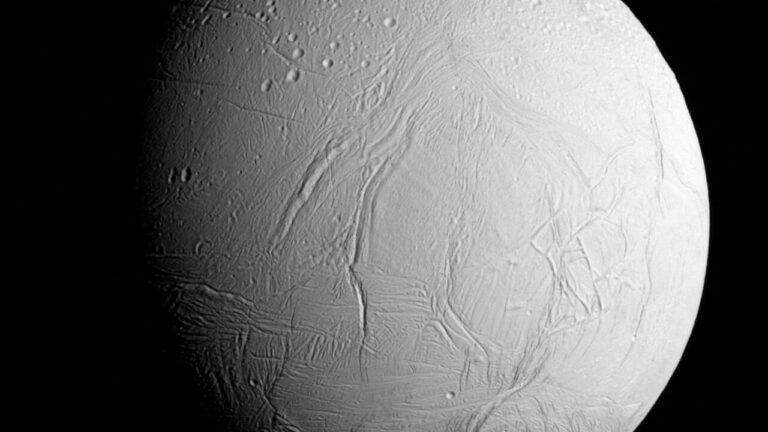
The possibility that one of Saturn’s moons can host life forms becomes more and more concrete. From the analysis of the data collected by the Cassini probe, in the mission ended in 2017, a group of scientists identified the presence of new complex organic molecules in the ice jets emitted by Encelado, the sixth largest moon on the planet. The discovery, made known by the European Space Agency (Esa) and published in the magazine Nature Astronomyunpublished scenarios on the chemistry that develops in the vast salty ocean that is hidden under the frozen crust of the satellite.
According to ESA experts, it is “a clear sign” that in the depths of Encelado are verifying articulated chemical reactions, some of which could lead to the formation of even more complex molecules, potentially relevant from a biological point of view.
“There are many possible paths that from the organic molecules that we have found lead to compounds potentially associated with life – explained the first signatory of the study, the Planetologist Nozair Khawaja – this increases the probability that the moon is habitable. In Cassini’s data there is still much to explore and we can’t wait to make new discoveries”.
Towards a European mission on Encelado
The new evidence strengthens the prospect of a space mission dedicated to Enceladus, an objective that ESA is already studying. The hypothesis is to send a probe capable not only of flying over the famous jets of the south pole – columns of steam and ice that rises thousands of kilometers in space for thousands of kilometers – but also to land on the surface to collect samples directly from the ground.
A team of scientists and engineers is evaluating the selection of new generation tools to be mounted aboard the probe. The goal is clear: to verify the presence of favorable conditions for life. Encelado, ESA underlines, already has all the fundamental requirements: liquid water, an internal energy source, essential chemical elements and now also complex organic molecules.
“Even any absence of life would be a huge discovery – adds Khawaja – because it would force us to ask us because, in an apparently perfect environment, life has not developed”.
Cassini’s scientific inheritance
The Cassini-Huygens mission, the result of the collaboration between NASA, ESA and the Italian Space Agency (ASI), was launched in 1997 and remained operational until 2017. It was Cassini, during its close-up flying, to reveal for the first time the existence of the jets of steam and ice of Encelado, laying the foundations for its entry into the list of the most promising places of the Solar System in the search for life extraterrestrial.
The phenomenon was subsequently confirmed also by James Webb Space Telescope, who photographed out of peculaches extended for almost 10 thousand kilometers in space. Today, thanks to the new analyzes of Cassini’s data, the chemical complexity detected in the subsoil of the Luna di Saturno seems to increase day by day, fueling the wait for a mission that could mark a decisive step in the history of spatial exploration.