

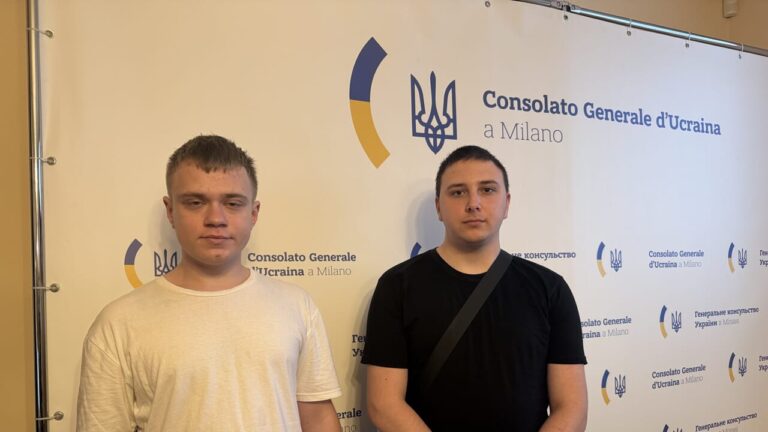
“I just want to survive.” This is the dream of Rostyslav, an 18-year-old boy who spent his school and adolescence years under Russian occupation in Ukraine. He has been living elsewhere for a year now. Still in the country, but not in an occupied area. We meet him together with Nikita, a peer who has experienced the same things, in a room of the Ukrainian Consulate in Milan. The two boys are safe now, but their voice betrays a consolidated, internal fear, and their eyes still have visible fatigue and fear.
Rostyslav comes from a city in the Kherson region, not far from the Dnipro river: an area of intense fighting, but also of the explosion of the Kakhovka dam, caused by the Russians, which caused ecocide in a very large area: the resulting flooding changed the natural habitat for several species, including some rare river fish. And it starved much of the remaining population. Nikita is originally from a small village of about a hundred inhabitants in the Zaporizhzhia region, also partly occupied by the Russians, which we often hear about due to the presence of the nuclear power plant.
You are safe from a good year. How did you manage to escape?
The story and the path overlap. “It was a long journey. You have to find someone who does the transport on the Internet, and it’s not a free service. It costs 1,500 dollars each. The journey is long. You pass through Melitopol, in occupied territory, and the Donbas, then I arrived in Russia, in Voronezh”, says one of the two: “From there I went to Belarus and Ukraine, where there is still an open passage”. He is probably referring to the Mokrany-Domanove one, which only works one-way for Ukrainians stuck in Belarus or Russia, and only for crossings on foot. The other boy nods. He makes it clear that his journey was very similar. The only way to try to enter Ukraine controlled by Kyiv from an occupied area is to pass through Russia, except for sporadic humanitarian corridors which, however, five years after the war, are almost no longer active.
Are your families still there or are they with you?
“I managed to leave with my mother and brother, while the whole family was able to leave the area,” says Rostyslav. “I, on the other hand, still have part of my family in the village,” explains Nikita.
What was daily life like during these years? Did you feel under occupation?
“At the beginning it was very difficult”, says Rostyslav: “Many houses were empty, people had fled, and the Russian soldiers entered them and started living there, among civilians. Ours (the Ukrainian army, ed.) bombed their positions, so we were under constant bombardment, because the soldiers were in the house next door. At the beginning it was very heavy, then we got used to it: drones, artillery. We were in an almost front-line area, with a very intense military presence”.
“I come from a small village which, even before the war, had around one hundred inhabitants”, continues Nikita: “The first months were tragic: they immediately cut off communications, no Internet and no telephone, for a year. They closed all the shops and stopped transport, there wasn’t even a car, we couldn’t move. At the beginning we were only looking for food, because the shops were empty. It was pure survival. I didn’t study at all”.
And the school?
“Between the ages of 14 and 15 they connected me online to a Russian school, created specifically for this purpose,” replies Rostyslav: “I followed the Russian program from home, because going out was dangerous. It was something new for me. I signed up because I still had to get on with my studies.”
“When the occupation consolidated, the school was no longer online. A bus would arrive, even in our little village, and take us to the real Russian school. You had to be there, attendance was mandatory. The teachers were half Russian and half Ukrainian, those who had adapted to the new system”, says Nikita.
Once you passed the survival phase, did you feel free to express your opinion on the war?
“No. It was not possible to express anything, for reasons of personal safety: it was necessary to remain silent and hide every thought, not just political ones. There was an absolute taboo on the war between Russia and Ukraine. The only freedom was the minimal freedom of daily communication, as get water or let’s make a coffee”, explains Rostyslav.
Could the Ukrainian language be used?
“I speak Ukrainian, but I also know Russian,” says Rostyslav: “At home I talked about everyday things in Ukrainian, because no one could control me: we are Ukrainian-speaking, and in my area most people speak Ukrainian. But with the military, who were omnipresent, you only spoke Russian. To survive: if you spoke to them in Ukrainian you put yourself at risk. And at school, with the compulsory subject of ‘Russian patriotic education’, imagine if you could say a word in Ukrainian. You had to answer in Russian, absolutely. It was also a source of great tension.”
What did they teach you in patriotic education class?
Nikita responds: “It was more or less called ‘Let’s talk about important things’. Once a week they told us the story of the ‘heroes of Mariupol’, the Russian soldiers who would ‘liberate’ the city, and the heroes of the special military operation (the way Russia defines the invasion, ed.). They were also very fixated on the victory in the Second World War, which they said only they had won. They told us about the occupied regions, which had ‘written their constitution’, and how wonderful it was to live there now that they had been ‘freed’: ‘You have finally returned home’”.
Did they also give you military training?
Nikita again: “Sort of. Notions of security during the conflict, a lot of theory on how to behave during military actions. But they didn’t make us use weapons, at least at school. Maybe they haven’t reached that point yet.”
Have you witnessed episodes of violence or heard about them?
“In another town there was a headquarters of the Ukrainian police, they turned it into a torture chamber. Everyone knew where it was and there were rumors that they were torturing people”, says Nikita: “A cousin of mine, a year older than me and already an adult, was taken because he hadn’t returned home before curfew. They beat him and kept him in a cellar for two or three days, then they released him. He saw a lot of people detained in that place. Luckily he wasn’t ended up in the actual torture chamber. Then he managed to leave the territory before us, asking around for money.”
“I too have witnessed scenes like this”, Rostyslav intervenes: “When the soldiers drink, and they drink hard, they start shooting at each other, to have fun. One takes a large machine gun, unlike a Kalashnikov, and shoots at the others, who were also drunk, because they were bored. Meanwhile they crossed the whole country. Imagine the civilians, what state of mind they were in: terrified. Another time a Chechen platoon decided to cross the river, because the town is nearby (we’re talking about the Dnipro, ed.). A Russian unit saw them, thought they were Ukrainians, there was confusion and started shooting. Other Chechens, when they found out, arrived and fired on all those Russian soldiers.”
What is the dream for your life?
Rostyslav responds simply: “I just want to survive, to make it to at least 22 alive, rather than hoping to make it to 30 and maybe old age.” And Nikita: “I really want peace. I want to return to my region and see it liberated.”