

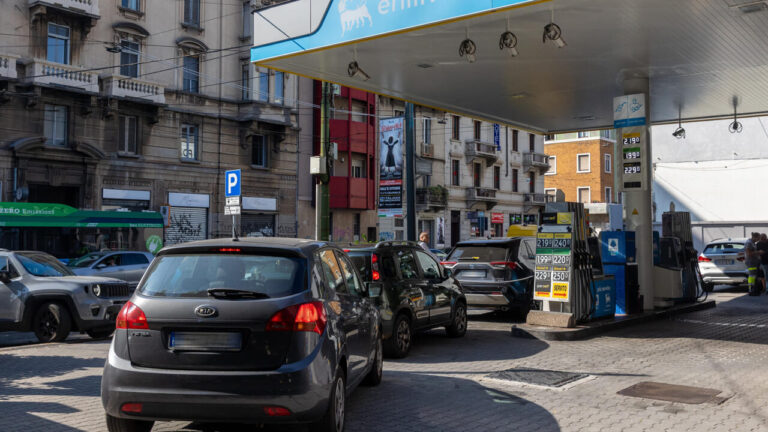
A new unknown regarding diesel is about to arrive for Italian motorists. Today, Monday 5 October, the 6.1 euro cent cut on diesel excise duties expires: it will be replaced by the mobile excise duty mechanism, already indicated by the Meloni government as a tool to contain any price increases. The change, however, could translate into new price increases from Tuesday 6 October, just as pump prices have recently recorded a slowdown after the strong increases in recent months. Without other interventions or compensations linked to the new mechanism, the price in some distributors could increase up to 6.1 cents per litre.
The effect of possible price increases will certainly be mitigated by the voluntary price cap introduced by the main oil companies in Italy (Eni, Ip, Q8, Tamoil). In fact, motorists could find themselves faced with price increases at independent service stations, those of small operators or where managers apply free prices not bound by the price cap.
How mobile excise duties work
Simply put, mobile excise duties are a variable fiscal mechanism that uses the extra VAT revenue generated by the increase in oil prices to temporarily reduce fixed excise duties on fuel. The mechanism was introduced by the Prodi government in 2008 and then modified by the Meloni government in 2023.
The principle is simple: when the price of crude oil increases, VAT revenue also increases, because the tax is calculated on a higher price. Part of this increased revenue can be used to temporarily reduce excise duties, thus lightening the final price paid by motorists. In essence, the system finances itself through the tax extra revenue generated by the increase in oil prices.
Cost analysis
Returning to fuel costs, the trend is photographed by Codacons, according to which on the ordinary network the average price of petrol has decreased in seven days by 11 cents per litre, with a saving of around 5.5 euros for a full tank. The drop in diesel fuel was even more marked, falling by 13.3 cents, equal to a lower expense of approximately 6.65 euros. On motorways the reductions were even more significant, with petrol at -19 cents and diesel at -19.1 cents per litre, for a saving of around 9.5 euros per tank. The problem, however, is that prices remain above levels before the escalation of the war in Iran.
According to Codacons, a liter of diesel still costs 52.1 cents more, 30.2% more than in that period. For a full tank it means an additional expense of more than 26 euros. International oil prices are also having an impact, while the situation in the Middle East continues to keep uncertainty high on the markets.
The companies that have lowered their price lists
In fact, in recent weeks, prices at the pump have started to decrease also thanks to the price cap adopted directly by the oil companies. The government had chosen the path of moral suasion, inviting operators to intervene to mitigate the impact of high fuel prices, and the results translated into a drop in prices.
Above all, the main oil companies contributed to the decline. Eni has introduced a price cap on its network, setting the price of petrol at 1.99 euros per liter and that of diesel at 2.19 euros, with an initial validity of thirty days and the possibility of an extension. Ip, Q8 and Tamoil joined the same initiative, progressively extending the discounts to their distributors. Overall, the reductions now concern a significant part of the network: between the Eni and IP stations already affected by the measures, almost a third of the distributors are covered by the reduced prices.
In less than a week, according to the latest available data, diesel has lost 12.2 cents per litre, a drop approximately double compared to the tax discount set to end today. Even petrol, which remained outside of the interventions for months, went from an average of 2.152 to 2.052 euros per litre.
What can happen on diesel from October 6th
From Tuesday 6 October the mobile excise duty mechanism is expected to come into play. The principle is to use part of the increased revenues deriving from price trends to offset any increases in prices at the pump and limit the impact on consumers. The measure was announced by Prime Minister Giorgia Meloni after the Council of Ministers on 16 September and was subsequently reiterated also in relations with the European Commission. The line was also confirmed in recent days by the Minister of the Environment and Energy Security Gilberto Pichetto Fratin, albeit with caution regarding its concrete application.
The risk, however, is that the end of the discount will still produce new pressure on the price of diesel, with an increase in price lists, even if in the meantime the price picture has significantly changed.
“Prolong discounts and price caps”
Hence comes the request to oil companies to extend the discounts and price caps introduced in recent weeks at least until the end of the year. “Oil prices are still at very high levels and the conflict in the Middle East does not seem destined to be resolved soon”, claims the association, which warns of the possible effect of the end of the tax cut on diesel.
On the other hand, the high cost of fuel has already taken its toll. According to an analysis by Adusbef, between March and August 2026 Italian motorists spent over 4.7 billion euros more on refueling compared to the same period the previous year. In the months of July and August alone the burden would have reached 1.7 billion euros. Overall, in the six months considered, around 30 billion euros were spent on petrol and diesel on Italian roads and motorways, compared to 25.3 billion in the same period in 2025.