

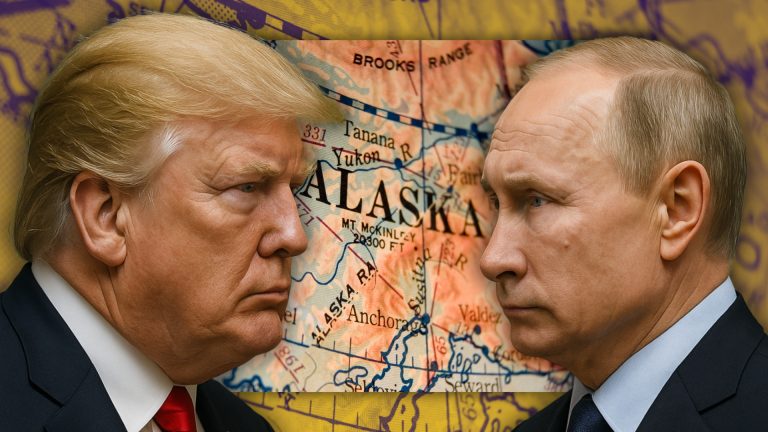
The historic face to face between Donald Trump and Vladimir Putin will be held today in Alaska. A meeting that, at least in the intentions, aims to reopen the Ukrainian dossier concretely and to start a path towards a possible agreement. But the summit, hosted in the city of Anchorage, promises to be a complex comparison, full of unknowns. “There are 25% probability that it is not good,” admitted the American president, however, suggesting that he believes in the will of the leader of the Kremlin to negotiate. Trump has already anticipated that, in the event of a positive outcome, the Ukrainian president Volodymyr Zelensky will contact to prepare a “second meeting”, this time to three. “It will be very, very important because at that point it will be the one in which they will agree. I already have three locations in mind,” he explained. The Tycoon also did not exclude the possibility of involving European representatives.
The tone, however, clearly changes if the meeting was wrecked. “I won’t call anyone,” said Trump, promising in that case a quick return to Washington. At that point, the White House may find itself forced to consider an instrument avoided so far: the introduction of direct sanctions against Moscow. An option discussed several times, but so far applied only indirect form, as in the case of the restrictions imposed on India for the purchase of Russian crude oil. Despite the pressures of Zelensky and allied countries, Trump clarified that he did not expect an immediate fire. “I am more interested in immediate peace,” he said. And he added: “We will do our best”.
Among the proposals that Trump could advance to unlock the negotiation, there is talk of a possible ease of economic sanctions and concessions on the level of natural resources, such as the access of Russia to minerals and rare lands present in Alaska or in the Ukrainian areas currently occupied. The Kremlin, however, seems concentrated on a far more precise goal: the recognition of Russian control over the attached territories. “There will be an exchange,” Trump reiterated, without going into details. A hypothesis that continues to meet the firm opposition of Kiev and the European chancelleries. Among the scenarios on the table, existing models would be evaluating, such as those applied in Korea or the West Bank, useful for overcoming the Ukrainian constitutional obstacles and the resistance of the allies. The risk is to make too many concessions to the tsar, transforming the negotiation into a triumph of Moscow
- Ukraine, Trump’s real goal and an opportunity for Meloni
Yesterday British premier Keir Starmer met Zelensky in London. At the center of the interview, the future security of Ukraine. The two leaders agreed that the Summit of Anchorage represents “a concrete chance of progress, as long as Putin acts in such a way as to prove to be serious about peace”. In European capitals, the evolution of the summit is prudence. A videocall among the main leaders could be convened already on the weekend to discuss the outcomes of the summit, if Trump decides to promptly communicate the results of the interview with Putin. In this context, Trump arrives in Anchorage in a far from simple position. According to several analysts, he has more to lose. On the contrary, Putin has already obtained a significant political result: to participate in a bilateral summit in US territory, avoid – at least for now – new penalties, and relaunch the image of Russia as a global power with its own sphere of influence.
The conditions of Russia are clear: the total withdrawal of Ukraine from Donbass, the ban on adherence to NATO and rigid limits to its military capacity. All these requests are unacceptable for Ukraine because they would actually leave it defenseless against new attacks. This is exactly what Ukrainian and European leaders fear. We must answer several questions, all factors that can move the balance. Will the Russian conquests confirmed de jure or simply de facto? Temporary or permanent? Will Ukraine be obliged to sell territories not yet busy? And above all, will it be left with sufficient territories, independence and sovereignty to survive as a national state?
One thing is certain: Putin has already achieved some success. He got to exclude Ukrainians and European ones from the negotiation table and now he could take advantage of the opportunity to bring The Donald to his side. Even the choice of the meeting place was told as a victory. Alaska, in fact, is far from Europe and Ukraine, but indeed it is as close as possible to Russia.
But Putin knows that treating with Trump will not be easy. And above all he is aware that the tycoon cannot afford agreements that would put it in difficulty in the eyes of the Americans. Perhaps little interested in Kiev’s fate, the Americans want to demand that the president does not disfigure on international tables. So the head of the White House is called to bring the tsar to the right street, putting stakes and tearing a satisfactory agreement for the West, not only for Zelensky. The priority is to put an end to the war, but without giving gifts to the Kremlin, ready to exploit the divisions between Washington and the European capitals to shift attention from their responsibilities, and try to pass the idea that Kiev and his allies to hinder peace. An attempt to divide the western front and isolate the Ukrainian dossier from the rest of the bilateral relations with the United States. The anchorage summit, between hopes and fears, could mark a turning point. Or leave everything as it is.
Franco Lodige, 15 August 2025
The article Trump-Putin’s vertex: who wins and who loses if … comes from TheVermilion.com.