

I open the writing on Adrian Paci with this beautiful quote: “No man is an island, complete in himself; every man is a piece of the continent, a part of the whole. If even a clip was washed away from the sea, Europe would have decreased, as if it lacks a promontory, as if a residence of your friends were missing, or your own house. The death of any man, because I am part of the human. So never ask for those who play the bell: it sounds for you ”. (John Women – From XVII meditation, in “devotions for emergency occasions” Editori Riuniti, Rome, 1994).
With No man is an island, Personal exhibition of the artist Adrian Paci (Scutari, 1969) Wednesday 11 June inaugurates the Second conciliation appointment 5the project of contemporary art promoted by the Dicastery for the culture and education of the Vatican, conceived on the occasion of the Jubilee 2025, and entrusted to the Curable by Cristiana Perrella for the first year of activity. The 2025 program of conciliation 5 invites us to reflect on the topic of hope, declined through Four artist interventions That during the year they will address current topics and with a strong social impact: prison, migration, the environment, poverty. For each appointment, the protagonist artist works both for the space of via della Conciliation – one Window Gallery Visible 24 hours a day – both in a city place of proximity, every time different and linked to the theme addressed, giving life in this way to a widespread art project, which extends outside the perimeter of the Vatican city.
After the Chinese artist Yan Pei-Ming (Shanghai, 1960) who worked on the prison condition in relation to the community of the District House of Regina Coeli, Adrian Paci concentrates his research on the transformative power of the journey, capable of producing suggestive imaginary.
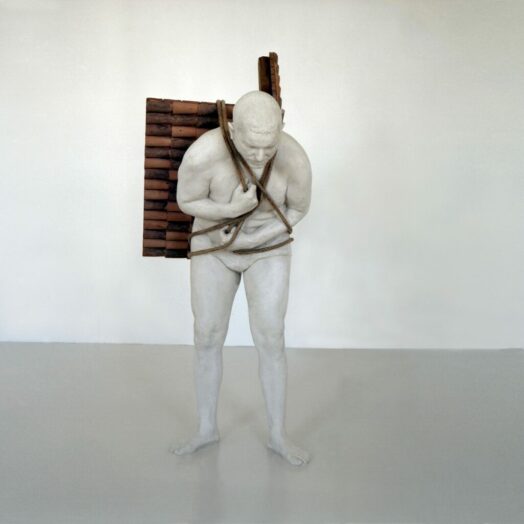
In the Conciliation space 5 – always visible along via della Conciliation – Adrian Paci presents sculpture Home to Go (2001): a male figure, a cast of the artist’s body, supports on his shoulders a upside -down roof, which in the form recalls a couple of wings, evoking the idea of a humanity suspended between precariousness and transcendence and placing the image of the human being at the center as a wayfarer and the idea of the obligatory and dramatic journey of those who are forced to go away from their land.
With its references to the Christian iconography of the Passion, often recurring in the artist’s path – as in Cappella Pasolini (2005) or via Crucis (2011) for the church of San Bartolomeo in Milan – Home to Go It is a work that dialogues with the sacredness of the place, being on the path that leads to San Pietro and the Holy Door, and with the history of ancient art, which the artist has learned since his first formation.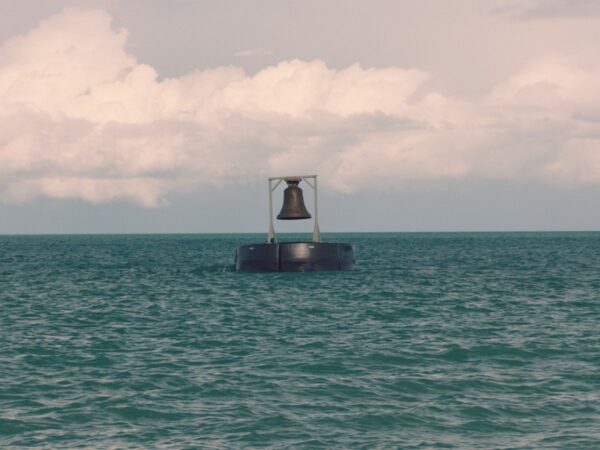
In close relationship with this work The Bell Tolls Upon the Waves (2024), one video installation that the artist sets up In the historical lanes Sistine of the monumental complex of Santo Spirito in Sassiaan ancient place of care and welcome whose origin dates back to 727 AD, when King Sassone ina founded the Schola Saxonum for the pilgrims directed to the Tomb of San Pietro.
Produced by the Giorgio Pace Foundation and exhibited for the first time in Italy, the work is inspired by an episode that really happened: In 1566 in Termoli, during a Turkish attack, the looters attempted to stole the bell of Santa Caterina, used to warn the sailors in case of danger: a vain attempt because in transport the bell ended at sea sinking the boat on which it traveled.
Re -enacting this story, Paci designed a bell for a floating platform on the sea in front of Termolias if the historical one had re -emerged from the seabed; The artist documented the whole operation with a video of great intensity, in which the bell rinses are generated by the movement of the waves, sometimes sweet, sometimes violent. The Bell Tolls Upon the Waves is a work with a strong symbolic value, which refers to a loss but also to an evocative presence, whose resonance is amplified by the context of the history in which it is installed.
The combination of an already known work, among the first to make the artist known at the beginning of his path, and a new production highlights the consistency with which Adrian Paci has always reflected on these issues, offering us a narrative that intertwines personal memory, spirituality and attention to the great issues of our time.
The title of the exhibition – No man is an island – is one Quote from the English poet John Women (London, 1572–1631), treat by meditation xvii (Devotions Upon Emergent Occasions, 1624), which reads “No man is an island, Entire of Itself; Every man is a piece of the continent, a part of the main (…) Any man’s death decreases me, Because I am involved in mankind, and therefore never send to know for whom the bell talls; it tolls for thee.»An invitation to recognize the common belonging and mutual responsibility, founding values for the Jubilee and for the entire programming of conciliation 5, which wants to be – as desired by Cardinal José Tolentino de Mendonça, prefect of the Dicastery – a space open to spirituality, critical thinking and transformative power of art.
The programming will continue in the autumn with the commissions to two other international artists, who will continue the investigation on the great themes of our time through art.
Carlo Franza