

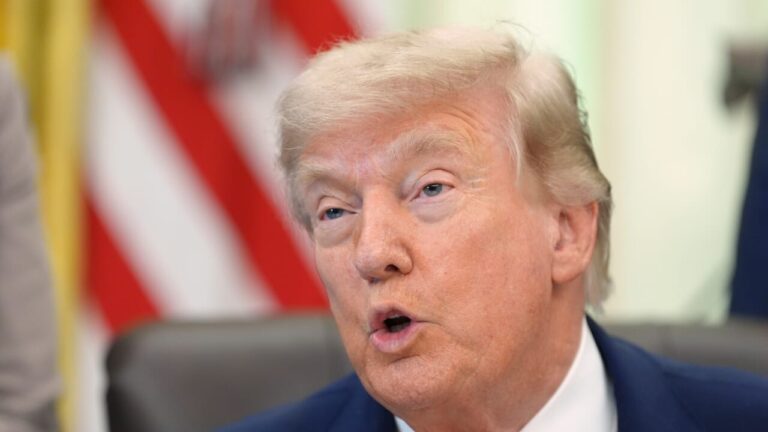
Agreement yes. Agreement no. Donald Trump has interrupted the planned raids against Iran, announcing (for the umpteenth time) the achievement of an agreement with Tehran to stop the conflict in the Middle East. The president of the United States spoke of an agreement that will be signed “soon”, even in the next few days, in Europe. Yet, despite the tycoon’s assurances, no confirmations have arrived from Iran, on the contrary.
Trump and the Iran deal
“We put an end to the war with Iran – said Donald Trump during a virtual rally in support of Georgia’s lieutenant governor Burt Jones -. They agreed never to acquire nuclear weapons, a condition on which we insisted. This was precisely the objective, it was 95% of the issue”. Pressed by the press, the tycoon faltered when faced with the request to indicate a precise date: “I don’t want to set a deadline, things will proceed quickly and after the signature the Strait of Hormuz will reopen. The talks with Tehran have been brought to the highest level of the Iranian leadership, while the discussions and the final points of the agreement have been approved both in principle and in detail by all parties involved, so as to bring them significantly closer to an agreement”. The words on the fundamental approval of the Iranian Supreme Leader Mojtaba Khamenei are more cryptic: “I understand that he approved, yes”.
Very few details are provided in the document: “They have been hit very hard and now they want to make the agreement more than I want it. For the USA and for the Middle East it is an excellent agreement. And it is also excellent for Iran. It is a very detailed memorandum of understanding, also agreed with other countries that have a strong influence on Iran. Tehran will not have nuclear weapons in any form and will not procure them: it is the most important paragraph”, the words of Trump at the White House, which among the countries agrees with the agreement also mentions Israel, Saudi Arabia, the United Arab Emirates, Qatar, Türkiye, Pakistan, Bahrain, Kuwait, Jordan and Egypt.
No confirmation from Tehran
And Iran? At the moment no confirmation has arrived from Tehran. At the tycoon’s words, the regime media hastened to explain that the Islamic Republic had not approved any text of the initial memorandum with the United States. Then the coldness from the spokesperson of the Foreign Minister Esmaeil Baqaei: “So far Iran – he said – has not reached a definitive conclusion on the agreement”. To complicate the picture, a clarification comes from Israel, one of the countries cited by the tycoon. Explaining the scenario, Israeli Prime Minister Benjamin Netanyahu, after speaking with Trump on the phone, stressed that Tel Aviv is “not part of the agreement.” The two spoke about the “memorandum of understanding that is emerging with Iran regarding the start of negotiations,” Netanyahu said, explaining that Trump promised that any agreement between Iran and the United States would include commitments to remove Tehran’s enriched nuclear material and welcomed the US president’s commitments on limiting Iran’s nuclear and missile programs.
Furthermore, according to Axios, even if the negotiations between the United States and Iran are indeed close to an agreement in principle on the main points of the dossier, one decisive step still remains, namely the green light from the Iranian Supreme Leader. According to the same sources close to the negotiations cited by the US newspaper, in the last few hours the talks would have allowed us to reduce the distances on three central issues: the mechanism for unlocking Iranian funds frozen abroad, the methods of reopening the Strait of Hormuz during a 60-day ceasefire and the framework of negotiations on the Iranian nuclear program during the truce period.