

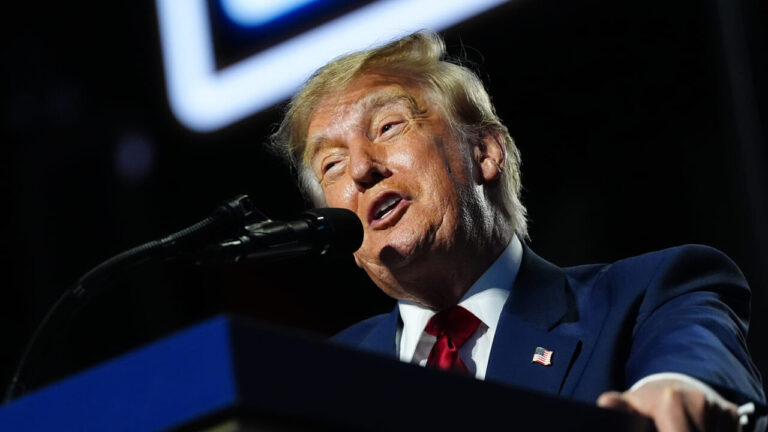
Trump’s 5 thousand dollars: the latest promissory note of populism
The whole world is a country. If in Italy in the last fifteen years the public coffers have been undermined by deplorable and populist measures such as the Citizen’s Income and the 110% Bonus – among other things, without any serious control mechanism against multi-million dollar scams – in the USA a further and illustrious precedent is looming: the “Trump Dividend”, that is: if you vote for me and I win, I will give you five thousand dollars on your nail. In fact, in recent days, at the Republican convention in Dallas in view of the upcoming midterm elections, Donald Trump promised Americans that, in the event of a Republican victory, an immediate tip of five thousand dollars will be guaranteed to every adult American citizen. Wanting to cloak it with some political dignity, Trump compared this sinister populist stunt to a sort of distribution of a large company’s profits to its shareholders.
A huge trade mark
In reality it is an enormous vote-exchange measure, a little salty to tell the truth (if we consider that in some parts of our country the votes “cost” from fifty to one hundred euros each, or if we think of Achille Lauro – the Neapolitan amateur and not the Roman trapper – who when he ran for mayor of Naples promised one shoe before the vote and the other after), but still such. An electoral promise that says a lot about the level of desperation that inhabits Republican and, more particularly, Trumpian circles. The idea of the electoral bill is certainly not a prerogative of the American tycoon. Recent history offers emblematic examples of politics based on do ut des purely economical, both in Italy and around the world. How can we fail to remember Silvio Berlusconi, the undisputed master of the genre, when in 2006 he sent millions of Italians the famous letter containing the promise to abolish ICI on first homes (such was the shock for his then opponent Romano Prodi who, in the Cesarini area, was spearheaded by the Cavaliere at the end of the TV debate from Mentana)?
Or again, when in 2013 he went further, putting on the table not only the abolition of the IMU, but even the refund in cash of the sums paid the year before by the Italians? Then, as Berlusconi’s strength and health declined due to his advanced age, the promises became increasingly bizarre, with the last one ensuring, in the event of victory, free dentures for all pensioners. Around the world we remember Andrés Manuel López Obrador who in 2018, in Mexico, built his consensus through the direct provision of cash to young and old; or in Greece, with Alexis Tsipras who promised debt cancellation and widespread and immediate subsidies for all in the aftermath of austerity; as well as in Thailand, when Thaksin Shinawatra conquered the poor countryside by promising moratoriums on agricultural debts and funds for the villages. It will be clear that the Trump dividend is only the latest of these populist ideas that are generally proposed to an impoverished electorate gripped by fear for the future.
The cost of the Trump dividend and the US debt nightmare
Like any self-respecting populist measure, the Trump Dividend would also represent a sensational blow to the already damaged American public finances. In fact, distributing 5,000 dollars to each of the approximately 260 million adult American citizens would entail a direct expense for the state coffers of approximately 1.3 trillion dollars. A dizzying figure, higher for example than the entire annual GDP of nations such as Switzerland or Turkey. To understand the gravity of this announcement, it must be placed in the current context of American finances. The public debt of the United States has exceeded the astronomical threshold of 34 trillion dollars, standing at over 120% of the national GDP (Italian debt, just for comparison, stands at 138% of its GDP). The rain injection of a further trillion and a half dollars without any structural financial coverage (such as equivalent cuts in spending or new tax revenues) would produce devastating consequences for the US and global economy, such as: a new flare-up of inflation. Instantly injecting such a mass of liquidity into private consumption would end up overheating demand, rekindling the spiral of inflation that the Federal Reserve has laboriously tried to contain in recent years; the explosion of interest rates: to finance the Trumpian maxi-cheque, the US Treasury would have to issue an enormous quantity of new government bonds (Treasuries) and the oversupply would force the US to offer higher yields to attract investors, driving up interest rates on global markets and increasing the cost of mortgages and loans for families and businesses; increased pressure on the sustainability of public spending: already today, interest expenditure on debt in the USA has exceeded the defense budget, adding further debt to the already existing one would risk triggering a spiral in which the central state would end up going into debt just to pay the interest on the previous debt, reducing the room for maneuver for healthcare, infrastructure and research.
But Trump’s promise would not only put the USA in trouble, but also the entire West. In fact, American debt is not an exclusively US problem, but also a global one. The dollar remains the world’s reserve currency Treasuries they represent the backbone of the international financial system. If the fiscal credibility of the United States were to deteriorate due to irresponsible electoral policies, the entire global financial edifice would enter an era of profound instability, resulting in the depreciation of the American currency, capital flight and increased uncertainty for markets around the planet. In short, superpowers such as China and Russia could benefit from it, assuming that the latter is still a “superpower”, to the detriment of Europe.
The Trump dividend is the H-bomb of the midterm elections
The Trump dividend, precisely taking into account the disastrous consequences just described, appears a bit like the H-bomb of desperation for Donald Trump who, looking at the latest polls, has the clear perception of the Republican defeat with the consequent limitation of his influence on US and global politics. In general, except in very rare cases, the party of the President in office almost always starts at a disadvantage in midterm elections and, in this case, the combination of the devastating economic situation, with the increase in the cost of living and the relative decline in approval for Trump in key districts, risks turning the vote into a defeat. In the event that the Democrats were to win the majority in the House, the Senate or both houses of Congress, the scenario for the second half of Trump’s term would become dramatic.
A defeat would hamper the legislative capacity of the White House and would open up nightmare scenarios for Trump himself, with the Democrats who could open a long season of congressional investigations, commissions of inquiry and the constant threat of new procedures of impeachment. And there would be plenty of material, including the dozens of conflicts of interest of Trump himself and his family unit and the Epstein case. The reaction of the MAGA world (Make America Great Again) such an outcome would not be long in coming and could retrace the grotesque and dramatic precedents of 2021, when in the aftermath of Joe Biden’s election and Trump’s consequent defeat, there was a full-blown assault on Capitol Hill. Not surprisingly, Trump himself is already personalizing the vote by explicitly asking his supporters to “pretend it’s me on the ballot.” If the Republican Party were to lose, the right-wing media apparatus, the influencers of the MAGA movement and the more radical base would not accept the verdict as in a normal democratic dynamic. The mantra of “rigged elections”, of voter fraud in large Democratic-led metropolises and of the “Deep State” in action to sabotage the President’s agenda would forcefully return. In short, a climate of civil war would be established.
With Trump halved, global relations would change
American domestic politics is never a purely domestic issue and, therefore, the question we ask ourselves today is: if Trump were to lose the midterm elections, what could happen at a global political level? A possible political weakening of Trump would have immediate and profound repercussions on global geopolitical balances, redefining the strategic axes on two crucial fronts. First, with respect to US-Russia relations and the Ukrainian front: a presidency hobbled by Congress would lose much of its ability to maneuver in foreign policy. Faced with a Congress potentially with a Democratic majority or split in half, the line traced by Trump towards Moscow would undergo a drastic slowdown. While on the one hand the tycoon has often sought a direct negotiating approach with Vladimir Putin, a weakened Trump and under the control of parliamentary commissions would not have the political strength to strike bilateral agreements without the consent of Capitol Hill. For the Kremlin, a White House distracted by internal struggles would represent a great opportunity to raise the stakes, betting on the tiredness of American public opinion and the decision-making paralysis of Washington.
Secondly, relations with Europe and NATO: for European countries and the Atlantic Alliance, the weakening of the occupant of the White House would translate into a political paradox. On the one hand, European chancelleries would breathe a sigh of relief in the face of the US administration’s reduced ability to impose hostile unilateral tariffs or to threaten impromptu exits from pacts and collective security agreements. On the other hand, however, an America turned in on itself and divided by an all-out institutional clash would leave Europe faced with the void of a leadership global uncertain. Without firm American leadership, the European Union would find itself forced to accelerate in forced stages the path towards strategic autonomy and common defense, aware that Washington’s political instability is no longer a temporary exception, but a structural constant of the 21st century. It would be one more event in history that would decree that Europe must become truly great and stand on its own two feet.