

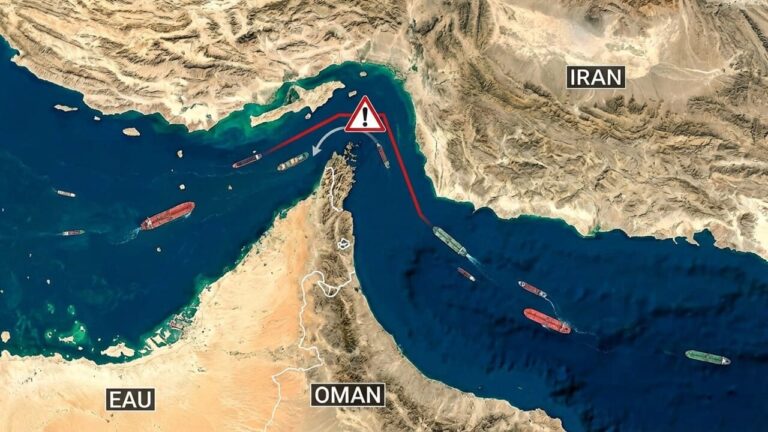
The naval blockade of Iranian ports in the Gulf marks an important transition: from kinetic the United States’ war on Iran becomes economic. The measure that came into force on Monday includes a transit ban for all ships entering or leaving Iran’s ports and coastal areas, “including ports located in the Arabian Gulf and the Gulf of Oman.”
The logic of the naval blockade
The move has its own logic: if Iran cannot export oil and import basic goods it will suffer financial consequences that will force the ayatollahs to accept the conditions imposed by the United States. CNN highlights that the US Navy, defined by Trump as the “best in the world”, has sufficient resources in the region and has long experience in applying naval blockades, including those imposed in the former Yugoslavia, Haiti and more recently in Venezuela.
According to an analysis by the Foundation for Defense of Democracies (Fdd), an influential think tank based in Washington, the blockade could prove effective. The halt to oil exports, it is highlighted, could cause an increase in prices within a few days. In fact, the FDD study center points out that over 90% of Iranian external trade passes through the Strait of Hormuz.
Trump’s move would also have another consequence: once the oil storage capacity is exhausted, the Iranians could be forced to stop producing crude oil as they no longer know where to store it. “Militarily they were literally punched in the face, but we couldn’t strangle their economy,” said retired Adm. James Stavridis. “And that’s why they think they still have a few tricks up their sleeve.”
The White House therefore hopes that the deterioration of economic conditions will work in the United States’ favor. Perhaps even triggering new protests against the regime. Faced with a popular rebellion – even a feared one – the Tehran government could be induced to take more lenient advice.
What if Trump’s was another gamble?
On the other hand, there are also several reasons to believe that Trump’s bet could turn out to be a gamble. CNN journalist Stephen Collinson points out that more than once the enemies of the United States – from Afghanistan to Russia – have shown that the governments of other states do not act according to Western patterns. In Tehran and its surroundings they reason with logic unknown in our latitudes.
Furthermore, the ayatollahs have already demonstrated that the suffering of the Iranian people is not the first concern of the regime, which indeed has not hesitated to repress any revolt in blood. Added to this is the fact that the battle against the United States is considered existential: by the regime certainly, but perhaps also by a part of the population.
What does the United States risk?
Furthermore, the naval blockade is not without risks for Washington. The first danger is that of an out-of-control escalation: Tehran could react by returning to strike US allies in the Gulf or it could rely on the Houthi rebels in Yemen to close another fundamental artery such as the Red Sea. At that point the conflict would risk spreading well beyond the current perimeter.
Then there is an economic problem. If the crisis in the Strait of Hormuz were to worsen, the immediate effect would be a reduction in the global supply of oil and gas, resulting in higher prices. A scenario that would also end up weighing on the American economy, fueling inflation and internal tensions in the United States too.