

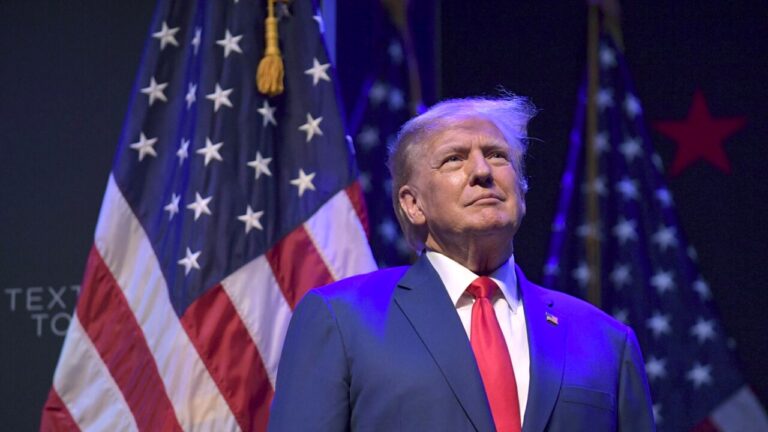
The Save America Act is Donald Trump’s latest weapon to hope to remain firmly at the helm of the White House while the polls continue to show a decline in support in his favor. The Safeguard American Voter Eligibility (Save) America Act It would require voters to provide proof of citizenship, implement stricter identification requirements and limit postal voting to exceptional cases (disability or illness, impediments related to military service or travel).
The practical effect would be to exclude millions of American citizens from voting – and precisely among those fringes of the population in which support for the Democrats historically prevails – marking an enormous compression of democratic participation. “The Good Lobby” calls it “a civil rights atomic bomb.” In short: the Save America Act would serve not to save America from an invasion of illegal voters, but to reshape the active electorate in favor of the Republican Party.
The bill was already approved by the House in February and the discussion recently resumed in the Senate, for which Trump has clearly expressed his desire to obtain a positive vote. “American elections are rigged, stolen and are the subject of ridicule all over the world. Either we fix them, or we will no longer have a country”, wrote the American president on Truth, explicitly asking “all Republicans to fight” so that the provisions of the Save America Act are approved.
For Trump, the mid-term elections next November 2026 are not a simple electoral deadline, but a crossroads for his political future. With a continuously decreasing approval rating, the President has identified the reform of the voting system as the key not only for national security, but for his own political survival.
At the center of this strategy is the Save America Act, which it is no coincidence that Trump describes as a “fight for the soul of the nation”. For many analysts, in reality it is an extreme attempt to lock down the outcome of the polls.
The legislative weapon: what is the Save America Act
As anticipated, the heart of the proposal, already approved by the House of Representatives with 218 votes in favor and 213 against, aims to tighten the criteria for access to the federal vote. If it became law, every American citizen would be required to present documentary proof of citizenship, such as a passport or birth certificate, in order to register.
In addition to this, the law would require the use of a photo ID at the polling station and the drastic reduction of postal voting, limited exclusively to cases of illness, disability or military service. For Trump, the stakes are absolute: he has defined the measure as “one of the most important laws in the history of the United States”, going so far as to threaten not to sign any other bill until this one is approved. His rhetoric turns a procedural issue into an existential emergency, arguing that without this law “we won’t have a country anymore” and that Democrats would win only through widespread fraud.
69 million married women may not be able to vote
While Republicans argue that the law is necessary to prevent non-citizens from voting (an already illegal practice), experts and think tanks are raising the alarm about a possible disorientating and disincentive effect of mass voting. According to the Brennan Center for Justice, approximately 21.3 million Americans do not have ready access to required citizenship documents (birth certificate or passport, which about half of Americans do not have).
The categories most affected would be young people and minorities: 24% of Americans under 30 and almost 50% of young African Americans do not have ready-made documentation.
Then there is the “invisible” issue of married women: approximately 69 million citizens who changed their surname after marriage could face insurmountable bureaucratic obstacles, since the surname on their birth certificate no longer corresponds to their current identity documents. Obtaining marriage certificates or divorce documents to prove legal relationship takes time and money, turning the right to vote into an administrative obstacle course.
The rhetoric about “rigged elections”
Trump’s narrative rests on the idea of rampant voter fraud caused by non-citizen voting. However, the data belies this urgency. Even the Heritage Foundation, a conservative think tank often close to Republican positions, recorded only 23 cases of non-citizen voting over a twenty-year period (2003-2022).
A study conducted in Utah between 2025 and 2026 found just one case among more than two million voters. According to analysts from the London School of Economics, the use of language that evokes a state of emergency and the need for immediate action serves Trump to create a forced consensus, painting anyone who opposes it as “anti-American”. It is a strategy that aims to shift attention from economic difficulties or a decline in popularity towards an issue of identity and national security.
The clash in the Senate and the “nuclear” option
The law’s path is now blocked in the Senate, where the Republicans control 53 seats out of 100, far from the 60 needed to overcome the filibuster. Trump urged party leaders to use the “nuclear” option, or eliminate rules requiring a supermajority, writing on social media: “Kill the filibuster.”
However, the resistance is not only democratic. Even among the Republican ranks there are constitutional doubts. Senator Lisa Murkowski joined Democrats in opposing the bill, pointing out that the Constitution gives states, not the federal government, the power to regulate elections.
“While disenfranchising citizens may not be the intent of the Save America Act, I believe that will ultimately be the outcome. In fact, I expect that to be the outcome,” Murkowski said. Furthermore, local election officials report that the law imposes new bureaucratic burdens without providing the funds necessary to manage them, risking paralyzing the electoral machine on the eve of the primaries.
Trump’s real challenge is not only legislative, but communicative. If he can get across the idea that the system is corrupt and that only the Save America Act can guarantee the correctness of the outcome, he will have obtained his ultimate weapon. Otherwise, the failure of the law could become the pretext to contest, once again, the legitimacy of the next elections.