

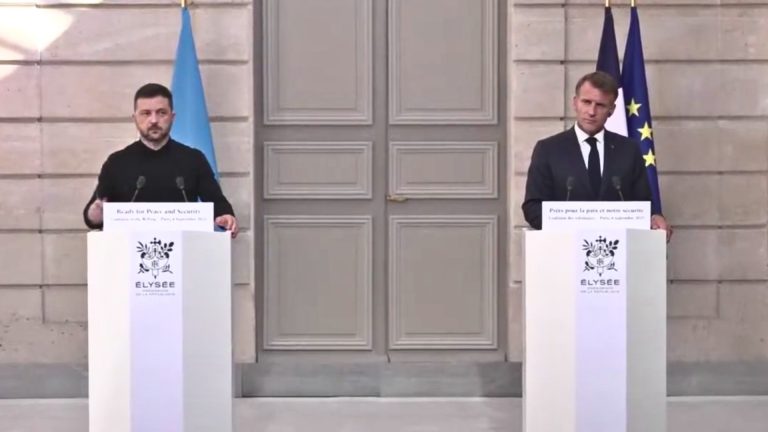
The summit of the “coalition of the willing”, an alliance of about 30 countries in support of Ukraine, took place today at the Elysée. The summit was chaired by French president Emmanuel Macron and British premier Keir Starmer, connected remotely. Among the high profile participants, Ukrainian President Volodymyr Zelensky was physically present, while US president Donald Trump intervened by telephone. Other European leaders, such as the Italian Prime Minister Giorgia Meloni and the German Chancellor Friedrich Merz, followed the event in videoconference.
The aim of the summit: establishing security guarantees
During the meeting, the participants discussed the long -term security guarantees for Ukraine. Zelensky has emphasized the importance of tangible support for the armed forces of his country, affirming: “The main guarantee of security is a strong Ukrainian army”. The leaders analyzed the availability of the nations involved to contribute in key sectors such as land, sea, air and cyberspace. Macron defined the focus of the summit as “to define solid guarantees of safety for Ukraine”, also reporting the unanimous approval of maintaining sanctions against Russia.
Leaders’ announcements and interventions
Macron has communicated that France will provide further military aid for a value of 2 billion euros and has proposed the creation of a European “reassurance force” to guarantee stability in any peace times. However, this force will not replace Ukrainian troops nor will it be directly engaged on the contact line. The British Stage Starmer sent a clear message during his speech: “You can’t trust Putin”. He also underlined the importance of pressing further on the Kremlin to end the conflict. Estone Prime Minister, Kristen Michal, also reiterated that Russia has no right to decide the future of Ukraine or Europe.
Debate on weapons and the role of sanctions
A central theme was the possible sending of long -haul missiles to Ukraine. The British government and other countries have expressed their support on this plan, proposing to strengthen Kiev’s arsenal to prevent further Russian attacks. Macron said that “revoking the penalties now would not make sense” and has reaffirmed the unity of the coalition countries on a rigorous policy against Moscow. However, the Russian spokesman Maria Zakharova defined Ukrainian requests as “guarantees of danger for Europe”, firmly opposing the measures discussed in the summit.
The debate on troops
To tell the truth, in the end, it seems that the meeting has not achieved the purpose imagined by Emmanuel. Macron ensures that the 26 countries present have “committed to sending troops to Ukraine as reassurance forces from the following day to the signing of a peace”. For the French president, the purpose of this contingent “is not to make a war but to guarantee peace and a ceasefire, that is, to prevent a new attack”. Not everyone, however, are of the notice. Germany has made it known that “will make its contribution” to ensure Kiev’s security but “will decide on a debt -time military intervention, once the framework conditions” clarified “, especially once it is clear” the nature and scope of the United States’ commitment “.
Dry, however, by Italy. Giorgia Meloni during the meeting “again illustrated the proposal of a collective security defensive mechanism inspired by Article 5 of the Washington Treaty, as a qualifying element of the political component of the security guarantees for Ukraine”. In a note, Palazzo Chigi said that the premier reiterated “Italy’s unavailability to send soldiers to Ukraine” while “confirmed the opening to support a possible fire with monitoring and training initiatives outside the Ukrainian borders”.
The same goes for Donald Tusk, Polish premier. “Poland, as we have repeatedly pointed out, does not plan to send troops to Ukraine, even after the end of the war – he said – We are responsible for logistics”.
Macron, however, sees the glass half full: all 26 countries, points out, will participate in the security guarantees “with a contribution ranging from the regeneration of the Ukrainian army, in the deployment of troops of land, sea and sky, or with the provision of bases”. “Everyone has their own contribution – he added – some by sending troops in the area, others making their NATO foundations available, I do not want to give details here, but all three countries are important contributions to these guarantees of security”. The US will also be part of it, even if for the moment the Eliseo prefers to keep the “hidden” plans to “Mr. Putin”.
The phone call with Trump
During the phone call with the American leader, the White House would have asked European countries to stop buying Russian oil which – says The Donald – allowed the Kremlin to collect in a year 1.1 billion euros.
TheVermilion.com is also on WhatsApp. Simply click here to register for the channel and always be updated (free).