

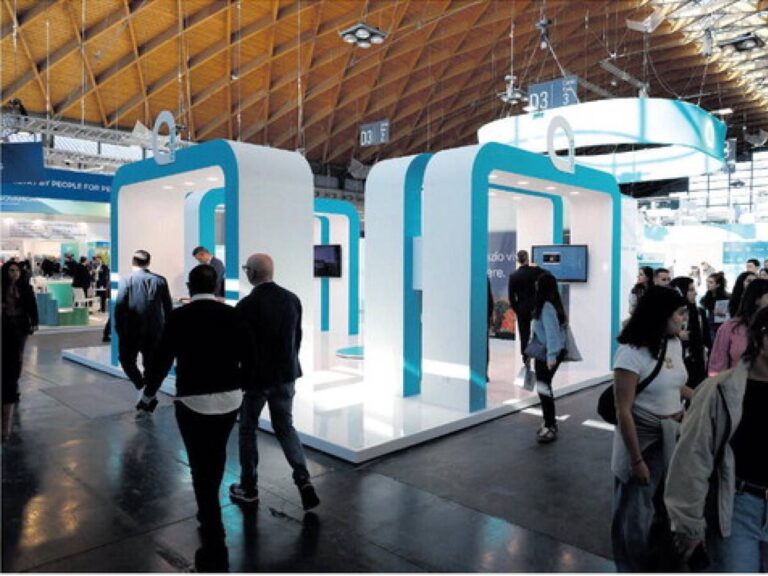
At Ecomondo 2025 in Rimini, we didn’t just talk about waste but about resources. Or rather, that sustainability that transforms what was “waste” into value, and which combines technological innovation and industrial responsibility. In this scenario, Acea presents itself as one of the protagonists of the Italian ecological transition, and brought its proposals made of innovative systems and artificial intelligence to the fair.
The Group welcomed visitors to a 200 square meter stand transformed into a laboratory of the future, where they could experience first-hand the vision of a circular economy based on innovation, energy efficiency and digitalisation. «For Acea, participation in Ecomondo represented an important moment of discussion and sharing on the issues of sustainability and innovation which are the basis of our daily commitment», explained the CEO Fabrizio Palermo, underlining how the Group’s strategy focuses on «a conscious use of resources, the digitalisation of processes and the diffusion of new technologies such as robotics and artificial intelligence».
The most evident symbol of this transformation is the Santa Palomba waste-to-energy plant, destined to become the most cutting-edge plant in Europe. Created by the RenewRome company, it represents – as President Barbara Marinali recalled during the panel dedicated to the “role of plant engineering and technological innovation for the industrial development of the sector” – “an act of courage, a true revolution for Rome and a decisive step towards a modern and sustainable system”. A project that marks the transition «from the concept of waste to that of resource towards a new model of waste management based on innovation, skills and responsibility» and which, in the words of the President, «places collaboration between institutions, companies and territories at the centre». The President also underlined “the importance of investing in managerial and technological skills to face the challenges of the ecological transition, overcoming the fragmentation of the sector and guaranteeing quality and efficient services for all citizens”.
The Santa Palomba circular resources park is not only an infrastructure that will make a fundamental contribution to closing the capital’s waste cycle, but a manifesto of industrial modernity. All this was shown through an immersive video and thanks to the 3D viewers of the Acea Virtual Tour project, which allowed visitors to explore the Group’s plants dedicated to recycling, the regeneration of plastics and the production of energy from waste. The objective was twofold: to show how technology works and to spread environmental culture and transparency.
But the revolution did not stop on the ground. It took flight with drones for the aerial monitoring of industrial sites, artificial intelligence systems for waste recognition and predictive maintenance models tell of an approach that merges industry and digitalisation, safety and sustainability. A way of “looking from above” at production processes to make them more efficient, less energy-intensive and more intelligent.
Not only that. Other fronts, other challenges.
«a.Quantum» also presented a.Quantum Hospital Services, the new reality dedicated to the sustainable transformation of healthcare facilities.
The project supports hospitals in the transition towards Green Hospital models, integrating energy efficiency interventions, intelligent management of medical waste, electric mobility and optimization of the water cycle with IoT technologies and artificial intelligence.