

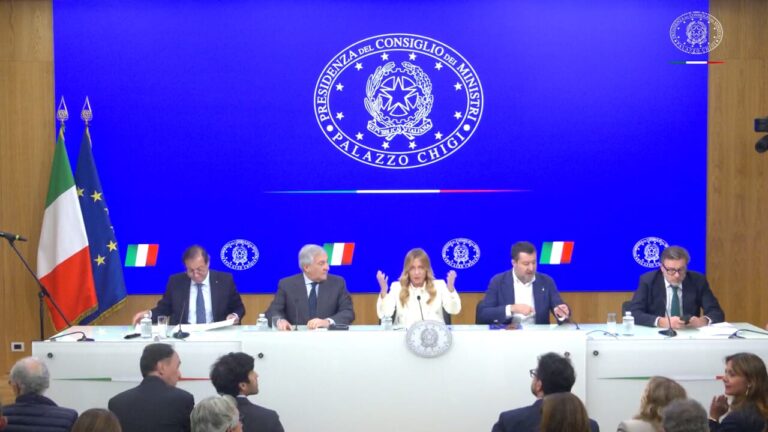
Green light from the Council of Ministers for the economic budget for 2027 of around 26 billion euros. After the latest negotiations on financial coverage and the requests of the majority parties, the government approved the budget bill, which will now have to face the examination of Parliament.
Prime Minister Giorgia Meloni illustrated the main measures during the press conference at Palazzo Chigi. From the cut in Irpef for incomes above 50 thousand euros to the flat tax for the self-employed, through the definitive abolition of car tax on less powerful cars and tax breaks for those who rent houses to young people. There is also room for interventions for the birth rate, with a new social security account for children and the strengthening of parental leave.
Irpef cut, the threshold rises to 55 thousand euros: how much the salary increases
One of the main measures of the maneuver concerns the Irpef, with the extension of the 33% rate to incomes up to 55 thousand euros, compared to the current 50 thousand. “Some might say that it is still not much. If we could we would have done even more, but it is a provision that must be read with those already made previously”, explained Giorgia Meloni.
The Prime Minister then quantified the fiscal benefit accumulated since the government took office: “When we took office, those who had an income of 55 thousand euros paid an Irpef of 16,550 euros, net of possible deductions from employment or pensions. Today they pay 15,350 per year. It corresponds to an annual net benefit of 1,200 euros and therefore to a monthly benefit of around 100 euros, net of the tax exemption of productivity bonuses”.
Flat tax for VAT numbers: the limit rises to 100 thousand euros
The government also expands the preferential tax regime for self-employed workers. The Prime Minister announced the increase of the revenue or compensation threshold for the flat-rate scheme from 85 thousand to 100 thousand euros. The intervention aims to broaden the range of professionals and small businesses that can benefit from the substitute tax normally set at 15%, reduced to 5% in the cases foreseen for new businesses. The extension must be coordinated with European VAT legislation. Details on the access requirements and how the new threshold will be applied will have to be verified in the text of the bill.
Car tax definitively abolished up to 80 kilowatts and on motorbikes
According to Meloni’s announcement, the exemption from car tax for small and medium-powered vehicles becomes structural. “So no car tax on small and medium power cars, up to 80 kilowatts, and on motorbikes. We are talking about around 70% of the vehicles in circulation”, he explained. The measure had already been introduced for 2027 with a duration limited to one year. The government now intends to make it permanent. “Many had tried to belittle this measure by claiming that it was an electoral bribe also because it was only valid in 2027 and they will be proven wrong because they will find in black and white what we had widely said: the measure is structural and definitive”, declared the prime minister. The new text will clarify the requirements and conditions applicable to the exemption when fully implemented.
Personalized plates are arriving, but they will have to be paid for
Among the innovations illustrated by the premier there is also the possibility of personalizing vehicle license plates. “This maneuver will give the opportunity to have personalized license plates, that is, you will be able to more or less indulge yourself as you wish, obviously incurring a cost”, announced Meloni. “Something tells me that the creativity of the Italians could show itself here,” he added. The possibility of choosing a personalized combination would represent a novelty compared to the current license plate assignment system. To know the limits of the permitted customizations, the costs and the procedures, we will have to wait for the implementation regulations.
Rentals, dry coupon at 5% and 1% for those who rent to young people under 35
News also on the home front. The government has decided to reduce taxation on agreed rent rental contracts, providing an even greater relief for owners who rent to young people. “The problem of rent affects all of Europe and Italy is no exception”, explained Meloni, recalling the housing plan launched by the executive. With the measure, he announced, “on rentals at an agreed rent the tax rate drops to 5% but for those who rent at an agreed rent to young people up to 35 years of age it is 1%”. Currently the preferential rate is 10% for contracts that comply with the conditions established by law. On an annual rent of 10 thousand euros, the tax would therefore go from 1,000 to 500 euros with the new rate of 5%, decreasing to 100 euros in the case of the 1% subsidy, with the same tax base.
Parental leave, an extra month for parents
An additional month of parental leave is included in the package of interventions intended for families. The announcement came from the Prime Minister during the press conference to present the measure. The measure aims to expand the period available to parents to care for their children. The conditions of access, the extent of the financial allowance and the methods for dividing the additional period between mother and father remain to be specified through the regulatory text.
A social security account for each newborn: the State pays 100 euros as a “welcome” bonus
Among the main innovations for the birth rate is the opening of a social security position in the name of each child at birth, with a first state payment of 100 euros. “For every child born, the INPS will open a social security position as if it were a small piggy bank in which the State will initially pay a 100 euro “Welcome” quota, but in subsequent years the parents will be able to increase it”, explained Meloni.
According to what was announced by the Prime Minister, the accumulated sums will not be taxable or seized and cannot be used until the age of 18, except in exceptional circumstances and with the authorization of a guardianship judge. “The more children you have, the more the State is present”, underlined the Prime Minister. The bill will have to define the concrete functioning of the new social security instrument.
The 300 euro voucher for pensioners over 75
“With this budget law we are introducing a social voucher of 300 euros for Italians over 75 with a pension of up to 28 thousand euros per year: we are talking about 5.5 million people, for a total cost of the measure of 1.6 billion euros”, announced Meloni after the approval of the maneuver in the Council of Ministers.
Pensions, towards a remake of Quota 100? Away from work aged 64, but with a cut in allowance
“The budget – he explains – can be used for health expenses that are not covered by the national health service for pharmaceutical expenditure and for specialist visits. So it is concrete help, and a way of telling millions of elderly people that they are not alone. Between the 3.4 billion euros for the National Health Fund and 1.6 billion of the voucher” for the over 75s, “we are talking about 5 billion euros for healthcare”, adds Meloni.
Bonuses for renovating your home and buying furniture
“In the construction sector we have confirmed the measures of 50% and 36% for building renovations for the first home, the furniture bonus of up to 5 thousand euros”, announced the deputy minister of Economy, Maurizio Leo, in a press conference at the end of the meeting that launched the measure.
Air conditioning and heat pumps in all schools
The maneuver also includes an intervention to improve the climatic conditions inside school buildings. “We have decided to use part of Nec energia’s resources to equip all schools with air conditioners and heat pumps and make our classrooms more liveable”, announced Meloni. The declared objective is to intervene on the thermal comfort of school environments, especially during the warmer months. The Prime Minister accompanied the announcement with a criticism of previous governments: “If in the past resources had been invested for this and not for wheelchairs it would have been better”. The exact amount of funding, the timetable for the interventions and the distribution criteria between the institutes remain to be known.
What happens now: the maneuver passes to Parliament
With the green light from the Council of Ministers, the parliamentary process of the 2027 Budget law opens. The text will have to be examined by the Chambers, which will be able to modify it through amendments. The final approval must arrive by 31 December 2026, to allow the provisions envisaged to come into force from 1 January 2027.