

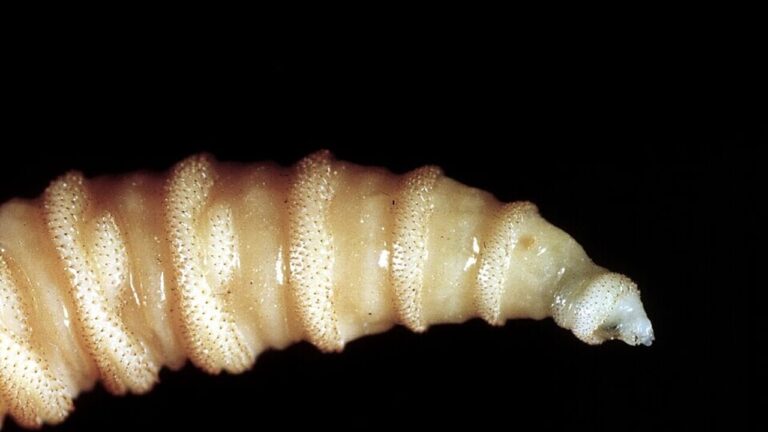
An ancient threat has returned to the southern plains of the United States. This is the new world screwworm (or scientifically, Cochliomyia hominivorax), also known as the killer fly or flesh-eating larva, an insidious parasite whose larvae feed on the living flesh of mammals. It can attack any warm-blooded animal, including humans. But it is famous, and feared, as a livestock parasite, difficult to eradicate and capable of causing catastrophic damage very quickly. In the United States it was eradicated decades ago. But it has recently resurfaced in Texas and New Mexico, with 12 confirmed cases as of June 3. And the epicenter of the American beef industry is trembling: experts agree that a large-scale epidemic could cause incalculable damage, and expand rapidly to the point of putting the entire US livestock sector at risk.
The life cycle of the flesh-eating parasite
Unlike more common fly larvae, which feed on necrotic or decaying tissue, the new world screwworm attacks living flesh directly. The female Cochliomyia hominivorax actively searches for open wounds, even small ones such as a scratch or the umbilical cord of newborns, to lay her eggs. Within a few hours, the larvae hatch and begin tunneling into the host’s healthy muscle tissue, feeding on the flesh. This destructive behavior causes very serious secondary infections and, if not treated promptly with specific insecticides, can lead to the death of the animal within a few days. The fly, native to the tropical and subtropical areas of the Americas, is considered one of the most feared parasites by veterinarians and farmers around the world, due to the speed with which a single outbreak can multiply.
The return of the insect therefore represents a serious blow to the American livestock industry, which believed the problem had been solved for over half a century. In the 1960s, the United States had in fact started a massive eradication program based on the introduction of sterile males into the environment: given that female screwworms mate only once in their lives, the encounter with an infertile male interrupts the reproductive cycle, leading to the collapse of the wild population. Thanks to this strategy, which cost hundreds of millions of dollars, the parasite was declared officially eradicated from US territory in 1966, and then pushed further and further away through an international collaboration program that also eliminated the insect in Mexico and Panama, creating a buffer zone between the United States and the areas where it remained endemic.
The current emergency
In recent years, however, the killer fly had made its reappearance in the two Central American countries. And last June 3 it officially landed in South Texas: the first case after almost 50 years, which was quickly followed by others, expanding the outbreak to 12 heads of cattle between Texas and New Mexico. The infection has so far been confirmed in cattle, sheep and a dog.
The American authorities have asked all pet owners in the affected areas to pay maximum attention to possible symptoms of contagion. And they are activating a response in the field, which should include the use of pesticides and a new campaign to introduce sterile males, with the aim of once again eradicating the predator from national borders. Meanwhile, controversy has erupted at a political level, with a cross-exchange of accusations between the Democrats, who blame the cuts made by the administration to federal agencies for the return of the screwworm to American soil, and the government, which tries to attribute responsibility to the previous administration’s migration policies, hypothesizing that health checks at the southern borders were insufficient to stop the transit of infected animals.
The risks for humans
Cochliomyia hominivorax larvae are highly destructive and tear host tissues with their sharp mouth hooks, causing wounds and ulcers that expand in size and depth. As the larvae develop and feed, the affected areas become painful, swollen, and may bleed or have an unpleasant odor; the larvae are typically visible in the wound, oriented upside down with the posterior spiracles exposed. Infestations of the mucous membranes and subsequent destruction of oral, nasal and ocular tissues may also occur. Untreated infestations can be potentially fatal. Bacterial superinfections may also occur.
Meanwhile, the US Food and Drug Administration has issued an authorization for the emergency use of nitenpyram, the first generic veterinary drug authorized against this parasite: the evidence collected has shown its ability to rapidly eliminate the larvae of the killer fly within a few hours of the first administration.
The risks on European territory
Although the epidemic to date has always remained limited to the American continent, European health authorities maintain a high level of vigilance. A technical document from the European Food Safety Authority (EFSA), presented in January, analyzed the potential risks of introducing screwworm into the European Union due to ongoing climate change. In fact, epidemiological models indicate that the rise in average global temperatures is expanding the fly’s survival range north and east.
In the past, the parasite managed to cross continental borders, arriving in Egypt in the 1990s, where it was eradicated only after a massive campaign led by the FAO and the International Atomic Energy Agency (IAEA). Commercial flows of live animals represent the main vector of introduction: the presence of wounds not detected during customs inspections can allow the larvae to overcome port and airport controls. And the temperatures of these years could lead to a climatic habitat favorable to colonization in the Mediterranean basin and in the Italian coastal areas, with potentially devastating consequences for national livestock farming.