


Points of sale that offer not only consumer food products, but also electronic and technological items. A context in which consumers, increasingly attentive to their pockets, compare offers and flyers in search of the most convenient promotions.
In Italy this distribution model established itself decidedly later than in other countries, but it was able to quickly recover lost ground as also confirmed by the results of the new edition of the Observatory on Italian large-scale retail trade created by Mediobanca Research Area.
Exponential growth
Sales growth of 4.3 percent is estimated compared to 2024, exceeding the +2.3 percent recorded in that year. In 2024, the aggregate of the major national large-scale retail trade groups, mainly food, achieved a net turnover of 109.8 billion euros, of which 13.4 billion attributable to foreign-controlled operators (12.2 percent of the total). Between 2019 and 2024, sales increased by 30.9 percent at an average annual rate of 5.5 percent.
Revenues from promotional activities are growing: they are +4.1 percent per year between 2019 and 2024, equal to 6.5 percent of retailers’ sales; real estate revenues are 1.2 percent. Large-scale organized distribution confirms the high incidence of hourly labor costs: the personnel costs of national retailers constitute on average 12.5 percent of sales, those for transport and logistics 3.1 percent and energy costs 1.9 percent.
Profitability will hold in 2024: marginal Ebit, an indicator of economic-financial efficiency, stands at 2.7 percent, while ROI, which measures the profitability of investments, reaches 7.1 percent. Both support investment growth (+4.9 percent over 2023). In the five-year period 2020-2024, national large-scale retail trade operators distributed dividends for 1.3 billion and injected resources through paid capital increases, for investment or strengthening purposes, for 691 million euros.
More central discount stores
In 2024, discounters, often referred to as the retail proposition on which attention is focused in relation to the effects of inflation on purchasing power, are no longer running alone: their turnover increased by 3.6 percent compared to 2023, against +2 percent of the other operators, recording an average growth rate in sales between 2019 and 2024 of 8.4 percent (+4.9 percent for the others). Marginality stands out: the Ebit margin, the operating margin, of the discount stores stands at 5.1 percent in 2024, significantly higher than the 2.1 percent of the other groups, as well as the ROI, the profitability of invested capital, equal to 16.6 percent against the 5.6 percent of the other operators.
Companies from the South stand out in terms of sales (+8.4 percent on average per year over 2019), followed by companies from Central Italy (+6 percent), while operators from the North-East are more dynamic than those from the North-West (+5.2 percent versus +2.9 percent). The Covid-19 pandemic has accelerated a structural change in Italians’ purchasing habits, to the benefit of discounters who have evolved not only in their offering, but also in local services and own brands.
Sicily at the top
At the beginning of 2026, the data from the Altroconsumo survey on the supermarkets, hypermarkets and discount stores most appreciated by Italian consumers were released. Over 22 thousand citizens were involved, also highlighting how online shopping has not yet fully entered the habits of the Italian population: only 12 percent of Italians do their shopping via the Internet, and just 2 percent do so every week. At the top of the ranking of the most popular national chains is NaturaSì, with 79 points out of 100: founded in 2009, it represents the largest company specialized in the distribution and sale of organic and biodynamic products.
Returning to the new edition of the Observatory on Italian and international large-scale retail trade with a prevalence of food, a particularly interesting piece of data emerges from the analysis of the accounts of individual operators: the Radenza Group achieved the highest growth in turnover between 2019 and 2024, equal to +13.5 percent. This is Coop’s master franchising in Sicily and represents one of the main operators of large-scale retail trade on the island, with over 240 points of sale distributed throughout the regional territory.
The Radenza Group, which has focused on the “Origine” line with products such as extra virgin olive oil, fresh milk, fish, cured meats, vegetables and fruit, describes itself as “a united family linked to the values of the territory. This can be seen from the typically Sicilian products that we proudly promote in our supermarkets, to support the realities of the regional supply chains”.
It is followed by iN’s Mercato (+12.1 percent), which is part of the Pam Group, led by the Bastianello family, present with over 560 points of sale in 12 Italian regions. Its history begins in 1994 with the inauguration of the first store, in Veneto. From there the growth was dizzying, thanks to the opening of new points of sale which in 1998 became 195 throughout the country. In 2011 iN’s Mercato introduced an organic line and between 2020 and 2021 it launched three new formats on the market: In’s Orto, Forno and Pescheria.
Record growth
Another important reality that emerges from the Observatory data is Tatò Paride (+10.4 percent). Born in 1850 with the opening of the first retail point of sale in Barletta, it debuted in organized distribution in 1978 and today has 342 points of sale. The company is led by the third generation of the family, with Bartolomeo Tatò and Paride Walter Tatò at the top of the group. And again, Agorà Network (+10.1 percent), a food distribution group with a strong link with the territory, whose company was founded in 2000 in Milan by Maurizio Gattiglia, Marcello Poli and Antonio Tirelli.
In the last year, RetailPro (+7.9 percent), which was born from a strategic partnership with the Pam Group, with a particular focus on Campania, and the aforementioned Agorà (+7.8 percent) and Gruppo Radenza (+6.3 percent) stand out. Followed by Sait (+5.4 percent), the Consortium of Coops of Trentino-Alto Adige, which exceeded 600 million euros in sales for the first time, and Eurospin (+5.1 percent), the largest Italian discount store, founded in 1993 and with over 1,100 sales points in Italy and Slovenia. Eurospin itself claims to be the queen of cumulative profits between 2019 and 2024: 1,931.2 million.
App for shopping
Let’s continue with Pac 2000 A (Conad Group), the largest cooperative in the consortium, with sales of 4,902 million euros in 2024. It is followed by Selex Gruppo Commerciale (+4.6 percent), founded in 1964 and today with an integrated multi-channel network made up of 3,254 sales points. The goal for 2026 is to reach a turnover of 23.25 billion. Let’s mention it then Conad And Lidl (both at +3.9 percent). As part of the investment plan for the three-year period 2023-2025, equal to approximately 2 billion euros, Conad has allocated a significant portion to digitalisation, focusing on the app Hey Conadlaunched in 2022 and enriched with new services in the sectors of health and well-being, pet care, financial and insurance services and mobility.
Speaking of Lidlwhich defines itself as a “quality discount store”, it is worth remembering that its origins date back to the 1930s Germanywith the affirmation of a company of NeckarsulmIn the Baden-Wurttembergactive in the wholesale of food products. In Italy, Lidl has been present since 1992, the year the first ad store opened Arzignanoin the province of Vicenza. Today the company can count on over 23,000 collaborators, approximately 800 points of sale and 12 logistics centers distributed throughout the national territory.
The Magnificent Seven
The market share of the top seven national operators – Conad, Selex Commercial Group, Coop Italy, Eurospin, Lidl, Esselunga And VéGé Group – it went from 52.2 percent in 2010 to 71 percent in October 2025. Without the liveliness of organized distribution, it would have remained at 50 percent. Founded in 1957 in Milan, Esselunga introduced the first supermarket in Italy. There’s more. Between 2019 and 2025 the market share of the seven organized distribution groups, excluding the Conad and Coop cooperatives, grew by 7.1 percentage points, also thanks to the expansion of the membership bases.
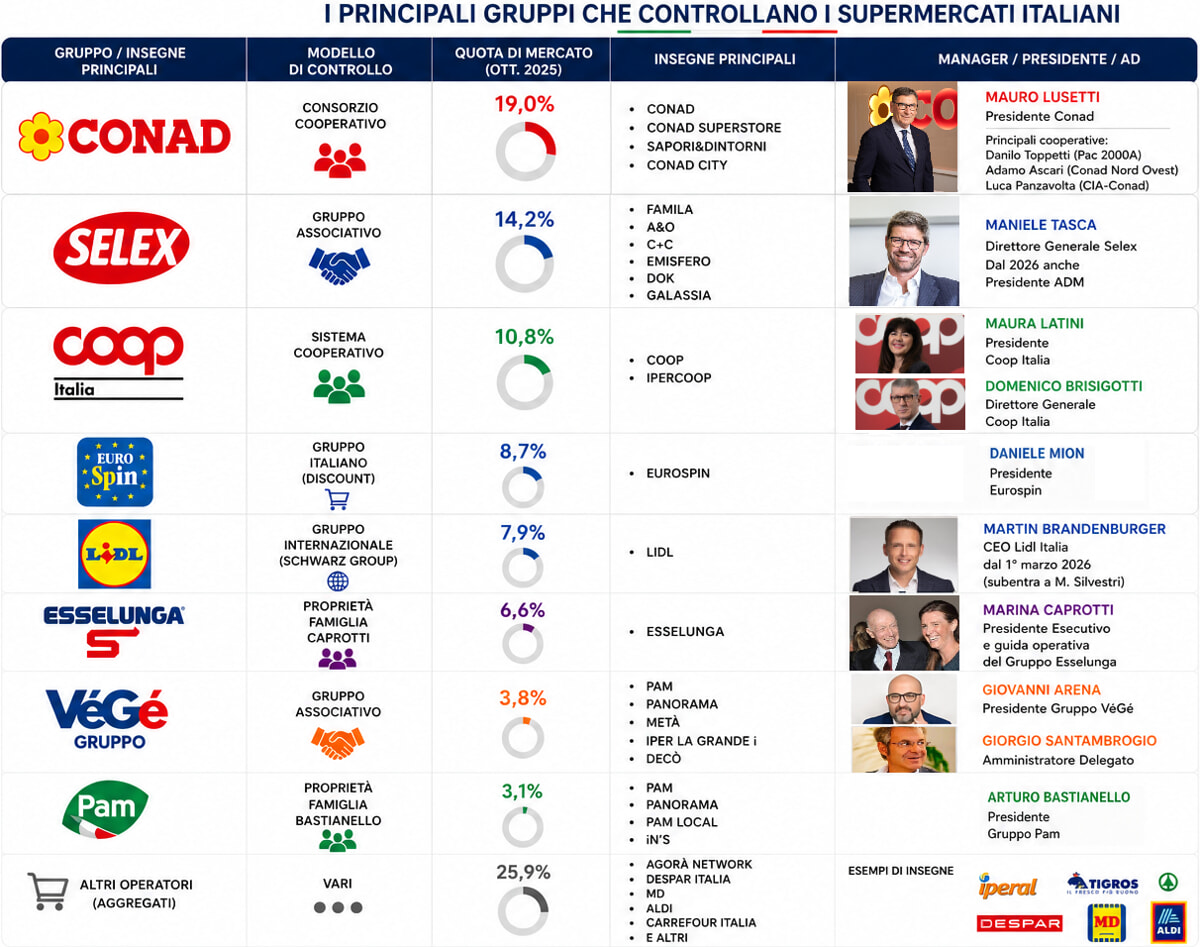
Instead, VéGé is the operator that has attracted the greatest number of new members (seven). Its history originates in 1925 BC Bredain the Netherlandswhen the visionary entrepreneur Theo Albada Jelgersma opened the first shop dedicated to “grocery” products, i.e. packaged foods such as pasta, preserves and biscuits, as well as drinks such as mineral water, carbonated drinks and wine. The Group’s Italian experience began in 1956. Seventy years later, the Group has 3,590 points of sale and a turnover of 16.2 billion.
Digital shopping cart
From the physical aisle to the digital cart: online supermarkets are redesigning large-scale retail trade. In Italy, the food e-commerce sector is going through a phase of progressive consolidation. In 2025 the value of Food & Grocery online purchases grew by 8.5 percent compared to 2024, a higher performance than the average growth of product e-commerce (+6 percent). These are some of the main findings that emerged during the conference Netcomm entitled “Strategies and innovation for the development of omnichannel Food & Grocery”.
In 2024, the overall turnover of the Italian food retail sector increased by 3 percent compared to the previous year, continuing the positive trend that has characterized the sector since 2022. In this context, discounters such as iN’s Mercato confirm themselves as the best performing channel, with economic-financial results above the average of the traditional large-scale retail trade, also thanks to the expansion and valorisation of private label products.
undefined
In the online channel there is a tendency to maintain higher average prices compared to physical stores: in December 2024 the differential was equal to +5 percent, compared to +3.5 percent at the beginning of the year. Last but not least, home delivery confirms itself as the preferred method for Italians, chosen by 82 percent of online shoppers. In parallel, there was an increase in withdrawals at lockers or points of sale, which reached 15.9 percent, an increase of 5.7 percentage points compared to 2024.
Dossier is the exclusive subscription investigative section of The Vermilion. If you want to support our journalistic work and subscribe, visit our showcase by clicking here.