

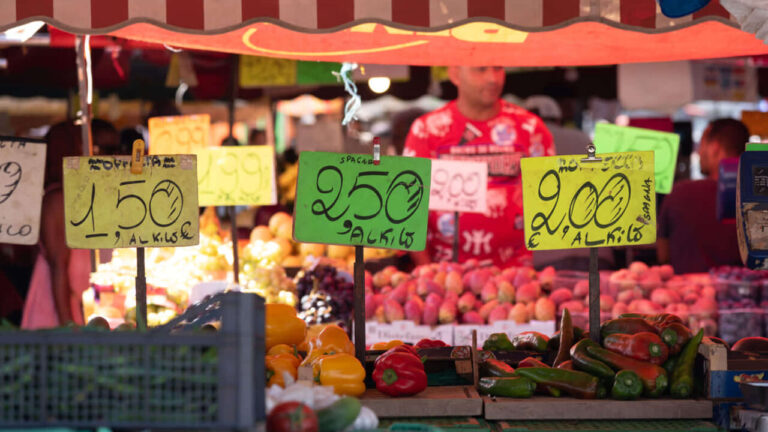
In a Reddit thread dedicated to the day when grocery stores and signs of Large-scale distributionlarge-scale retail trade, stock up on fresh products, the interventions are very varied. One user writes: “I don’t think there is a specific day of the week that a supermarket chain stocks.” Another indicates Tuesday as the ideal day, advising against Sunday. The confusion is total.
Let’s try to clarify things a little. It being understood that saving is also important when choosing where to buy fruit and vegetablesthere is an interesting fact to explore: according to Ismea, the Institute of services for the agricultural food market, fruit and vegetables represent one of the main items in the spending of Italian families, with a value of almost 43 billion euros.
Data from the Ismea-Niq Observatory highlight an increase in purchases of vegetables (+3.3 percent), potatoes (+5.3 percent), nuts (+2.7 percent), chestnuts (+4.6 percent), kiwis (+7.2 percent) and strawberries (+8.9 percent). Red fruits stand out, with blueberries and blackberries growing by 26 and 37 percent respectively, and tropical fruit, with mango (+36 percent) and avocado (+47 percent).
The organic trend was also positive, increasing by 7 percent in quantity and 7.9 percent in value. Strategic segments include families with children of Generation Alphayoung consumers raised in a digital environment, increasingly capable of influencing their parents’ purchasing choices, especially in relation to food quality, environmental sustainability and health.
When to shop at the market to save money
Generation Alpha therefore confirms itself as a strategic target for the future of the fruit and vegetable sector. “Be careful, though. While on the one hand the data relating to the increase in purchases of vegetable raw materials is comforting, on the other I wonder if their lower cost compared to animal proteins is not also a reflection of the current economic crisis. Translated: I buy what costs less.” Speaking to The Vermilion is Paolo D’Ercole, owner, together with Chiara Valzania, of the Scima restaurant in Rome. Here the couple offers a constantly evolving menu, built on seasonality and market availability: from Sardinian lorighittas with mussels and cherry tomatoes to roasted halloumi with peppers, up to Salento pasta and chickpeas, to give just a few examples.
Precisely in D’Ercole and Valzania, who do not rely on suppliers and personally choose the raw materials, we asked if there is a more convenient day to buy fruit and vegetables, also in terms of savings. “Let’s start from an assumption: the issue of the sustainability of the costs of fruit, vegetables, meat and fish it affects us very closely. We shop at the market every two days and are in contact with very small producers. At certain times of the year we leave and travel around Italy: if we find a box of vegetables that we like, we buy it and cook it.”
The owners of Scima, a restaurant opened in August 2024 a few steps from the Appia Antica Regional Park, then go into the merits of the issue: “As a day to buy fruit and vegetables, we do not recommend Saturday, because you bring with you the tiredness of the week and often on the fruit and vegetable market stalls you can find everything, even out-of-season products. Better to go to the market on Monday, so as to be able to plan the meals for the week. Regardless of the day, however, the advice is to go there a lot soon.”
Seasonality is not a question of price
To buy fruit and vegetables, an excellent solution it could be to contact one of over 400 Slow Food presidia present in Italy, purchasing the products directly from the producers or at farmers’ markets. Movement founded by gastronome and writer Carlo Petrini in 1986, Slow Food promotes a food-based dietary model “good, clean and fair”, as opposed to the frenetic life model imposed by modern society and industrial standardization. “Some think that Slow Food presidia are expensive, but this is not the case. Priverno’s chiacchietegli, for example – explains Chiara Valzania – are a variety of broccoli protected by a small Lazio presidia and cost less than those sold in the supermarket”.
The problem, then, is that we have lost part of our food culture? “Exactly, and we need to find it again. Even through seasonality: there is a reason why in summer we eat tomatoes, watermelon and melons, rich in water; in winter, however, we enjoy oranges, rich in vitamin C”, replies the couple. Then underlining the importance of going back to listening to our needs.
“Italy – they recall – is the country with the largest biodiversity in Europe, but today we are used to finding out-of-season vegetables and fruit every single day of the year. Just think of papaya and pineapple, which are in fact always available. This is a completely wrong concept.”
The time we no longer find
In the treaty De brevitate vitaecomposed between 49 and 52 AD, the Roman philosopher Lucius Anneus Seneca writes: “We do not have little time, but we waste a lot of it.” And time is precisely one of the main obstacles to adiet more aware. “In recent years, vacuum-packed food has replaced frozen food and the supermarket has accustomed people to convenience: no longer just the bag with ready-made minestrone, but also pre-diced pumpkin, peeled potatoes and cut courgettes”, explain D’Ercole and Valzania.
It is the reflection of a habit that pushes us to look for increasingly comfortable solutions. But the point is not just how much we spend, but how much we are willing to change our habits.
“There’s no point beating around the bush: you can always find time to go shopping”, underline the owners of Scima. “We need to get closer to small producers. There are many farms that organize weekly deliveries of fruit and vegetable boxes, following what the land offers at that moment.”
Carving out time to shop in a more sustainable way also means recovering a nutritional education that was once part of everyday life. “After the war everyone had their own salad bowl before the meal – observe the two restaurateurs from Rome -. Now, unfortunately, it would be unthinkable”.
Dossier is the exclusive subscription investigative section of The Vermilion. If you would like to support our journalistic work and subscribe, Click here.