

“To fish you need to have a clear mind. Like billiards. You look at the ball, concentrate on the trajectory you want it to take and then give the cue the force you want. With confidence and determination. When fishing, you cast the line, then focus on the float. You don’t cast the line so randomly. A fisherman can be recognized by his cast.” These are words of the well-known French writer and journalist Jean-Claude Izzo, taken from the crime novel “Total Casino” (1995), set in Marseille.
A fisherman, therefore, is recognized by the throwing of the hook. And who loves fish? Also from the ability to choose the right time to bring it to the table, without sacrificing quality but trying, when possible, to save money. Hence, some questions: what is the best time of the week to buy fish, molluscs and crustaceans? And, conversely, which one where prices tend to be higher? Let’s try to clarify things a little.
What is the best day to buy fish
The best day to buy fish depends, first of all, on the type of fish. In fact, depending on the species, the capture methods, the equipment used and even the weather conditions change. For example, some bottom-dwelling species, such as sole and red mullet, are subject to specific restrictions and closed periods, which can affect the availability of fresh fish during the week.
Generally speaking, therefore, Monday may not be the best day to buy some types of fish, because you risk finding products caught in the previous days or coming from markets that were closed during the weekend. In the case of a very fresh product, even a few days of difference can affect the quality, especially if storage has not been optimal. For this reason, in addition to the day, it is important for the consumer to verify, where available, the origin, the date of capture or landing and the conservation methods of the product.
Also know the seasonality of fish it can help you save money and make more informed choices, without forgetting the importance of reducing waste. An aspect, the latter, which also concerns the way in which fish is purchased and prepared. As a user writes in a Facebook group dedicated to food shopping: “As an operator in the sector I can assure you that 80 percent of people want to eat fish without even finding a bone in it. They want it already clean, practically perfect. And the responsibility also lies with those TV programs that offer recipes with fish always filleted, where more than half of the meat is thrown away.”
Prices and deals in local markets
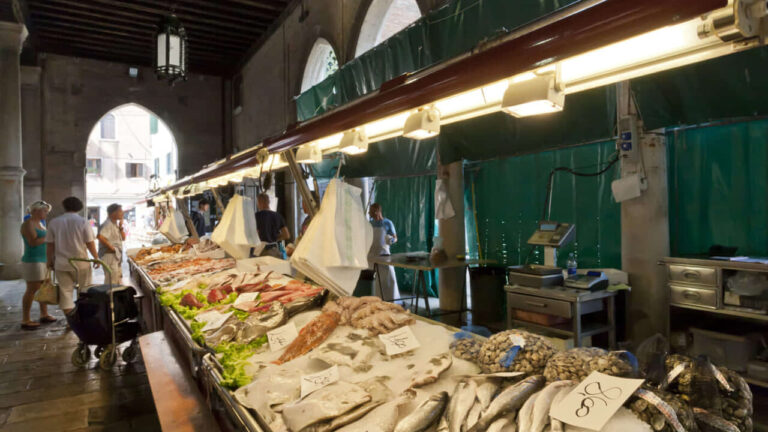
Those who can go shopping every day of the week, perhaps because they are retired or work as a freelancer, can enjoy the advantages offered by local markets. This is the case of the market of Testaccio in Rome. Here there are historic fishmongers, such as that of the Mastroianni family, and stalls such as that of Simona and Daniele, where it is possible to purchase quality fish: from calamari to clams, from shellfish to paranza, but also ready-made products: from skewers to the preparation for risotto alla pescatora.
As for prices, oily fish such as anchovies, sardines and mackerel, rich in omega 3, generally remains among the cheapest choices: ranging from 5 to 10 euros per kilo; Sardines and anchovies can cost even less than 5 euros, while mackerel and horse mackerel fluctuate on average between 6 and 14 euros per kilo. More expensive, however, are some varieties of white fish and valuable species, such as sea bream, sea bass and squid, the price of which ranges on average between 15 and 30 euros per kilo, depending on the type and origin.
And the Monday rule? This applies in particular to the direct sale of fresh fish caught at sea in fishmongers. Today, however, between aquaculture and frozen product, the relationship between day of the week and freshness is less direct. In general, the best time is when it is more likely to find freshly caught and landed product: in some situations, therefore, Tuesday or Wednesday may be suitable days. Much depends, however, on the species, the port, the fishing area, the market and the capture method.
The offers do not depend on the day of the week
“From the point of view of promotional policies, there are no days of the week that are more convenient for purchasing specific categories. Convenience is determined above all by commercial planning and the promotional calendar, rather than by the day on which the customer makes the shopping.” Luana Mastrorillo, promotion specialist at Maiora SpA SB, one of the leading companies in large-scale retail trade in central and southern Italy, explains this to Dossier The Vermilion. “Promotional initiatives are planned based on various factors, including seasonality, agreements with suppliers, sell-out needs and commercial objectives. Thus, categories such as fish, meat, fruit and vegetables, personal and home hygiene products and detergents can be affected by offers at different times of the year, without a fixed recurrence”.
Therefore Mastrorillo underlines that for fresh products, promotional activities are often influenced by seasonal availability and the valorization of local production, while for grocery and non-food products they follow a commercial planning defined in collaboration with the industry. “However, we are increasingly implementing weekly offers on the freshest departments, so as to guarantee a significant rotation of seasonal products, enhancing their freshness and seasonality, distinctive elements of our commercial policy”.
We therefore ask the promotion specialist of Maiora SpA SB if there is, in general, a more favorable day of the week to purchase certain categories of products. “I would say no. For the customer it may be particularly convenient to exploit, for example, the opportunities offered by shopping vouchers. The objective is to guarantee customers a constant level of convenience throughout the promotional period. For this reason, the most useful reference for the consumer remains the flyer, both digital and paper, and the app, on which we increasingly focus customer-oriented activities”, replies Mastrorillo.
Which fish to choose in every season of the year
In the documentary film “Marche: from water to table” (2022), directed by Giampiero Solari, the starred chef Mauro Uliassi underlines: “It is essential to try to understand well the periods, and respect them, in which fish can be purchased. A great dish can only be obtained with excellent raw materials”. Respecting the seasonality of fish means taking the biological cycles of fish species at heart, contributing to more sustainable fishing and serving products that best express their peculiarities.
Here is the calendar, month by month, of seasonal fish: which species to find at different times of the year and which ones to orient yourself on when choosing the product.
- January: the year opens with various species available, especially anchovies, squid, mullet, grouper, snapper, hake, St. Peter’s fish, octopus, amberjack, turbot, sardines, sea bream, scorpion fish, cuttlefish, mackerel, sole, sea bass and mullet.
- February: increases the richness of the catch, with anchovies, squid, mullet, grouper, snapper, prawns, hake, croaker, John Dory, amberjack, turbot, sardines, scorpion fish, cuttlefish, mackerel, sole, sea bass, red tuna and clams.
- March: spring brings new species to the table: anchovies, mullets, groupers, snappers, pink prawns, crabs, prawns, hake, St. Peter’s fish, anglerfish, stingrays, amberjacks, turbot, sea bream, scampi, scorpion fish, cuttlefish, mackerel, sole, red tuna, red mullet and true clams.
- April: the school is enriched with anchovies, lobsters, mullets, groupers, snappers, pink prawns, crabs, hake, John Dory fish, swordfish, anglerfish, skates, amberjacks, sea bream, sardines, scampi, scorpion fish, cuttlefish, mackerel, sole, sea bass, tuna, squid and mullet.
- May: the choice remains wide and varied, ranging from lobsters to mullet. And again: groupers, snappers, pink prawns, crabs, hake, swordfish, anglerfish, rays, amberjacks, sea bream, sardines, scampi, mackerel, sole, sea bass, tuna, squid and mullet.
- June: with summer new protagonists arrive on the table: mullet, snapper, hake, sea bream, swordfish, anglerfish, rays, amberjack, sea bream, sardines, scampi, mackerel, sole, sea bass, tuna, squid and mullet.
- July: it is one of the months richest in variety and offers anchovies, mullet, snapper, gurnard, pink shrimp, crabs, lanzardi, lecce, murmore, hake, seabream, swordfish, amberjack, sea bream, sardines, scampi, sole, sea bass, horse mackerel, tuna, squid, red mullet and clams.
- August: even in the hottest month of the year there is no shortage of choice. Mullet, snapper, hake, sea bream, swordfish, amberjack, sardines, sea bream, mackerel, sole, bluefin tuna and mullet make their way.
- September: on the fish stalls you can find anchovies, squid, mullet, snapper, dogfish, prawns, octopus, croaker, sea bream, swordfish, amberjack, turbot, sea bream, sardines, cuttlefish, sole, sea bass, red tuna, red mullet and clams.
- October: the autumn catch offers numerous possibilities, from anchovies to squid and mullet. And again: groupers, snappers, gurnards, dogfish, prawns, octopus, hake, croaker, sea bream, swordfish, amberjack, turbot, sea bream, sardines, cuttlefish, sole, tuna and mullet.
- November: the month of All Saints brings with it numerous species: anchovies, squid, squid, mullet, grouper, snapper, dogfish, prawns, octopus, hake, croaker, sea bream, octopus, turbot, sardines, cuttlefish, sole, red mullet and clams.
- December: the year ends with a wide choice: anchovies, squid, squid, mullet, snapper, dogfish, prawns, octopus, hake, sea bream, octopus, turbot, sea bream, sardines, cuttlefish, mackerel, sole, sea bass, dogfish, red tuna, red mullet and clams.
Buying seasonal fish can therefore be an advantageous choice for both savings both for the quality of the product. It means following the rhythms of the sea, just like we already do with fruit and vegetables. In addition to bringing often tastier and more convenient products to the table, this choice allows you to diversify your diet and enhance lesser-known species.
Dossier is the exclusive subscription investigative section of The Vermilion. If you want to support our journalistic work and subscribe, Click here.