

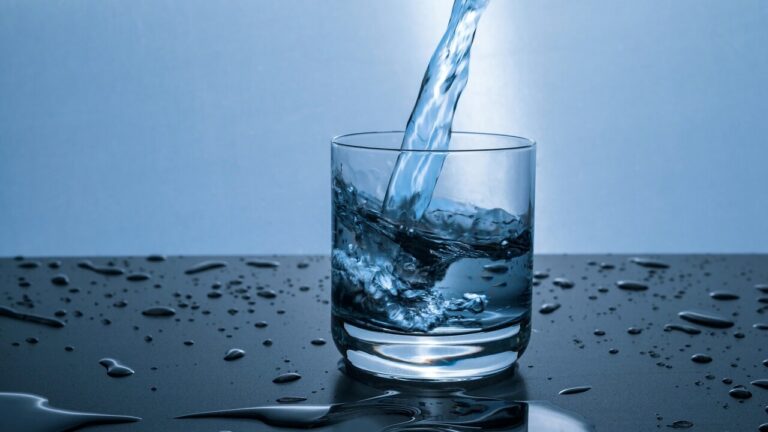
To stay healthy you need to drink at least two liters of water every day: the rule seems so consolidated that it doesn’t even require an explanation. But There is no universal amount of water to drink that is valid for everyone. Requirements change with age, sex, nutrition, temperature, physical activity, pregnancy and health conditions. And above all there is a misunderstanding that has accompanied this story practically from its origins: an important part of the water we need comes from food and other drinks.
Who convinced us of the famous two liters
One of the most accredited leads leads to the post-World War II United States. In 1945 the Food and Nutrition Board of the National Research Council published a recommendation according to which an intake of approximately 2.5 liters of water per day was appropriate for an adult, using as a reference approximately one milliliter for each kilocalorie consumed. But immediately afterwards came a fundamental clarification: a large part of that quantity was already contained in the food.
This is explained by physiologist and nephrologist Heinz Valtin, professor at the Dartmouth medical school, who reconstructed the story in 2002. From “taking in a certain amount of water overall, a good part of which through food” we gradually moved on to “drinking that amount of water”.
Then came the eight glasses
Another passage in history dates back to the Seventies and leads to Fredrick J. Stare, one of the most influential American nutritionists of the twentieth century and founder of the Nutrition department of the Harvard School of Public Health. In the book Nutrition for good healthco-authored with Margaret McWilliams in 1974, suggested that approximately six to eight glasses of liquid per 24 hours would be appropriate for an average adult. In the United States the very easy to remember formula of the “8×8” would therefore become established: eight glasses of eight ounces each. That’s about 64 ounces, which is just under 1.9 liters.
Does science really say today to drink two liters?
Here an apparent paradox arises, because numerous health institutions actually indicate quantities very close to the famous two litres. The European Food Safety Authority, EFSA, considers a total daily intake of around 2 liters for women and 2.5 liters for men to be adequate for adults. But “total” is the key word: the value includes water from both drinks and food. Furthermore, the requirement varies depending on environmental conditions and physical activity.
In Italy, the Crea guidelines recommend, under normal conditions, drinking an average of 1.5-2 liters of water per day, remembering however in the same document that every day we also take in hundreds of milliliters of water through food.
The study that undermines the one-size-fits-all rule
One of the most interesting demonstrations came in 2022 from a large international study published in Science. The researchers analyzed the water exchange in the bodies of 5,604 people, aged from eight days to 96 years, living in 23 countries, using stable isotopes. The result is that water exchange varies enormously. It depends on body size, age, energy expenditure and physical activity, but also on temperature, humidity, altitude, pregnancy and breastfeeding. Athletes, for example, have different needs than those of a sedentary person; those who live and work in the heat lose more water than those who spend the day in an air-conditioned environment.
John Speakman, one of the study’s authors, summarized the finding this way: A “one-size-fits-all” policy on water intake is not supported by the data. And above all he specified that the body’s water exchange does not coincide with the water we have to drink, because a portion comes from metabolism and a significant part from food.
They convinced us to pay our weight in gold for water
Now a conspiracy theory circulating on social media claims that the eight glasses a day are an invention of the giants that produce bottled water. Although there is not enough evidence to support that mineral water companies invented the two-litre rule, it is equally clear that the “you must drink continuously” message is perfectly compatible with a market in which water is no longer sold only to quench thirst, but also as a product associated with health, well-being and lifestyle.
For years the shelves and online shops have been filled with special “waters”, whether alkaline, protein, vitamin, collagen, coconut, birch, hydrogenated, or flavoured. In some cases these are true mineral waters with a high ranking. In other cases they are functional drinks, i.e. products added with vitamins, proteins, zinc, collagen, plant extracts, flavorings or sweeteners. But not all promises that revolve around “special waters” have the same weight.