

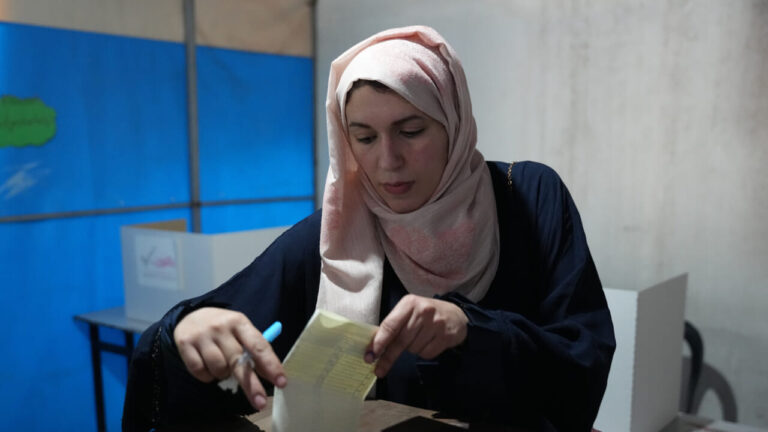
After almost twenty years, the Palestinians have returned – at least in part – to the polls, even in a fragment of the devastated Gaza Strip. A political signal, rather than a true democratic transition. Unsurprisingly, President Mahmoud Abbas’s Fatah movement won the 2026 Palestinian municipal elections.
Fatah claimed an “overwhelming victory”, claiming to have won the majority of local councils in the West Bank and to have contributed to the formation of 197 municipal administrations, in many cases also through agreements and joint lists with other factions. The official results confirm the party’s dominance, leading in strategic centers such as Hebron, Tulkarem and Salfit.
Turnout in the West Bank stood at around 56%, while in the Gaza Strip it dropped to 22%, reflecting the devastating weight of massacres, displacements and restrictions. In Deir al-Balah, the only center in Gaza involved, only around 70 thousand voters were registered and a non-negligible share of the ballots were null or blank.
The absence of Hamas and the shadows around Fatah
Deir al-Balah itself represents the symbolic heart of these elections. For the first time since 2006, voting was held, albeit in a limited way, in a territory controlled by Hamas. Here the list supported by Fatah obtained 6 seats out of 15, while candidates considered close to Hamas stopped at 2 seats. The other seats went to independent local groups.
The official absence of Hamas had a profound effect on the outcome. The Islamist movement, which has governed Gaza since 2007, did not participate in the elections: to run it was necessary to accept the program of the Palestine Liberation Organization, which provides for the recognition of Israel and the renunciation of armed struggle. A condition that has effectively excluded Hamas and other factions. Despite this, local observers reported the presence of candidates informally close to the movement and a control over the territory that was visible even during the vote.
Fatah’s dominance was undoubtedly facilitated, at least in part, by an uncompetitive electoral system. In numerous cities, including Ramallah and Nablus, only one list was presented. In total, nearly 200 local authorities were awarded without opposition. In other cases, such as Jenin, the result was more uncertain: here Fatah obtained 6 seats out of 15, on par with an independent list, in a climate marked by tensions and protests. In Qalqilyah, no list was even presented, forcing the Palestinian Authority to appoint the municipal council directly.
Prime Minister Mohammad Mustafa called the vote “an expression of national will” and a first step towards a more inclusive political system. Even the inclusion, albeit limited, of Gaza was presented as a political signal: an attempt to mend, at least symbolically, the rift between the Palestinian territories.
Yet, beyond the official declarations, many shadows remain. Several observers, activists and citizens have denounced lack of transparency and a real lack of competition. The most obvious fact is that these elections, although important, do not change the underlying balance. Fatah consolidates its institutional control, but does so in a context marked by the absence of its main rival, the weakness of the democratic system and declining popular legitimacy after years without national elections.