

“Today our children are exposed to a space they should never have had to navigate alone, one of addiction, violence, abuse, manipulation and pornography. We will no longer allow it: we will have zero tolerance on this issue.” With these words, last February 2, Spanish Prime Minister Pedro Sánchez announced at the World Government Summit in Dubai his intention to legally ban the use of social networks by minors under 16 years of age. The socialist leader spoke openly of the “Far West” and “digital sovereignty”, inviting other European countries to follow Madrid’s example. His, however, is certainly not an isolated initiative.
States that have promoted initiatives against social media
Sánchez’s announcement sparked an immediate reaction from Elon Musk, who attacked the prime minister, calling him “a tyrant and corrupt, a traitor to the Spanish people”. But Spain is not the only country that is considering measures of this type.
Last Tuesday 27 January the French parliament approved a bill to block social media for children under 15. “It’s what scientists recommend and what the French want. The brains of our teenagers are not for sale, neither for Chinese nor American platforms” underlined French President Emmanuel Macron.
The one who has already taken this step, becoming the first nation in the world to introduce a general ban, is Australia. In November 2025, Canberra prohibited the use of social networks by all children under 16, requiring platforms (Instagram, TikTok, Facebook and others) to delete teenagers’ accounts. Companies now risk fines of up to 50 million Australian dollars if they do not prevent access, and there is no scope for exemption even with parental consent.
Similar initiatives are also being studied in other countries, including Denmark, the Czech Republic, Slovenia and Malaysia, which are evaluating various forms of restriction on the use of social media for young people.
But why this sudden rush to limit a sector that is now an integral part of the daily media diet? And what do we really know about the effects of social networks on mental and cognitive health? The first scientific evidence already exists, and it is not at all reassuring.
Thus brain biochemistry is used to produce interactions
Let’s start with the numbers. Today one in three children between the ages of 11 and 13 already has a social profile, despite almost all platforms setting the minimum age for registration at 13. Furthermore, according to the Istituto Superiore di Sanità, digital tools enter the lives of children between 2 and 5 months.
The early and continuous use of digital devices is associated with clinical risks ranging from overweight to eating disorders and mood disorders. But above all, when we talk about the impact of social media on our lives, and in particular on those of adolescents, today we have scientific evidence that ten or twenty years ago was mostly conjecture.
When we talk about social networks we must imagine them as platforms designed to keep us glued to the screen and continually solicit our reactions: it is the basic mechanism on which the business model of the large digital giants is based. The real “oil” is not entertainment, but our data and our digital traces: what scholars call behavioral surplus, that is, the set of information that allows us to be classified both as individuals and as social groups, to then sell us products and, increasingly often, also lifestyles, values and political visions.
All this happens through continuous stimulation of our brain biochemistry. In fact, the use of social media activates neural circuits which, according to several neuroscientists, are the same ones involved in traditional addictions – those to drugs, compulsive sex or alcohol. The most apt comparison, however, remains that with gambling, based on intermittent and unpredictable rewards that maintain high attraction and lower our capacity for self-control.
How social media addiction works
The key word is dopamine, a neurotransmitter that is not so much linked to pleasure itself, but to the desire and anticipation of reward: the more it is stimulated, the more it pushes the brain to repeat the experience. The problem is that these peaks are followed by phases of lower activation which, especially in younger people, can be associated with irritability, anxiety and depressed mood.
The infinite scroll on platforms like Instagram and TikTok thus reproduces – on a digital scale – the same mechanism as the slot machine: unpredictable rewards, continuous novelties and a brain always looking for the next stimulus. A system which, in the most extreme cases, can encourage compulsive behaviors and forms of behavioral addiction.
A real “social media addiction” is not yet formally recognized in the main psychiatric manuals, while the diagnosis of addiction to the internet and online video games (Internet Gaming Disorder), which follows very similar logic, is already more consolidated.
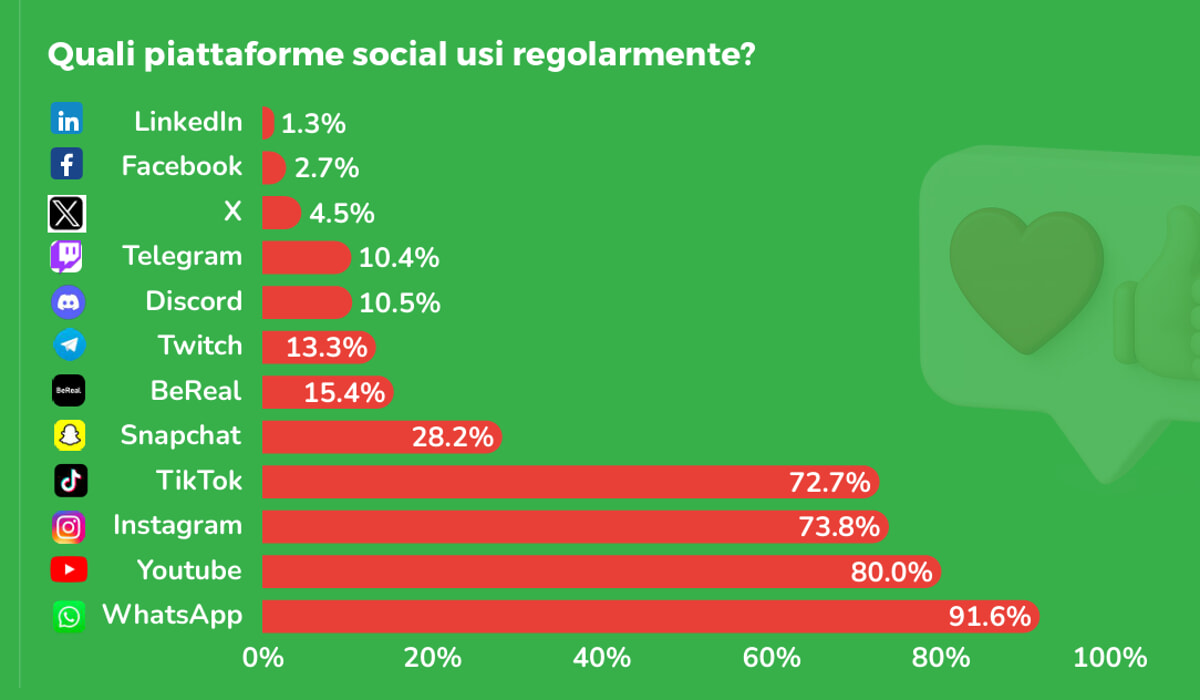
According to a survey by the Social Warning association, released on the occasion of Internet Safer Day today, Tuesday 10 February, 77.5% of students between 11 and 18 years old feel dependent on digital devices, while over 91% believe that their use affects their well-being.
“When more than three out of four young people perceive themselves as addicted and more than nine out of ten recognize health effects, we are faced with a clear request for help”, observes Davide Dal Maso, president of Social Warning. “Is the time that school and family dedicate to these issues really enough?”.
To strengthen the doubt there is another fact: 91% of teenagers, in case of uncertainty, look for answers directly on the internet.
Anxiety, depression and social media: what we know
If the studies on the brain mechanisms activated by social media are now solid, the evidence on their effects is less clear. Scientific reviews show an association between intense use of social media and increased anxiety, depression and psychological stress, but there is still no total consensus in the scientific community: some researchers underline that it matters a lot how and in what context the platforms are used.
At the same time, many scholars report a surge in depression, anxiety and suicide attempts among adolescents from 2012 onwards, in parallel with the spread of smartphones and social media.
However, the evidence on the increase in cyberbullying and forms of social anxiety among younger people is more shared.
Social media and eating disorders: the “echo chamber” effect
However, the link between the spread of social media and the increase in eating disorders appears quite solid, linked above all to continuous exposure to “ideal” bodies – very thin or hyper-muscular – often retouched with filters, and to the permanent social comparison typical of scrolling.
Several studies show that girls who use highly visual platforms such as TikTok and Instagram are more at risk of developing symptoms related to eating disorders. The algorithm plays a key role, which tends to propose contents that are increasingly similar to those already seen, fueling the so-called “echo chambers”.

This is how Facebook, Instagram or TikTok feeds are created, entirely tailored to our tastes and beliefs. A mechanism that can make us believe, for example, that the only ideal of beauty is that of ultra-thin bodies, or that the world is populated almost only by people who think politically like us.
They are real cognitive distortions that can have serious consequences, while many scientists also warn of more general changes in the way we think and process information.
The economy of distraction and indignation
As we have seen, social media feeds on our attention: the more time we spend on the platforms, the more their profits increase. A real economy of distraction has been structured around this.
Platforms don’t just offer content: they monetize every second by designing their products to interrupt and detain us as much as possible. Notifications, infinite scrolling, ever-shorter videos, and algorithms that reward the emotional or polarizing are not technical happenstances, but deliberate tools of a business model that thrives on our difficulty concentrating.
In this logic, distraction is not a side effect: it is the fuel of the system. The more fragmented attention becomes, the more data, views and profits grow.
Numerous studies indicate that this has had a significant impact on our cognitive faculties. The platforms, based on continuous notifications, infinite scrolling and very short videos, train the brain for speed and reactivity, but weaken prolonged attention.
As a result, it becomes more difficult to read long texts, follow complex lessons or work without interruptions, while the habit of multitasking and continuously switching between different stimuli is strengthened, a theme particularly analyzed in adolescents.

Not only that. A side effect of social media is what many scholars call the “outrage economy”. A 2021 study from Yale University showed that algorithms tend to reward outrageous content: Posts with highly emotional and moral language are more likely to go viral.
Thus information becomes increasingly tribal, while the truth is replaced by post-truth, that is, a series of opinions based on personal beliefs, emotional appeals and prejudices rather than on verifiable facts. The key word in this case is “polarization”, a communication modality that now also dominates our interactions outside the screens and which, according to many analysts, contributes to the deterioration of public debate and the rise of contemporary populism.