


Objective: stop working. Yes, but how? The idea of being the master of your own time again is seductive. To abolish the alarm clock as well. But you need a plan. You need to build capital and have the ability to make it profitable, as well as be able to carefully plan your incoming and outgoing cash flow.
The Fire movement
Fire. Acronym for ‘financial independence, retire early’. AND a movement that has gained popularity from 2010 onwards, especially among millennials, i.e. the generation born between the early 1980s and the mid-1990s. The true Fire is not necessarily a nabob and does not necessarily aspire to be one. He doesn’t need the money to accumulate Ferraris in the garage and Rolexes in the drawer, but to scrape together enough money to no longer go to the office. Very often those who aspire to Fire are in fact happy to make some sacrifices in order to pursue a greater good and ontologically the enemy of money: idleness.
The 4% rule
The basic rule of the Fire movement is the “4% rule”: you can withdraw about 4% of your capital every year without running out of it. The theories aired on the sacred blogs of the movement therefore predict accumulating at least 25 times the estimated annual living expenses.
The plan involves supporting yourself by investing your capital in shares, ETFs or government bonds. Which obviously involves a risk component. Example: if I plan to live on 1,400 euros a month, 16,800 euros per year, I will need at least 420,000 euros of capital to generate an income with a real return (i.e. net of inflation) of at least 4%. However, the gross return will have to be much higher, often close to 8%, to cover inflation, taxes and management costs. That’s a very high performance and far from guaranteed. Like any investment there is a margin of risk. And a higher return is usually associated with a greater chance of ending up in the red.
In the case studies it was observed that with a balanced portfolio and withdrawing 4%, a figure which is then adjusted for inflation, the capital should survive for at least 30 years. What if you live longer? Over the years, the followers of the movement have developed increasingly complex formulas and on the web there are dozens of calculators to estimate the years remaining until day X: that of dismissal.
Estimating the amount you will need to live the rest of your life in idleness is an extremely difficult task. In the meantime, we need to hypothesize scenarios over very long periods: what will be, for example, the return of the ETFs or securities we have in our portfolio? We can only assume this on the basis of models that refer to the past, but it is not certain that they will be replicated in the future.
There are myriad unknowns: a sudden collapse of the stock markets, a crisis in the global economy, a huge expense that we hadn’t taken into account, a health problem, the arrival of aliens.
Giorgio is still “young”, but he is tired of working
Let’s take an example. Let’s suppose that Giorgio, 45 years old, is in possession of a decent sum in his current account: 100 thousand euros. His salary is 2 thousand euros net and he spends 1,400 between rent, bills and current expenses. The rest is invested with an average real return of 4%. Finally, let’s assume that from the age of 69 onwards you can count on a pension of 650 euros. Based on these variables, the ChatGpt credit informs us that Giorgio could stop working at 57 after having accumulated a capital of 323 thousand euros. All this while maintaining the same standard of living.
If, however, we wanted to set a date of death, say 85 years of age, the time to leave work could come a little earlier, at 56 years of age, with a capital of 300,000. However, the estimates are rather optimistic. Also because, by including the weight of taxes and inflation (estimated at 2% per year) in the 4%, we have implicitly relied on a gross interest higher than 8%. An income that is anything but predictable. However, we are on thin ice. It doesn’t take much to ruin all of Giorgio’s plans. A fall in stocks would make it very difficult to recover the capital loss. Every investment, as we know, involves a margin of risk.
There are also other expenses that we have ignored for convenience: the management costs of ETFs (the so-called Ter, which is around 0.2% per year) and the commissions to be paid to the broker. These are marginal costs but in the long term they still have an effect of eroding profits. The reality is that the world is full of Fire aspirants who are still behind the desk.
Aim for the brick
Fans of the brick will already be jumping on their seats. Have we got it all wrong? Let’s try to change strategy. This time Giorgio is 30 years old and has a salary of 2,200 euros. As an investor he is quite shrewd and has a diversified portfolio between government bonds and ETFs. He is also an avid saver and manages to put aside 1,000 euros a month. He already has an emergency fund in his account and everything he saves goes into his savings plan. Let’s assume that his investment guarantees him a net return of 3.5%, taxes and management costs included.
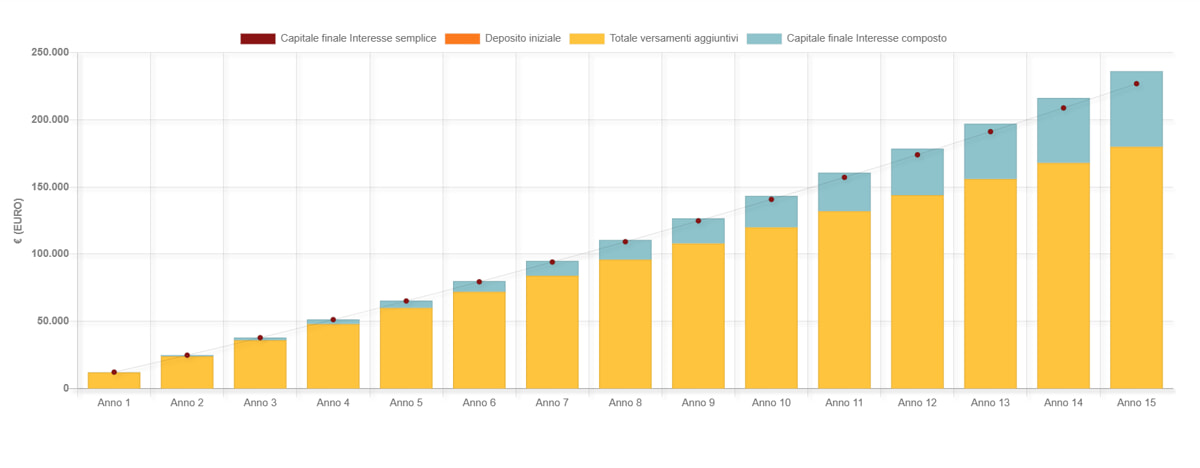
The comes to our aid simulator of the Bank of Italy. Considering the net nominal return, i.e. excluding inflation, in 15 years Giorgio can accumulate a capital of approximately 236 thousand euros, with a profit of 56,286 euros.
| Voice | Simple interest | Compound interest |
| Initial capital | €0.00 | €0.00 |
| Total additional payments | €180,000.00 | €180,000.00 |
| Total interest | €46,987.50 | €56,286.11 |
| Final capital | €226,987.50 | €236,286.11 |
All in all not bad. But now our Giorgio finds himself having to decide what to do with his money. And it is aimed at the real estate market. With what he has accumulated he can buy a two-room apartment and maybe even keep something aside for emergencies. Let’s suppose that our aspiring Fire lives in a provincial city in Northern Italy. Finally, let’s assume that by making an income from your investment you can earn 750 euros per month in rent.
And here comes the fun part: you have to take taxes into account. Giorgio will have to pay 21% tax for the rental (we opted for the dry tax) and the Imu: considering a realistic rate of 0.86% he will have to shell out 722 euros per year in Imu and 1,890 in tax, for a net profit per year of just 6,388 euros.
| Voice | Annual amount |
| Rental income | €9,000 |
| Dry coupon taxes 21% | €1,890 |
| IMU (0.86%) | €722 |
| Total tax expenditure | €2,612 |
| Net annual rental income | €9,000 – €2,612 ≈ €6,388 |
| Monthly net rental income | €6,388 / 12 ≈ €532 |
Not to mention that plan B also involves many unknowns: a defaulting tenant, extraordinary maintenance, as well as – if you look at the long-term investment – possible renovation costs whose cost is almost always a drain. Your home will most likely increase in value, but the “capital gain” effect could be eroded in whole or in part by inflation. Incidentally: if Giorgio decided to leave that money in government bonds and ETFs, without investing any more money and with the same average return of 3.5%, he would obtain around 659 euros per month in interest (simple and not compound) by withdrawing that sum every month.
| Initial capital | €226,000.00 |
| Total additional payments | €0.00 |
| Interest accrued over 10 years | €79,100.40 |
This is not to say that turning to the financial market is the most advantageous option. The variables can be infinite. Nor should it be forgotten that the 3.5% yield, however realistic, is not guaranteed. These are mere hypotheses, which however make a fact clear: aptitude for saving or not, leaving your job when you are “young” is too ambitious a goal for those who do not have a really significant salary.
To become financially independent there is another way: trying to do without money. Maybe not completely, but almost. While there are those who puzzle over their calculators, others have already moved on to the facts. To return to being masters of your own time, little may be enough: a ruin in the Apennines, a vegetable garden, some solar panels, a bit of savings and a wood stove. Maybe a little income. In addition to an ability to adapt not for everyone. But we don’t want to give you strange ideas.