

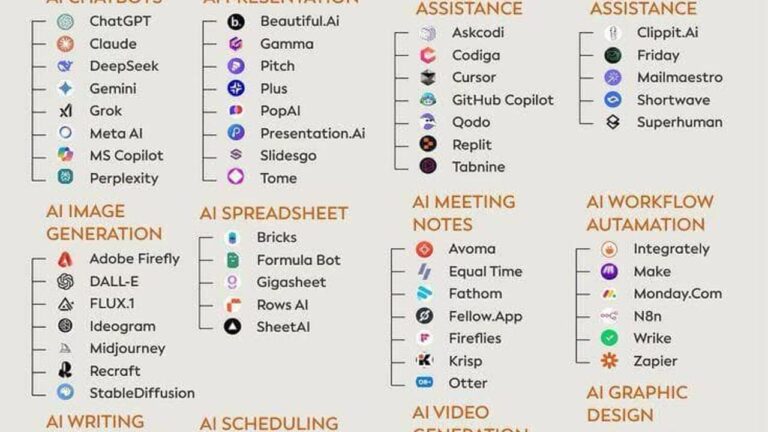
You don’t live on ChatGpt alone. In fact, there are artificial intelligence tools, free or paid, that help write texts, create high-impact images or graphics and so on. From the aforementioned ChatGpt, the best known and most used for creating content in just a few clicks, to Gemini developed by Google Deepmind, which has an integrated AI model in the Nano Banana application. From here, the opportunity to edit photos in an advanced and intuitive way through text prompts, but also to intervene on light, backgrounds, poses. Without necessarily having to have technical skills.
Choosing the right artificial intelligence for individual needs can seem like a huge challenge. But that’s not the case. There is plenty of time to learn how to use it, almost “wearing” it like a tailor-made suit. On the other hand, the word “artificial intelligence” was used for the first time in 1956 by the scholar John McCarthy as part of a series of conferences entitled “Dartmouth Summer Research Project on Ai”. Seventy years later, we’re here wondering: what AI should I look for? It’s not a little.
The Magnificent Seven
The choice of the best artificial intelligence for each of us depends on the work we do but also on our needs, including hobbies. A teacher, a student or a professional who writes a lot can rely on a chatbot based on generative Ai, such as ChatGpt, for support in preparing lessons, summaries or writing emails in a short time. So, which chatbot should you choose? Here, in strict alphabetical order, are our recommendations:
- ChatGpt: Launched on November 30, 2022, OpenAi’s ChatGpt has reached millions of users in every corner of the globe in a very short time. It attracted attention at the time thanks to its ability to answer user questions and create content on demand. Today it has not lost its appeal and, at a company level, it is useful above all for carrying out research and in-depth analysis, with particular reference to marketing campaigns.
- Copilot: arriving in Italy a year after ChatGpt, the Ai assistant “Microsoft 365 Copilot” automates multiple tasks: writing emails, creating presentations in PowerPoint, filling out tables in Excel. Explains JPGownder, vice president and principal analyst at consultancy Forrester Research: “The concept is that you are the ‘pilot,’ but the co-pilot is there to perform tasks that can make your life much easier.”
- Dall-E: Developed by OpenAi, the artificial intelligence algorithm generates images from text input. Along with recreational use, Dall-E can be used to create images for professional purposes. In particular, this neural network finds application in creative sectors such as design, fashion and interior design. Giving the professional and the simple enthusiast new sources of inspiration.
- Gemini: Google’s answer to OpenAi’s ChatGpt, the “Gemini” artificial intelligence assistant is useful for both “writing, brainstorming, generating images in real time” and for quickly summarizing and locating information from Gmail or Google Drive. Particularly tasty are its “Nano Banana” models, which transform illustrations and photos from textual prompts, and “NotebookLM”, useful for students to upload handouts and notes.
- Grok: defined as “an assistant powered by artificial intelligence, developed by xAi, designed to be maximally truthful, useful and curious”, Grok is the generative Ai of Elon Musk’s social A feature that differentiates it from other generative apps? It resides right in the access to all the data of the former Twitter platform. This allows it to provide users with updated answers (even with a humorous tone) on numerous topics.
- Midjourney: it has similar functionality to those of Dall-E, but is considered more performing in creating conceptual graphics images. That said, a specificity of Midjourney is that everyone can use it. You don’t need graphic designer skills or knowledge of digital graphics or Photoshop: simply enter the right text commands in the prompt to obtain the desired image in a very short time.
- Perplexity: Optimized for creating market reports and comparing academic sources, to give just two examples, Perplexity is a chatbot and conversational search engine that leverages OpenAa’s Gpt-4, Gpt-5, Claude, Gemini, Mistral and Llama2. There’s more. Very valuable in extracting value from data and, in marketing matters, in supporting those who create graphics.
No monsters to fight
Ultimately, the “right” artificial intelligence changes based on four elements: the intent we want to achieve, our sector, the time available, the resources to invest in the paid versions. Therefore, before approaching an AI tool, the question we should always ask ourselves is how this artificial intelligence could help us. Companies, professionals, students: everyone has their own “type” of Ai.
View this post on Instagram
Whatever you think, being overwhelmed by the fear of not knowing where to start is the wrong approach: artificial intelligence is not a “monster” like the one created by the user Jose Luis Rodriguez Mena on Instagram using Midjourney. Rather, it is a concrete and fascinating help, which if used in the best possible way can (really) make a difference. Try it to believe it.