

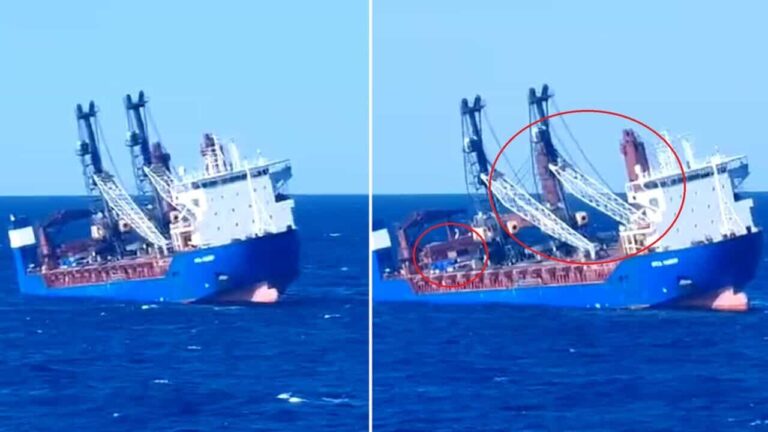
On December 23, 2024, a Russian cargo ship, the Ursa Major, sank in the waters of the Mediterranean Sea, about 100 kilometers from the Spanish coast, in still unclear circumstances. The ship left St. Petersburg and, according to official navigation data, was headed to Vladivostok, in the Far East. However, a CNN investigation revealed that the true destination could be the North Korean port of Rason and that “probably” the ship was carrying components for two nuclear reactors intended for Pyongyang’s submarines.
The shipowner: “Terrorist act”
Built in 2009, the Ursa Major – also known as Sparta 3 – set sail just two months after Kim Jong Un sent troops to support Russia’s invasion of Ukraine. According to the version provided by the Russian newspaper Kommersant, the ship was carrying a load of port cranes of 380 tons each, necessary for the expansion of the Russian terminal on the Pacific, on the border with China and Korea, as well as two doors necessary for the nuclear icebreaker Project 10510.
The operator and owner of the vessel is a company called SK-Yug, part of the Russian logistics giant Oboronlogistics. The owner’s thesis is that the Ursa Major was the victim of a “terrorist act”.
The Russian ship sank in the Mediterranean
So what happened on the day of the accident? According to what has been reconstructed, on 23 December – after a sudden deviation from course – the Ursa Major launched a distress signal due to three explosions on the right side, near the engine room, which killed two sailors, making the ship ungovernable.
The 14 surviving members escape to safety in a lifeboat and are picked up by the Salvamar Draco, a Spanish rescue ship. At 7.27pm a Spanish military ship also arrived to provide assistance, but half an hour later the Russian Ivan Gren, sent to escort the cargo, ordered the nearby boats to stay two nautical miles away. According to a source close to the investigation, the Ursa Major was stable and did not appear to sink anytime soon. At 9.50pm the Ivan Gren launches a series of red light flares, followed by four explosions. At that exact moment, seismic signals are also recorded in the same area. Shortly thereafter, at 11.10pm, the Ursa Major was declared sunk.
A Russian ship at the site of the shipwreck (and four other explosions)
However, the mysteries do not end there: a week later the Russian Yantar – officially a research vessel, but suspected of being an espionage unit – returns to the site of the shipwreck, staying above the wreck for five days. During this period – CNN writes again, citing a source familiar with the investigation – another four underwater explosions were detected, probably aimed at definitively destroying the sensitive cargo on the seabed to prevent its recovery.
The submarine reactors and the admission of the ship’s captain
So far the Spanish government has remained silent on the issue. The only official statement, reported by CNN, is in response to a question presented by some opposition parliamentarians. The note reports the version of the captain of the Ursa Major who, under pressure from Spanish investigators, made shocking revelations, according to which those indicated on the cargo manifest as ‘manhole covers’ were actually components for two nuclear reactors similar to those used by submarines. The man assured that the ship was not carrying nuclear fuel, information which, however, is difficult to verify.
The hypothesis is that the reactors would be used in Korean submarines as propulsion instead of old and noisy diesel engines. Designed to withstand enormous shocks and pressures, they are able to function without oxygen, thus allowing them to remain submerged for many months without having to resurface. For Pyongyang, a quantum leap in terms of military technology.
A Western action?
According to the Spanish investigation, the 50 centimeter hole found in the hull could have been caused by a Barracuda-type supercavitating torpedo, an advanced weapon supplied only to the United States, some NATO allies, Russia and Iran. The investigation seems to suggest that Western military action to prevent the transfer of nuclear technology to Pyongyang was behind the attack.
Then there is another piece of the puzzle that makes the reactor track much more than a suggestion. American aircraft specialized in the detection of nuclear radiation (the so-called Wc-135R “nuke sniffers”) flew over the area once on August 28 last year and again on February 6 this year. The Spanish government has never spoken of a risk of radioactive contamination on its coasts, a hypothesis which therefore seems to be excluded. However, the story presents many obscure points that will probably remain so. Also because the black box still lies at the bottom of the Mediterranean. THE remains of the Ursa Major, they explain from Madrid, have been located at 2,500 meters below sea level, a depth such as to make recovery impossible “without huge technical resources and risks”.