


Are there any US-funded biological laboratories in Ukraine? Yes, but in the declassified documents from the Trump administration there is no evidence of the existence of Ukrainian “secret biolaboratories” used to develop biological weapons, as Russian propaganda has claimed for years and as some accounts are now relaunching on social media.
Those laboratories “working on or harboring dangerous pathogens” mentioned in the papers made public by the director of US national intelligence, Tulsi Gabbard, were anything but secret. They exist in Ukraine, as in many other countries, for medical research, disease and public health monitoring, veterinary medicine, vaccine development.
The US program to support biological laboratories abroad
In the official statement, the Office of the director of national intelligence speaks of “more than 120 biolaboratories in over 30 countries”. Gabbard – presenting the publication as a revelation on an opaque global network of biolaboratories financed by the American taxpayer – uses very polemical tones by accusing previous administrations of having hidden information and links the story to the topic, very sensitive in the United States after Covid, of so-called gain-of-function research, i.e. experiments that can increase certain characteristics of a pathogen.
It is a theme that speaks to the Trump administration’s new line on risky biological research and to the distrust of experiments considered dangerous after the pandemic.
But when we move from the press release to the papers, the picture becomes more complex and much less explosive. The published document is made up of four slides, mostly obscured. The first concerns a veterinary institute in Kharkiv, indicated as a possible repository of some dangerous pathogens. The next slides talk about more than 40 Ukrainian laboratories “built and supported” by the United States, training provided to Ukrainian scientists to work in biocontainment, certifications for “particularly dangerous pathogens” and American investments in some diagnostic or reference laboratories.
Striking names appear inside the cards: anthrax, tularemia, tuberculosis, plague, Mers, Sars, Marburg, Ebola, Lassa. Read like this they seem like the inventory of an arsenal. But the presence of pathogens is not enough to talk about biological weapons. Public health, veterinary and research laboratories can store or study dangerous agents to recognize outbreaks, develop diagnostic capabilities, monitor animal and human diseases, and secure samples inherited from old Soviet programs. The difference between a laboratory working on a pathogen and a biological weapons program is enormous: in the first case we talk about diagnosis, biosecurity, epidemiological surveillance; in the second of development, production or storage of agents intended for military use. The declassified slides do not show this last step.
The context
Some information contained in the slides refers to bilateral agreements, Pentagon programs, publicly owned Ukrainian laboratories, contracts with companies such as Black & Veatch, fact sheets on diagnostic laboratories and reference centers. After the collapse of the USSR, the United States financed programs to reduce nuclear, chemical and biological threats in former Soviet countries.
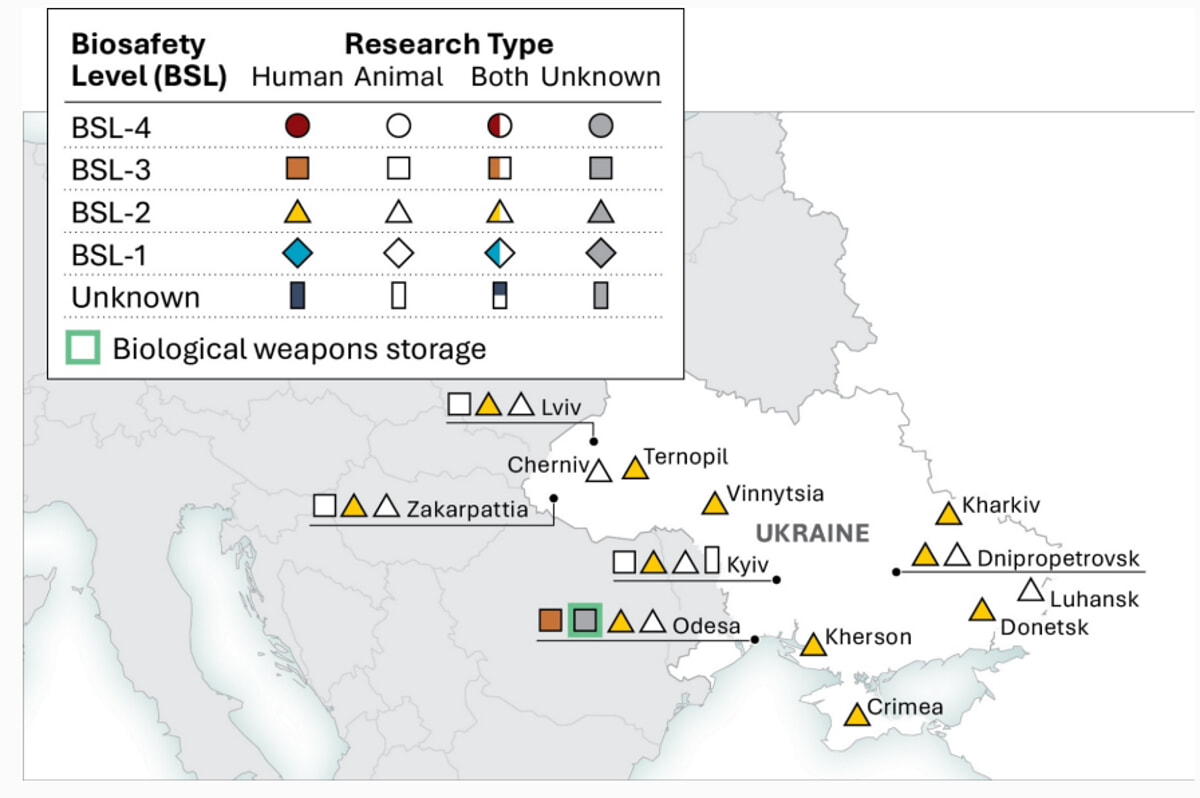
In Ukraine, the Pentagon’s biological program, known as the Biological threat reduction program, had been active since 2005. The stated goal was to help Kiev secure biological materials, improve civilian laboratories, strengthen its ability to detect epidemics and reduce the risk that pathogens could be stolen, dispersed or misused. It was no secret: the Pentagon had already published official sheets acknowledging support for 46 Ukrainian laboratories, health facilities and diagnostic sites. According to the official records of the US Department of Defense, the Ukrainian laboratories were owned and operated by the Ukrainian government, scientists were encouraged to publish research results. It’s a very different description from that of a clandestine network of military laboratories.
Russian propaganda
Russian propaganda on “Ukrainian biolaboratories” has been carried out by Moscow for years against various countries in the post-Soviet space that had chosen to cooperate with the United States or with Western institutions on biosafety programs. The most cited precedent is the Lugar Center in Tbilisi, Georgia, which has been the target of similar Russian accusations for years. There too, Moscow had spoken of an alleged facility used by the United States for suspicious biological activities. Georgia, however, opened the center to an international visit in 2018: twenty-two experts and observers from seventeen countries inspected the laboratory under the Biological Weapons Convention and concluded that the observed activities were consistent with prophylactic, protective and peaceful purposes. Russian experts had been invited, but Moscow chose not to participate.
The point, then, is not to deny that biological laboratories exist in Ukraine or that the United States has funded and supported them. This is true and was already known. And that doesn’t mean there aren’t serious issues. The maps indicate real risks: laboratories with dangerous pathogens in a country at war, sites vulnerable to Russian attacks, biosecurity problems in some facilities, the need to know precisely which samples are stored and under what conditions. These are national security and health issues, not irrelevant details. The Pentagon itself, in 2022, explained that after the Russian invasion the Ukrainian Ministry of Health had ordered the safe destruction of some samples to reduce the risk of accidental release in the event of bombings or occupation.
Trump throws himself a $60 million birthday party with ‘cage fights’