


Water has become an increasingly sophisticated consumption category. There is water for those who want to cook like a chef, one for those who train, one for those seeking wellbeing, one for those who want a nice bottle on the table, one for those who can afford to drink an iceberg.
Sea water can be bought at the supermarket
In the e-commerce section of the Tosano group, 5-litre packs of “Acqua dal Mare” are sold for 9.50 euros: 1.90 euros per litre. Not to drink it like table water, but to cook. Pasta, fish, shellfish, soups, dough, bread, pizza, brines. The product itself is nothing new: for years, star chefs – and aspiring ones – have started to embellish their gastronomic story, but the launch of the product on supermarket shelves is the perfect image to describe a rapidly expanding sector.
Let’s start immediately from a necessary premise: why should I buy sea water to cook spaghetti? For the avoidance of doubt, this is not yet another “social” idea of those who soak bruschetta and mozzarella on board the boat, a truly dangerous practice given the high content of chemical and microbiological pollutants, bacteria, microplastics, hydrocarbons, organic residues, but a “premium” product. Behind “Acqua dal Mare” there is a wine company, the Montespada agricultural company linked to the Venetian Albertini family, who in 1992 took over an estate in the heart of Gallura, in northern Sardinia.
What is sea water used for in cooking
As mentioned, edible sea water is not water collected with a bottle on the beach or a short distance from the coast: that can contain bacteria, contaminants, residues and unwanted substances. The product sold by Montespada (but also by many other companies, as we will see) for food use is instead treated, filtered, controlled and packaged sea water. It serves above all as a salting ingredient: instead of fresh water plus salt, a liquid that already contains mineral salts is used.
Chemically, seawater contains a more complex mixture of mineral salts than the simple salt solution obtained by adding sodium chloride to tap water. The most important difference is magnesium. There is much more of it in sea water than in homemade salt water. Magnesium can give a more “mineral” sensation, sometimes slightly bitter. Then there are sulphates, calcium, potassium and bicarbonates, which change the taste profile: it is not just salty, it is more “marine”. It is this composition that gives it a different flavor from the drier salinity of hand-added salt.
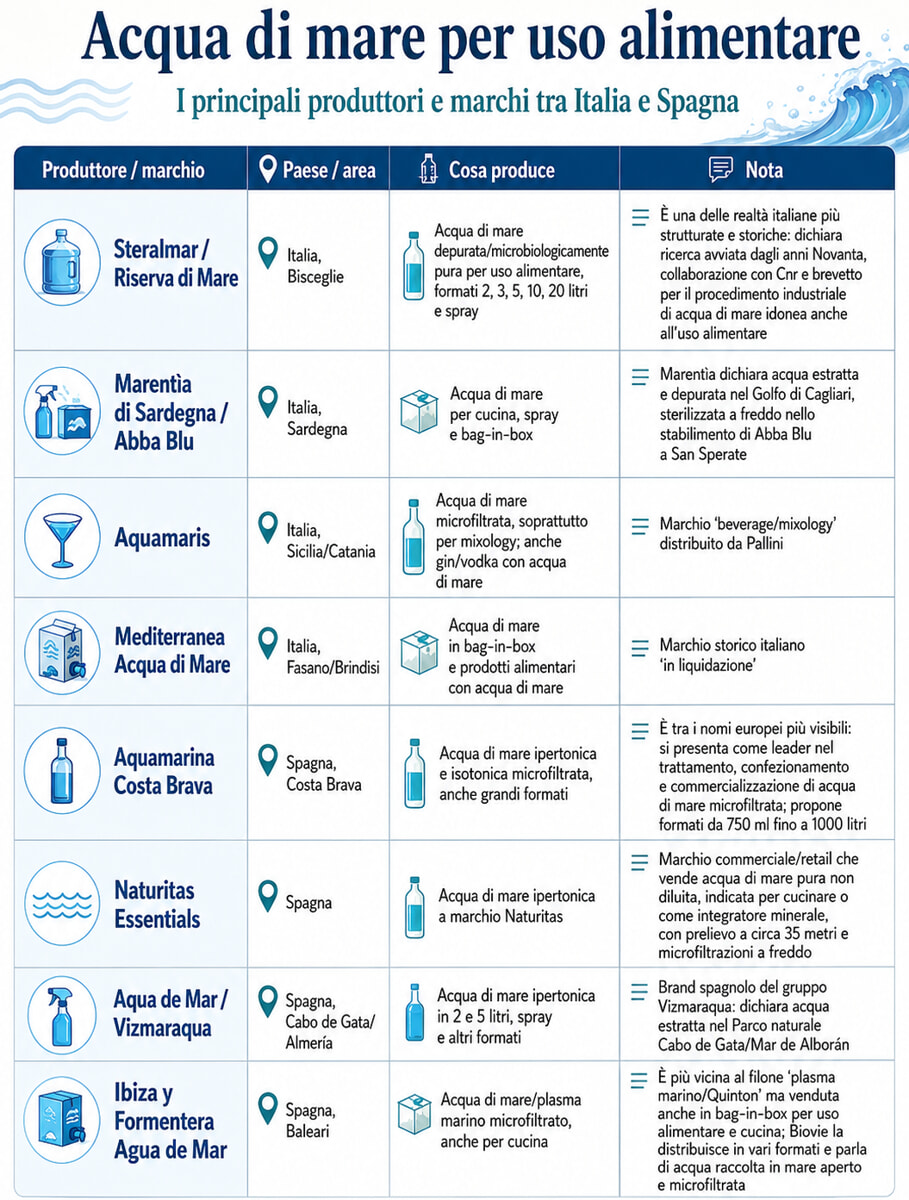
Producers propose it to prepare broths, fish soups, vegetables, shellfish, but also bread and pizza and to cook pasta and rice, although here the difference can be more subtle, especially if the seasoning is very tasty. It is also worth remembering that in many cases it is not used pure, but diluted with fresh water, because the salinity of sea water is high – around 35-38 grams of salts per liter – when usually around 7-10 grams of salt per liter are used for pasta.
In a nutshell: is it a commercial gimmick? In part yes. But the so-called premium water sector is a growing sector.
The special water market
Sea water is only the latest chapter of special waters. For years the shelves and online shops have been filled with special “waters”, whether alkaline, protein, vitamin, collagen, coconut, birch, hydrogenated, or flavoured. In some cases these are true mineral waters with a high ranking. In other cases they are functional drinks, i.e. products added with vitamins, proteins, zinc, collagen, plant extracts, flavorings or sweeteners.
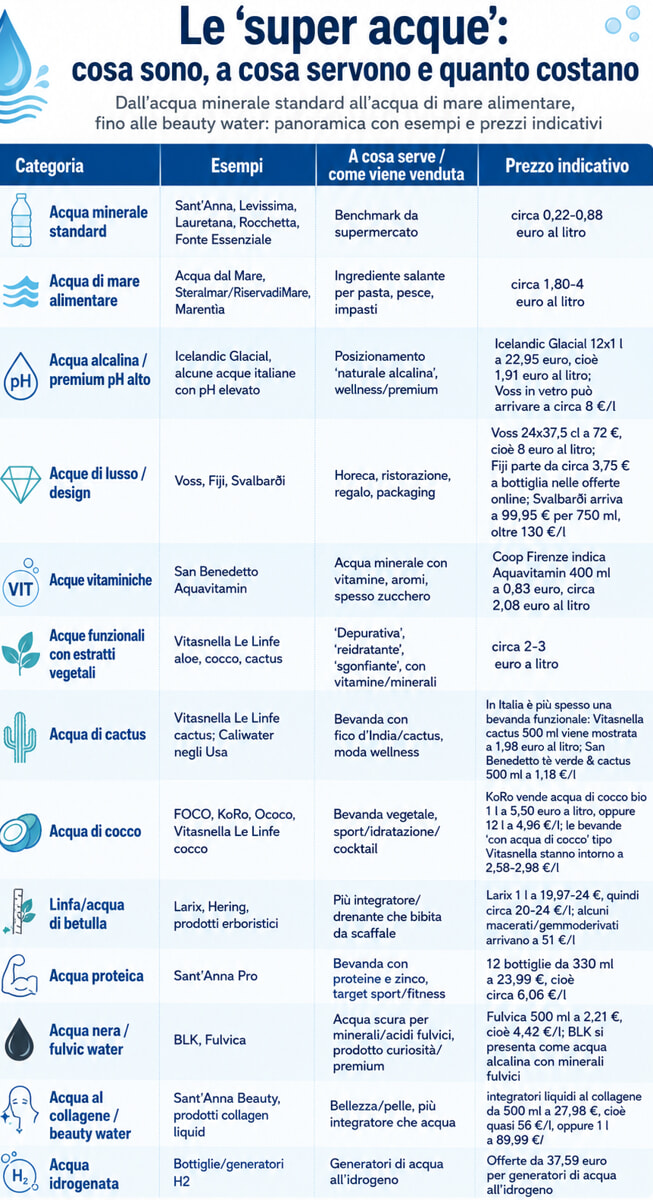
If common mineral water is priced around 25-40 cents per liter (even less on offer), some “wellness” or thermal waters reach around 80-90 cents per litre. Then we change category: sea water for cooking costs around 2 euros per litre; functional drinks often exceed 2 or 3 euros; protein waters cost around 6 euros per litre; the waters of luxury may rise further.
Because everyone wants to sell water
The industry numbers explain why more and more companies are entering this market. Globally, the functional and premium water segment is already worth several billion dollars and growing more than traditional mineral water: the consumer is willing to pay more if the water promises something beyond hydration. Thus, alongside protein waters, vitamin waters, flavored waters, those with plant extracts, those with aloe, coconut, cactus, magnesium, group B vitamins are also born. Then come beauty waters, with collagen or hyaluronic acid, designed to talk not only about hydration but also about skin, beauty, daily routine.
According to the market research agency Mordor Intelligence, the global functional water market was worth 9.12 billion dollars in 2025 and is expected to reach 15.04 billion in 2031, with an annual growth rate of 8.7%, while the premium water segment alone which was worth 30.53 billion dollars in 2025 could reach 49.06 billion in 2031.
The point, however, is not just how much the market is worth. That’s what it can do. Bottling classic mineral water is already a profitable business and in Italy is worth around 3.4 billion euros a year, but it is a mature sector where growing significantly is difficult. The most interesting growth is precisely in the adjacent segments: functional waters, flavored waters, premium waters, waters for specific food use. They are expanding niches that promise significant margins thanks to the promise of consuming not only water but proteins and mineral salts, or in other words well-being and performance. So if a 1.5 liter bottle of mineral water sold for 30 cents at the supermarket leaves producers with reduced margins offset by large volumes, a 330 milliliter bottle of protein water is instead sold for 1.99 euros.
Sant’Anna Pro, for example, is a drink with mineral water, proteins and zinc: a pack of 12 330 ml bottles is sold on the manufacturer’s shop for 23.99 euros, or 6 euros per litre. It is no longer mineral water: it is a drink for the gym, for a protein break, for “smart” consumption
Coconut water, birch and other “disguised” drinks
For luxury waters the situation is even more extreme. Svalbarði sells a 750 ml bottle for around 100 euros – over 130 euros per liter – promising to deliver pure water obtained from icebergs from the Svalbard islands to the table: the costs of collection, transport and packaging are certainly higher than normal spring water, but the final price belongs to the language of luxury. You pay for the history, the rarity, the experience.
The model is clear: the stronger the narrative – whether focused on health or performance rather than exclusivity – the further the price moves away from the real cost of the product. It is no coincidence that large beverage groups have invested in this segment over the years: Coca-Cola with Smartwater and Topo Chico, PepsiCo with Lifewtr and Bubly, Nestlé and Danone with their respective strategies on premium, flavored and functional waters. Water, after all, is the perfect product for premium: everyone drinks it, it costs relatively little to produce and the perceived value can be built almost entirely with branding, packaging and marketing.
The great cauldron of “super waters” also includes products that are not mineral water but vegetable drinks. Coconut water, for example, is sold as a natural product, to drink on its own or to use in smoothies and cocktails: online it can cost around 5.50 euros per litre. Birch sap, often placed among supplements and draining products, can cost much more: in some online pharmacies it can be found between 20 and 50 euros per litre, depending on the brand and format. They are different products, but united by the same commercial logic: taking a daily gesture, drinking, and transforming it into an identity-based consumption. Sporty, healthy, gourmet, premium, natural, exotic, purifying, beautiful to look at or photograph.
But are they really good?
Not all promises that revolve around “special waters” have the same weight. The documentable characteristics of a mineral water are one thing: fixed residue, sodium, mineral salts, origin. Another thing are marketing messages that suggest lightness, energy, purification, beauty or performance. Edible seawater, for example, should not be treated as a health drink. It is a salty ingredient. It can be interesting in the kitchen, but it contains salt and must be dosed.
The same principle applies to functional drinks: you need to read the label. Some contain proteins, vitamins or minerals; others have flavorings, sweeteners or sugars. Just because they are called “water” does not automatically mean that they are equivalent to mineral water.
The question, in the end, remains the same: how much are we willing to pay? There are those who will cook pasta in sea water for almost 2 euros a liter and those who will experience the thrill of sipping an iceberg spending even more than a hundred. In the middle there is a huge market where the story increasingly counts. Meanwhile, almost all the large Italian mineral water groups – Sanpellegrino/Nestlé, San Benedetto, Ferrarelle, Sant’Anna, Co.Ge.Di. – have launched or are launching functional or premium lines. It is not a niche phenomenon: it is an industrial strategy.
Dossier is the exclusive subscription investigative section of The Vermilion. If you want to support our journalistic work and subscribe, visit our showcase by clicking here.