

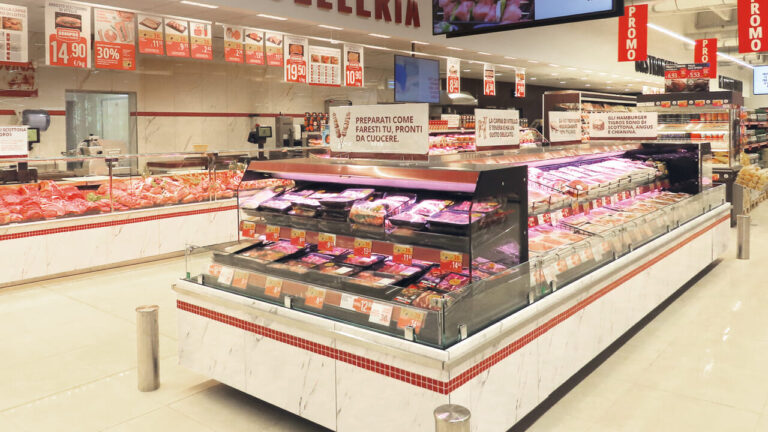
Eternal question: does it cost more to buy at the market or at the supermarket? Before answering, however, a premise is necessary. In fact, according to data from the Italian Consumer Center, food prices recorded a surge of around 25 percent compared to the period before the strong inflationary wave that began in 2021 and was further aggravated, in 2022, by the Russian invasion of Ukraine. The increases mainly affected basic necessities such as meat and fish. Translated into numbers, in 2026 filling the shopping cart costs on average 1,824 euros more than in 2021.
“Coloured boxes, frozen pink meat, there’s everything around me”, sings Lucio Battisti in the song Supermarket (1971). Just as these verses suggest, when you go shopping the choice is increasingly wider, but your wallet tends to shrink. The snapshot taken by the Italian Consumer Center, relating to the increase in prices of agri-food products in the last five years, shows that the average monthly expenditure of a family has gone from 480 euros in 2021 (data Istat) to 632 euros in February 2026. This is an increase of 152 euros per month, equal to 1,824 euros more per year (+32 percent).
What changes between supermarket and market
According to a survey by Nomisma, in 2025 the meat supply chains in Italy generated 13.8 billion euros of agricultural production, of which 8.8 billion attributable to beef and pork alone. The numbers speak clearly: Italians love meat. A Censis report reveals that 96.5 percent of citizens declare that they consume it: among these, 45.9 percent do so regularly, while 50.6 percent eat it from time to time. And this despite the undeniable increase in prices. In the last five years, a whole chicken has gone from 4.22 to 7.60 euros per kilo, while chicken legs have risen from 3.70 to 6.95 euros. The price of minced veal? It increased from 7.99 to 14.50 euros per kilo.
But do Italians prefer to buy meat at the butcher’s shop, in local market shops or at the supermarket? According to an analysis by Altroconsumo, 79 percent of Italians choose the butcher’s shop. A preference that inevitably translates into a higher expense, for various reasons: from the grinding carried out on the spot to the possibility of choosing the cut to be ground, from the shorter supply chain and greater traceability to the personalized service and higher management costs.
So, if in the butcher’s counter of a large supermarket and hypermarket chain like Carrefour ground beef is sold for around 12-13 euros per kilo in convenience packs, in a traditional butcher’s the price fluctuates between 16 and 22 euros per kilo, with even higher peaks in the case of fine breeds or selected meats.
Organic meat and short supply chain
If we only talk about prices, it is undeniable that in discount or in the most competitive supermarkets, especially during promotions, you can find the most convenient offers. “But if, in addition to the price, you also consider the quality level, the situation changes”, explains Gloria Nossa, sales manager at the Ridibio organic farm in Calvenzano (Bergamo), to Dossier The Vermilion. And he then goes into detail: “If you are looking, for example, for an Italian chicken breast from a controlled supply chain, it is likely that you can find it at a price equal to or even lower than the market or in a shop. The same goes for cured meats.”
In this regard, the data released by Assica, the meat and cured meats industrial association adhering to Confindustriarelating to the production and consumption of the sector in 2025, highlight a clear preference of Italians for cooked ham, which represents 28.1 percent of the total cured meats consumed. This is followed by cured raw ham (21 percent), the mortadella and frankfurters category (19.6 percent), salami and bresaola with 8.3 percent and 2.4 percent respectively.
Freshness can make the difference
Returning to meat, Nossa underlines: “If you opt for the biologicalit is true that the market price may be higher, but the quality is also superior. The same reasoning applies to many non-organic products: high-quality meat sold in the supermarket is often offered at high prices, while at the market or in the butcher’s shop you can find products with a controlled supply chain, meat that is predominantly Italian and, in many cases, processed directly by the butcher”.
Another aspect that is anything but negligible is the freshness of the meat. “Some time ago I bought a piece of veal at the butcher’s shop to prepare vitello tonnato, but I only cooked it four days later. Yet, the meat was still perfectly fresh. If I had bought it at the supermarket, I would have had to consume it much earlier.” Also up Reddit many consumers say they buy chicken and pork at the supermarket, where the prices are generally cheaper, instead reserving the butcher’s shop for quality cuts. “Butchers are more expensive, but if you are a true meat lover it’s worth it, at least to indulge in a treat every now and then,” writes one user.
However, it is good to remember that vacuum or modified atmosphere packaging can, in some cases, significantly prolong shelf life compared to simply wrapped meat.
Where to buy fish for less
Let’s continue our shopping and stop at the fish counter. According to the aforementioned Altroconsumo survey, in Italy around 50 percent of people buy fish at fishmongers. The study also shows which aspects are most considered at the time of purchase: the visual aspect (72 percent), the conservation methods (53 percent) and the geographical origin (34 percent).
Last January, Altroconsumo itself presented the results of the annual ranking of the supermarkets, discount stores and local brands most appreciated by Italians. For the quality of the fish, but also of the meat, the choice falls on Borello Supermercati, Piedmontese company that has been operating in the large-scale retail sector since 1972.
As noted by Ismea, the Institute of Services for the Agricultural Food Market, in the fresh fish segment consumers tend to be more loyal to the point of sale, be it the fishmonger or the fish counter in the supermarket, rather than to the brand of the product. However, one question remains: where can you save the most? “It must be recognized that, in several cases, prices are aligned with those of the main large-scale retail trade brands (Large-scale distribution), like Coop or Esselunga”, replies the expert.
Sea bream, sole and turbot: how prices change
On the price front: farmed sea bream can cost between 13 and 18 euros per kilo in the fish shop and between 9 and 14 euros per kilo in the supermarket; sole between 20 and 35 euros per kilo in the fish shop and between 12 and 25 euros per kilo in the supermarket; turbot costs between 30 and 45 euros per kilo in the fish shop and between 20 and 35 euros per kilo in the supermarket. “However, let’s consider that the fish sold in fishmongers or at the market has a different quality level, thanks to a shorter supply chain”, explains Nossa.
But what are the most requested products? The response from the sales assistant at the Ridibio organic farm comes immediately: “I would say the more traditional ones, such as sea bream, sea bass, cod and anchovies, as well as molluscs, for example mussels. It being understood that, as with meat, many customers buy fish at the market once a week and, if necessary, freeze it to consume it in the following days.”
Dossier is the exclusive subscription investigative section of The Vermilion. If you want to support our journalistic work and subscribe, Click here.