

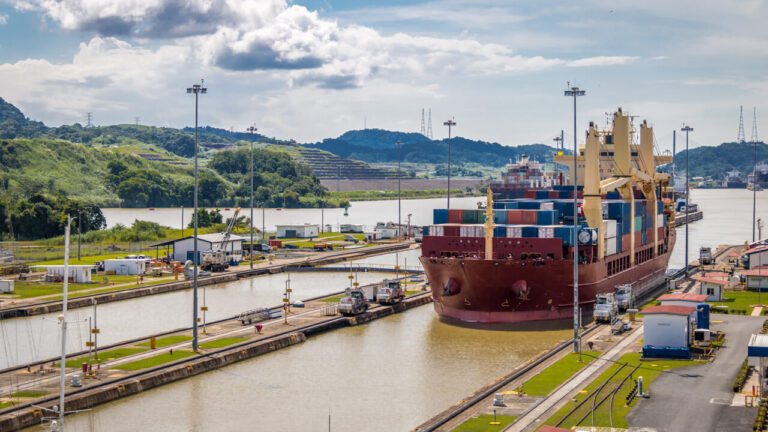
The drought puts pressure on one of the most delicate points of world trade. The Panama Canal will reduce the number of ships that can pass through it each day due to poor rainfall and a strengthening El Niño. A decision that brings to mind the 2023-2024 crisis, when the too low level of the basins forced dozens of ships to wait or choose much longer routes.
From 3 September the Canal Authority will make available 9 daily slots in the new Neopanamax locks and 25 in the old Panamax, for a total of 34 passages per day. From September 15th the Panamax slots will drop to 23 and the overall limit will therefore reach 32 ships per day. In the first six months of 2026 traffic had averaged around 35 ships per day, while the system can handle around 40 under favorable conditions.
Why is there no water in the Panama Canal
The problem lies in the functioning of the Canal itself. In fact, to raise and lower ships in the locks, an enormous quantity of fresh water is needed, coming mainly from Lake Gatún and from the system of artificial basins that feeds the infrastructure and which at the same time provides drinking water to a significant part of the Panamanian population.
The rainy season has already begun, but it is not bringing the hoped-for water. According to data released by the Authority, between May and August rainfall was 34% lower than the historical average, while the water flowing into the basin was even 44% below normal levels. Complicating the situation is El Niño, which in Central America tends to favor warmer and drier conditions.
The “monster” that makes scientists tremble: El Niño may become the strongest in history
The Authority had already begun to limit the draft of ships, i.e. the maximum depth reached by the hull in the water. Less water in the lakes means that larger ships have to travel with less cargo to avoid the risk of hitting the bottom. Some of these further restrictions have been postponed for now: the limit of 14.63 meters for Neopanamaxes will come into force on September 2nd, while the following limit of 14.48 meters has been moved to October 1st.
Why the Panama blockade could weigh on prices
The Canal is anything but a local issue. About 5% of global maritime trade passes through this strip of water which allows ships to move between the Atlantic and Pacific without circumnavigating South America. For the United States, the dependence is even greater: approximately 40% of American container traffic uses this route.
Fewer slots potentially mean more queues, higher transportation costs and longer delivery times. The Authority itself warns that ships arriving without a reservation may have to wait longer.
The precedent is that of 2023. During the great drought caused by El Niño, Panama drastically reduced daily passages: in December of that year, just 22 ships were authorized per day, compared to around 36 in a normal situation. The result was queues, million-dollar auctions to obtain a seat and diversions to alternative routes.
And this is precisely the scenario that Panama is trying to avoid. But the Authority has already warned that other restrictions cannot be ruled out if rainfall continues to be insufficient in the coming weeks.
The risk for world trade
The news comes at the worst possible time: on the other side of the world, the war with Iran has almost paralyzed the Strait of Hormuz, while Houthi attacks make passage through Bab el-Mandeb, the southern gateway to the Red Sea and therefore the Suez Canal, increasingly dangerous.
Three different bottlenecks, for completely different reasons, are simultaneously compressing the planet’s major trade routes. If multiple strategic steps simultaneously lose capacity, alternative routes begin to burden each other. The consequences can ripple along the entire chain: a ship that takes ten, twenty or thirty days longer to complete one voyage is not available for the next one. To transport the same quantity of goods, more ships are needed. The demand for cargo is increasing, freight rates, fuel consumed and insurance premiums are growing. And a part of these increased costs inevitably ends up on the companies that import the goods and, subsequently, on prices.