

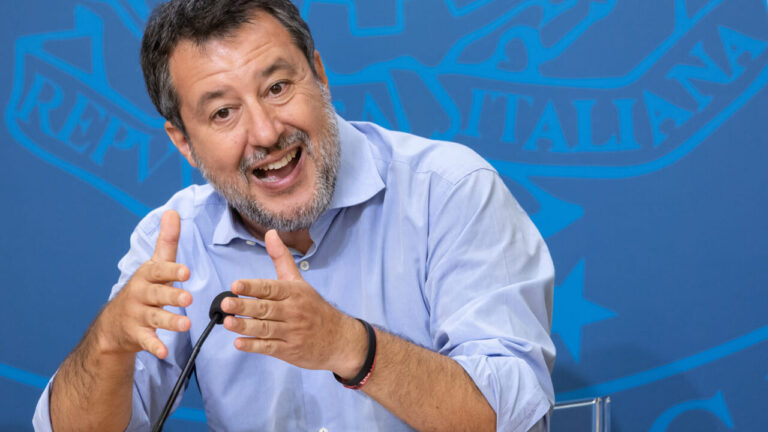
Five percent of profits, for three years, to be requested from the ten largest Italian banks. The secretary of the League Matteo Salvini puts his proposal for the next budget law on the table and reopens a dossier that had already created more than one tension within the majority in the past.
“As the League we will ask for a three-year contribution from the top ten Italian banks”, announced the deputy prime minister during a visit to the Pigneto station construction site in Rome. His hypothesis is simple: take around 30 billion in total profits as a reference and ask the institutions for 5% each year. If the base remained the one indicated by Salvini, it would mean around 1.5 billion euros per year and 4.5 billion in three years.
Almost 12 billion in profits in six months for Intesa and UniCredit
What convinces Salvini above all is the latest financial statements of the banks. UniCredit closed the first six months of 2026 with approximately 6.3 billion euros in net profit, while Intesa Sanpaolo achieved approximately 5.6 billion. Together they therefore reach just under 12 billion. And broadening our gaze to the five largest groups – Intesa, UniCredit, Banco Bpm, Mps and Bper – net profits in the first half of the year exceeded 15 billion overall.
“I saw the two half-yearly reports of the two largest Italian banks which made profits of almost 12 billion in the first half of the year”
Matteo Salvini, leader of the League
According to Salvini there would therefore be space to ask for a new contribution to the sector. The leader of the League maintains that part of the banks’ results is also linked to public guarantees and above all to the difference between what the institutions collect by lending money and what they recognize to savers on deposits. It is the topic of the interest margin, one of the main sources of revenue of the banking system.
The Spanish model cited by Salvini
Salvini explicitly indicated a precedent, the tax introduced by Spanish legislation which affects the positive margin deriving from interest and commissions for three years, with an exemption of 100 million euros and progressive rates: from 1% for the first bracket up to 7% for the part of the tax base exceeding 5 billion.
“I don’t agree with anything about the Sánchez government except the economic intervention they have made on their banks” said Salvini who therefore takes the political principle from Spain – asking for an additional contribution from the big banks – but proposes a different mechanism for Italy.
With that money Salvini wants more soldiers in the cities
There is also already a possible allocation of resources. Salvini would like to use part of it for security and, in particular, to “double the Strade Sicure military”. “With 2 billion you can do a lot”, claimed the deputy prime minister. In the previous days, the leader of the League had also proposed asking the banks for money to finance interventions on pensions, salaries and the cost of living and had also indicated the credit institutions as a possible source of the resources necessary to extend the cut in excise duties on fuel.
Furthermore, it would not be the first intervention in the financial sector. The budget for 2026 has already asked for a substantial contribution from banks and insurance companies through various tax mechanisms.
The problem is called Forza Italia
Salvini says he is sure of the support of the allies: “I am convinced that the entire majority will accompany us”. But it is precisely on this point that the proposal could encounter the greatest difficulties. Forza Italia has repeatedly contested the idea of a real tax on extra bank profits. During the discussion on the 2026 budget, Antonio Tajani went so far as to define the very concept of a tax on extra profits “from the Soviet Union”, while subsequently accepting the compromise reached by the majority on the contribution of the financial sector.
For the more liberal wing of the majority, the risk is that the introduction of a new tax levy could be passed on, at least in part, to customers through less favorable conditions, commissions or more expensive credit. However, the real discussion will arrive in September, with the start of the debate on the budget law. Giorgia Meloni today indicated the government’s three economic priorities for the recovery: “Ease taxes, strengthen purchasing power and encourage increasingly stable employment”.
It remains to be seen whether, in order to find the money needed to reduce taxes for Italians, the majority will be willing to increase them for the banks.
Record profits but high costs for account holders: why banks are increasingly “richer”