

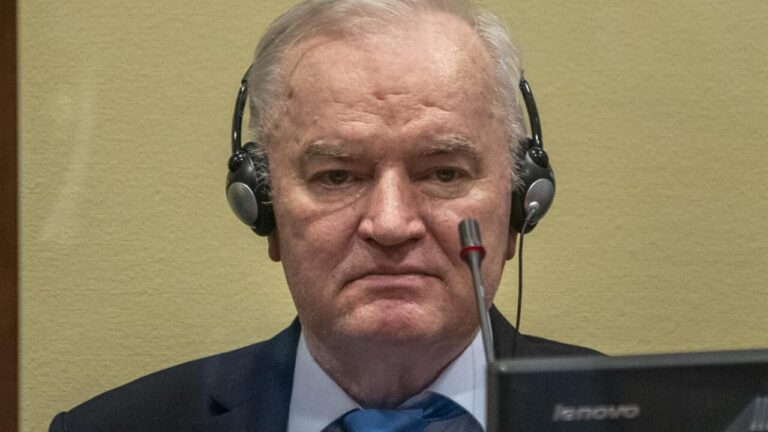
Ratko Mladić will receive military and state honors. This was announced by the Serbian Minister of Justice, Nenad Vujić, specifying that it will be up to the family of the former Bosnian Serb commander to decide the place and manner of the funeral.
The Serbian Prime Minister’s statement and Belgrade’s requests
“We are ready to leave for The Hague as soon as we know what the next steps will be, in full respect of the family’s wishes,” Vujić told K1 television. The Serbian government, he added, is in constant contact with Mladić’s relatives.
The former general died in The Hague, where he was serving a life sentence for genocide, crimes against humanity and war crimes. The president of the International Residual Mechanism for Criminal Courts, Graciela Gatti Santana, has ordered an investigation into the circumstances of the death. This is the normal procedure when a prisoner dies in court custody.
However, Belgrade requests that the investigations are not limited to establishing the clinical cause of death. Vujić announced the sending of a letter to the Hague mechanism to ask it to also verify whether Mladić received adequate care in the last days of his life.
According to the minister, since August 20, Serbia had sent four letters seeking his release for humanitarian reasons. The doctors at the penitentiary hospital have already reported the need for palliative care and invited the family to reach The Hague as soon as possible.
“All signs pointed to the end being near,” Vujić said. The Serbian government had therefore asked that Mladić be able to spend his last days in his homeland, arguing that, in a terminal phase, palliative care should also include the closeness of family members. The guarantees necessary for the transfer, the minister assured, had been provided with the support of President Aleksandar Vučić.
Who was Ratko Mladić
Ratko Mladić was the commander of the army of the Bosnian Serb Republic during the war fought between 1992 and 1995. He is considered one of those most responsible for the atrocities committed during the conflict and the symbol of the ethnic cleansing campaign conducted against Bosnian Muslims and Croats.
His name remains linked above all to the siege of Sarajevo, the longest in modern history which caused the death of over 11 thousand people and around two thousand children and to the Srebrenica massacre. In July 1995, forces under his command captured the UN-protected enclave and killed more than 8,000 Muslim men and boys. The massacre was recognized by international justice as genocide.
After the war Mladić remained a fugitive for sixteen years, until his arrest in Serbia in 2011. In 2017 the International Criminal Tribunal for the former Yugoslavia sentenced him to life imprisonment; the sentence was definitively confirmed on appeal in 2021.
Mladić has never acknowledged his responsibilities. For the families of the victims he remains the main face of the Srebrenica genocide, while part of Serbian nationalism continues to consider him a hero.
In Belgrade, some media note, hundreds of writings have appeared on the walls praising the general who died yesterday in The Hague. Last night some young people displayed a large banner from the Branko bridge, which connects the old city with New Belgrade on the Sava river, with a photo of Mladic in uniform giving the military salute and the slogan “From your struggle lives our freedom”, accompanied by the lighting of smoke bombs. Progressive political forces and the student movement are opposed to this “celebration”.
A contrast that makes Belgrade’s decision to reserve military and state honors for him nothing short of “incandescent”.