

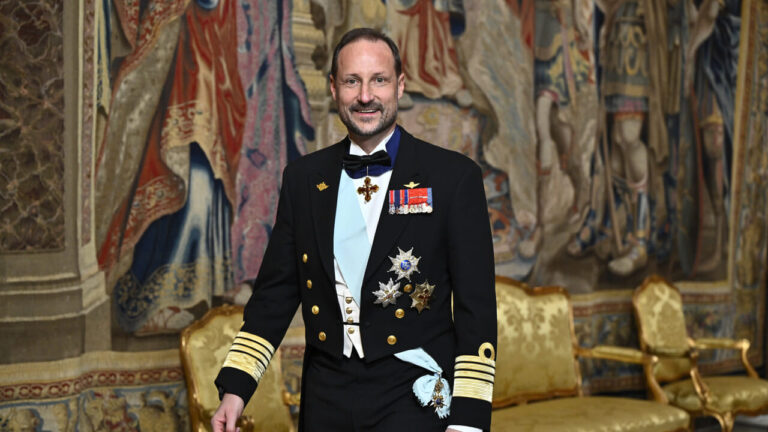
The death of King Harald V closes an era for Norway and opens another, much more complicated one. At 89 years old, the sovereign who had led the country since 1991 leaves the throne to his son Haakon, who becomes king at the worst moment for the royal family: between the Epstein case involving his wife Mette-Marit, the conviction of her son Marius Borg Høiby and a trust in the monarchy that has shown deep cracks in recent months.
The death of King Harald V
“It is with deep sorrow that we announce the passing of His Majesty King Harald,” the Norwegian Royal Palace said. The sovereign died on Friday 28 August at 6.35 am at Oslo University Hospital, where he had been hospitalized for several days. In the previous hours the Royal House had announced a clear worsening of his conditions. Queen Sonja and Crown Prince Haakon, former regent, had canceled all public engagements.
With Harald’s death, Haakon automatically became the new king of Norway.
The king who didn’t want to abdicate
Harald V had ascended the throne in 1991 and was Europe’s oldest reigning monarch. Since August 17 he had been hospitalized for hemolytic anemia, a pathology characterized by too rapid destruction of red blood cells. In recent years he had had several health problems: in 2003 he had undergone surgery for bladder cancer, while in 2024 he had a pacemaker implanted.
Despite his age and physical condition, he had always ruled out abdication. Harald claimed to have sworn a life-long oath before Parliament. However, his death gives his son a very different monarchy from the one he inherited over thirty years ago.
Mette-Marit and the Epstein case
The most delicate problem for the new king concerns his wife. The documents published in the United States on the Jeffrey Epstein case have revealed a dense network of contacts between the American financier and Mette-Marit. The princess had corresponded with Epstein between 2011 and 2014, when the man had already been convicted of sexual crimes. In the documents released by the American authorities, Mette-Marit’s name appears hundreds of times, along with numerous email exchanges.
The news caused an earthquake in Norway. Prime Minister Jonas Gahr Støre also intervened publicly, speaking of “poor judgement” on the princess’s part. Particularly harsh words in a country in which the government traditionally maintains a strong distance from the private affairs of the Royal House.
Mette-Marit later expressed “deep regret” for her friendship with Epstein and apologized for the consequences caused to the royal family.
The Marius Borg Høiby case
As if that wasn’t enough, in the same months the royal family was also overwhelmed by the legal case of Marius Borg Høiby, Mette-Marit’s son born from a relationship prior to her marriage to Haakon. Høiby, 29, was sentenced at first instance in June to four years in prison for numerous crimes, including two rapes and violence against a former partner.
Marius has no noble titles and does not hold official positions in the monarchy, but his closeness to the royal family has transformed the trial into one of the most followed cases in recent years in Norway.
The new queen’s illness
Mette-Marit’s health condition also makes the beginning of Haakon’s reign even more complex. The new queen has suffered from chronic pulmonary fibrosis for years and underwent a lung transplant in June 2026. After several weeks of hospitalization she was discharged in July.
His personal story had already caused discussion before the wedding. When her engagement to Haakon was announced in 2000, Mette-Marit was a single mother. He had also openly talked about a difficult youth, admitting that he frequented environments where drugs were circulating and publicly distancing himself from his past.
The most difficult crown for Haakon
This is the paradox of the Norwegian succession. Harald leaves the throne after remaining one of the country’s most popular figures for decades. Haakon picks it up just as the royal family is going through one of its most fragile moments.
The Epstein case, the Høiby trial and Mette-Marit’s health conditions risk accompanying the new sovereign for a long time. The death of Harald V therefore not only opens a new kingdom. He also leaves Haakon with a much more difficult mission: to prevent the family’s scandals from transforming the monarchy’s image crisis into a crisis of the monarchy itself.