

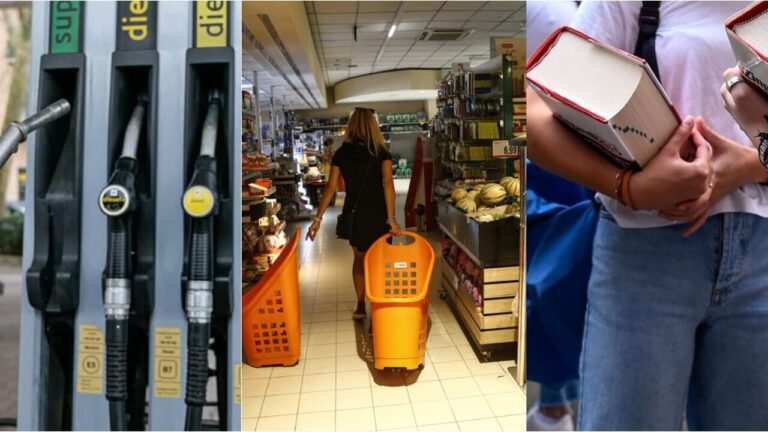
The return from summer holidays will be traumatic for families, not only because of the return to work and everyday routine. The widespread increases in costs, ranging from electricity and gas bills to school, food and transport costs, will weigh heavily on shoulders (and wallets). A “perfect storm” caused above all by the conflict in the Middle East and the blockade of the Strait of Hormuz.
The autumn blow
The surge in energy markets has pushed inflation, triggering a series of increases that will have serious repercussions in the autumn period. An alarm also raised by Federconsumatori: “As expected, the inflation rate in August rose to 3.3% on an annual basis. An increase that is affected by international tensions on the prices of energy goods, both unregulated (the rate of which goes from +11.4% to +16.9%) and regulated (from +14.8% to +18.8%), costs which will have a particularly heavy impact as the autumn season approaches. With these levels of inflation the consequences for each family will amount to +1,089 euros per year. Increases which add to those suffered in recent years, in the face of stagnant salaries and pensions. As if that were not enough, in September the expenses of many families are aggravated by the return to school, with expenses that can reach, between texts and school supplies, 1,219 euros per child”.
Petrol and diesel, updated prices
Among the main items there are obviously fuels. Even today, the prices of petrol and diesel continue to rise, with Ip increasing the price of green fuel by two cents and diesel by three cents, Q8 and Tamoil by one cent for petrol and two cents for diesel. In particular, based on updated Mimit data, the national average price of self-service petrol is today, Thursday 3 September, 2.039 euros/litre (compared to 2.027 euros/litre on 2 September) and that of self-service diesel is 2.147 euros/litre (compared to 2.131 on 2 September). On the motorway network, the national average price of self-service petrol is 2.124 euros/litre (compared to 2.110) and that of self-service diesel is 2.221 euros/litre (compared to 2.206).
Filling up more and more expensive
While waiting to understand whether a further extension of the discount introduced by the government will arrive, the situation remains alarming, as underlined by the president of the UNC (National Consumers Union): “In just 2 days on the road network, a 50 liter tank costs 85 cents more, both for petrol and diesel. On the motorway, diesel fuel costs 85 cents more while petrol is even 1 euro more. In just one day, from yesterday to today, a refueling of diesel increases by 75 cents highway and 80 on normal roads, petrol, respectively, 70 and 60 cents”.
The president also raises a strong alarm about the expiry of the government’s micro-measures: “If the Meloni government did not renew the discount, on 6 September diesel fuel would reach 2,392 on the motorway, just shy of 2.4 euros, and 2,318 on normal roads”. Dona’s attack then shifts to the overall management of tax flows: “In short, ridiculous allocations such as the 14.5 million needed for the fuel bonus for workers included in the fuel decree of January 2023 are not enough, motorists must be given back the extra VAT they paid from March to August 2026 compared to that paid in the same months of 2025, instead of making phony calculations as they do now, lowering the excise taxes of 30 cents for diesel and 15 cents for petrol”.
Gas and electricity bills
The pressure on consumers will also be felt on their bills. According to Altroconsumo, in 12-month fixed price offers, the most widespread type of contract for energy, the average price of the raw material grew, between June and August, from 13.1 to 13.6 cents, with an increase of 4% in just two months. How much will your bills increase? According to Nomisma estimates, cited by Corriere della Sera, in 2026 Italian families could face a higher expense of 110 euros for electricity (+14%) and 347 euros for gas (+30%) compared to last year. Instead, according to Facile.it estimates, between September and 2019 a typical family on the free market with indexed prices could spend 982 euros on electricity and gas, 270 euros more than in the same period last year, with an increase of up to 40%. In detail, the estimated expenditure for electricity is 273 euros (+27%), that for gas is 709 euros (+43%).
Transportation and airline tickets
The cascade effects will also be felt on transport. From February to July, according to Istat data, prices in the sector grew on average by 5.4% in Italy. Domestic flights saw a 6.2% year-on-year increase in July, while European and international flight prices fell. The situation could worsen in the first few months, with the increase in the cost of fuel which could also push up the prices of airline tickets. City transport is also destined to increase in price in various areas of the country: in Lombardy Trenord railway services will increase by 3.889% and local public transport by 1.857%, while in the province of Venice the expected increase is between 5 and 10%. Already in force, however, are the increases in Campania (+5.8%) and Emilia-Romagna (+1.32%).
The shopping cart
The impact on food goods is also inevitable, given that energy and transport affect the entire supply chain. The consequences could be very serious, as also underlined in a note from Federconsumatori: “Families, in this scenario, are forced to cut, even on energy and food consumption, vital and indispensable goods that are no longer within everyone’s reach. It is necessary and urgent for the government to return to taking care of families by immediately initiating concrete measures to support purchasing power”.
“What is needed is the adoption of a suitable excise duty cut – continues the note -, of at least 20 cents on petrol and at least 25 on diesel, for an adequate period of time and not in a spot manner, for a few days, as done so far; a remodulation, even temporary, of the VAT rates on a basket of essential goods (with a saving that the ONF has calculated at over 530 euros per year per family); a more substantial energy bonus, and extended to an audience of families; the creation of a Fund to combat energy and food poverty to help and support the most vulnerable families; monitoring, controls and sanctioning interventions against speculation along the supply chains, in particular for consumer products and fuel; a fair tax reform, truly aimed at supporting low incomes and medium incomes, those hit hardest by these dynamics;
School and books
September is also the month of going back to school, which promptly translates into a drain on family budgets. According to the latest monitoring by the Eures-Adoc Observatory, conducted on over 3,500 texts in 100 high schools, the overall expenditure of Italian families for textbooks alone will reach the record figure of 1 billion euros (800 million for new volumes and 200 million for used ones), to which must be added at least another 200 million euros for dictionaries, technical equipment and stationery. The average annual expenditure on books is growing everywhere, standing at 217 euros for middle schools (+0.9%) and 342 euros for high schools (+3.3% compared to the previous year).
The economic impact is concentrated above all in the entry classes of the new cycles: the first year costs on average 323 euros in middle school and rises to 393 euros in high school. The choice of major accentuates the economic differences: classical high school is confirmed as the most expensive path with an annual average of 392 euros (almost 2,000 euros for the entire five-year period), exceeding the expenditure of technical institutes by 42% (276 euros on average per year). If the complete school kit is included, the expense for a student starting high school reaches 928 euros and exceeds 1,000 euros for classical high school. For large families with two children starting different cycles, the total expense for returning to school exceeds 1,500 euros.
The survey also highlights a territorial paradox: studying costs significantly more in the South (with average peaks of 375 euros per year in high school, compared to 316 euros in the North), the area of the country which historically records the lowest incomes and where the most noticeable price growth has occurred in the last two years (+23.4%). A situation aggravated by the absence of tax deductions on education, a sector in which Italy ranks last in Europe in terms of its impact on GDP.