

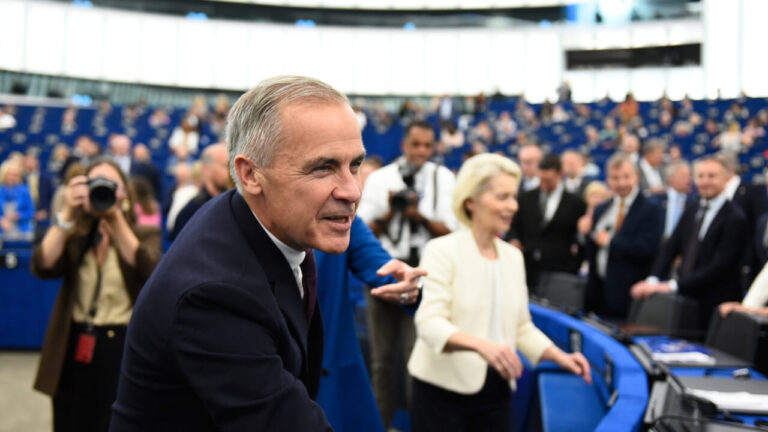
The European Commission intends to work with Canada to become the “first associate member” of the EU. In her speech on the state of the European Union, in Strasbourg, the president of the commission Ursula von der Leyen effectively opened the door to an integration of the North American country into the economy of the European Union. But at least for now, Canada will not become a de facto member.
The context
Von der Leyen’s move comes in a difficult international context for Canada given the failure of trade negotiations with the United States. Just a week ago there was yet another chapter in the conflict, with President Trump deciding to raise duties on some Canadian goods to 50 percent in response to a similar crackdown from Ottawa. In the past, the head of the White House had repeatedly raised the possibility of making Canada “the 51st American state”, using the threat of tariffs to demonstrate how much the Canadian economy depends on the US one.
It is precisely to counter these pressures and Washington’s commercial unpredictability that Ottawa has begun seeking an unprecedented alliance with the European Union. To compensate for the progressive distancing from the historic North American partner, Canadian Prime Minister Mark Carney has already started confidential talks with the main European leaders in recent weeks. His presence at the Strasbourg plenary as “guest of honour” was certainly not accidental.
von der Leyen’s invitation
“We must urgently rethink our partnerships” said von der Leyen, addressing Carney. “I would therefore like to work with you to pave the way for Canada to become the first associate member of the EU. We share an ocean, values and a vision of the world. And now we will also build our common future together.”
Dear @MarkJCarney we want to bring the relationship with Canada to the highest level possible.
I would like to work with you on opening the door for Canada to be the first associate member of the EU.
And create a common prosperity and economic security space. pic.twitter.com/GqIjGBz6aY
— Ursula von der Leyen (@vonderleyen) September 16, 2026
“Dear Mark, Europe and Canada believe in democracy” he added. “We believe that power does not belong to the strongest, the richest or those who shout the loudest, but to all of us. Let democracies have the freedom to choose who they work with.”
What does “associate member” of the EU mean?
From a formal point of view, the status of “associate member” does not exist, therefore one can only make inferences on the subject. Von der Leyen’s expression seems to refer to a hypothesis of very close cooperation, based on commercial agreements and adherence to common values. A free trade program, Ceta, already exists, but with the new acceleration given by Carney and von der Leyen, relations between the two economies could become closer.
Von der Leyen listed the priorities of the agreement: advanced manufacturing, technology, defense, Arctic, energy, critical minerals, batteries, artificial intelligence, quantum computing, cybersecurity and economic security. According to Euronews, Ottawa is already in talks with Brussels to join the Erasmus+ exchange programme, Horizon Europe research funding and mutual recognition of workers’ qualifications.
In any case, the status of “associate member” is not yet clear. The EU already has collaboration agreements with third countries such as Norway and Switzerland (which however do not have the right to speak on European legislation), but von der Leyen’s words seem to allude to an even deeper integration.