

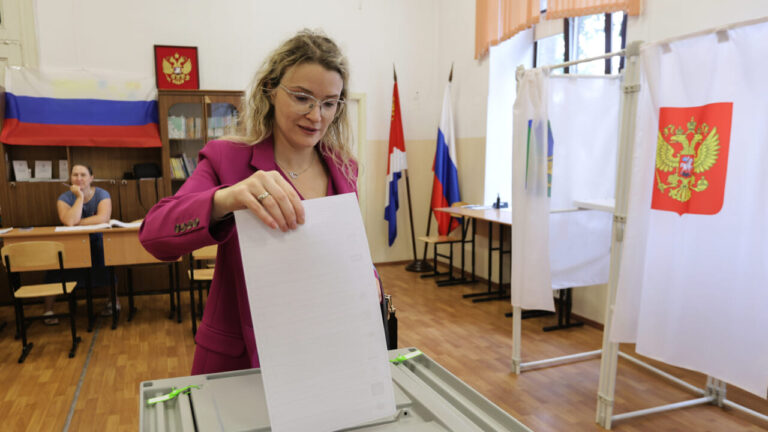
Parliamentary elections will be held from 18 to 20 September in Russia and in the occupied Ukrainian territories. Citizens will vote for the renewal of deputies of the Duma, the lower house of the Russian Parliament. Although Vladimir Putin is keen to call citizens to the polls, there is very little that is free in these consultations.
How elections work
First of all, some technical information before delving into the analysis of the situation in Russia. The Duma is made up of 450 parliamentarians. Half of the deputies are elected with a closed-list proportional system within a single national constituency, the other half with a dry majority system within single-member constituencies.
The political formation that regularly accumulates the majority of preferences is United Russia, Putin’s personal party. In the last consultations, those of 2021, he received around 49 percent of the votes. At a safe distance were the Communists with 17 percent and the Liberal Democratic Party, with about 6 percent.
Exclusions, specious investigations and the association of independent observers
Don’t fool yourself though. These formations have very little opposition. The parties competing for what Putin decides to leave must submit to the Kremlin’s dictate. So much so that in the past legislature all the movements voted in favor of the 170 laws supporting the war in Ukraine.
Anyone who opposes the conflict with a pacifist ideology is excluded from the electoral competition. This is the case of the Jabloko party which, according to some polls, could aspire to 24.6 percent of the vote. The political formation will not be able to have its candidates participate in the proportional vote, where there was greater hope of success than in the majority vote.
However, Putin’s purges also affected individual people. In Nizhny Novgorod two aspiring deputies were accused of Nazi propaganda and Satanism because in an old photograph they were wearing t-shirts of the bands Motorhead and Iron Maiden.
Finally, to surround the consultation with an aura of transparency between 14 and 15 April 2026, the International Association of Independent Political and Electoral Experts (Iapee) was created in Moscow. A coordination of observers called to monitor the vote in Russia. Among the personalities called there is also full professor Angelo d’Orsi, who has always been critical of support for Ukraine.