

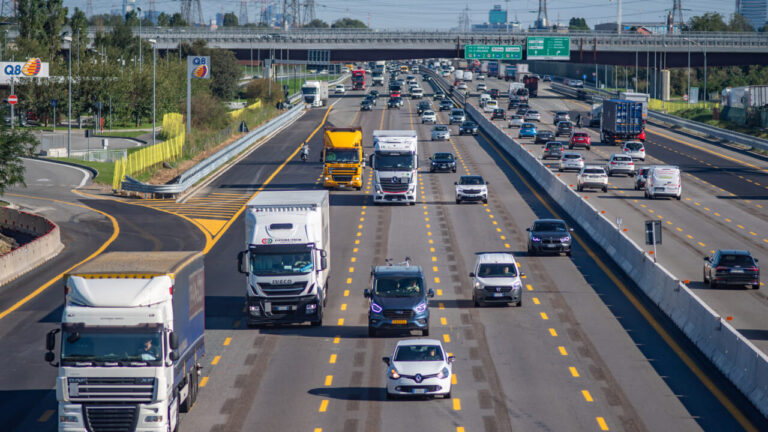
To spend less at the pump you don’t necessarily need to change your car. If the solution, as we have already written, is often to move towards models with lower consumption and emissions, our driving style and habits can also have a considerable impact. And there are many variables. On the motorway, where you travel at high speeds for long stretches, slowing down can significantly affect the fuel consumed. On urban routes and on ordinary roads, continuous variations in pace also count: accelerating and then braking a few meters later means spending energy without traveling a long way. Not to mention the weight carried, the air conditioning and the tyres. But let’s go in order.
The example of the motorway: how much can be saved by reducing speed
Let’s start with concrete examples. We use the prices of 2.141 euros per liter for petrol and 2.281 euros for diesel, based on the latest weekly survey by Mase, the Ministry of the Environment and Energy Security.
The problem is that, although many recent combustion models have an average consumption estimated at around 5.5 liters per 100 kilometres, consumption varies significantly as speed increases, especially on motorway sections. Let’s therefore assume that, at 130 km/h, consumption rises to 7 liters per 100 kilometres: a plausible value in light of those found in tests on some models in circulation today.
According to the International Energy Agency (IEA), reducing motorway speed by 10 km/h can cut the fuel consumed by the individual driver on the affected stretch by 5-10%. If a car consumes 7 liters per 100 kilometers at 130 km/h, by moving to 120 km/h the saving would be 0.35-0.7 liters per 100 kilometres. By applying the prices indicated, for a thousand kilometers you would save approximately between 7 and 15 euros on petrol, between 8 and 16 euros for diesel-powered cars. Considering the 10 thousand kilometers traveled on average by car annually, if entirely on the motorway at the speeds considered, the savings could therefore reach around 150 euros for petrol and 160 euros for diesel.
But the savings can be even more significant, as reported by the Adac, the German Automobile Club. According to the association, traveling the same distance at 100 instead of 130 km/h can save 25% on fuel. Here too the reference is the route traveled at those speeds, not all the kilometers traveled during the year. Applying this estimate to the same hypothetical car, the saving would be 1.75 liters per 100 kilometers: approximately 3.75 euros for petrol and 3.99 euros for diesel. Over a thousand kilometers traveled entirely at those speeds, the cost would be approximately 37 and 40 euros respectively; on 10 thousand kilometres, at around 375 and 399 euros. Values that are starting to be considerable.
Six out of 10 Italians have bought an SUV: the shock between petrol over 2 euros, car insurance and tax, what to do now – by Daniele Tempera
The physical reason for the increased consumption? It is mainly air resistance, which increases rapidly with pace. The aerodynamic force increases approximately with the square of the speed: doubling the speed means, all other things being equal, quadrupling that force. This does not mean that the liters consumed by the car quadruple, because the engine, transmission, tires and other factors also affect the total consumption, as we will see.
How to save on ordinary roads and urban sections
Below 100 km/h, especially on ordinary roads and in traffic, the savings depend more on regular driving than on finding an ideal speed. Looking ahead, maintaining a safe distance and taking your foot off the accelerator in time before a roundabout or traffic light helps avoid unnecessary braking and restarting.
With a manual gearbox it is best to switch to a higher gear when the engine can support it without effort, avoiding either keeping it revved too much or making it proceed at too low a speed. A review by the Joint Research Center of the European Commission reports, for optimal shifting, consumption estimates of 1% lower in heavy traffic and 2% in light traffic. With the automatic gearbox, if present, the “Eco” mode can favor savings-oriented gear changes. But the concrete effect depends on the model.
There is no ideal speed valid for all cars. In a test of 74 vehicles, the US Department of Energy generally found the best efficiency at cruising speeds between about 65 and 80 km/h, where air resistance is still relatively low. This does not mean that the engine must idle: it must work in the appropriate gear, without struggling when moving or climbing hills.
How much can you save with all these habits? A study published in Energy Economics estimated, after an efficient driving course, an average reduction in consumption of 4.6% on city routes. However, the benefit varies from driver to driver.
Weights, tires and air conditioning: how much they affect final consumption
Then there is ordinary maintenance. Checking tire pressure when cold, following the values indicated by the manufacturer for the car’s load, limits rolling resistance. The IEA indicates that regularly checking the pressure can save up to 1.5% of fuel. A roof box left mounted unnecessarily increases air resistance: its effect is especially severe at higher speeds. It is also worth avoiding habitually carrying heavy objects that are not needed: according to an estimate from the US Department of Energy, about 45 kilos of additional weight can reduce the efficiency of the car by about 1%, with a greater impact on lighter vehicles. One hundred kilos of ballast can therefore account for more than 2%.
Petrol over 2 euros and a stop to diesel: which car is worth buying and how much you really save – by Daniele Tempera
A separate discussion concerns air conditioning, which has now become essential in the scorching summers we are experiencing. The compressor requires energy: according to the International Energy Agency, air conditioning can generally account for 4–10% of fuel consumed, depending on the climate and usage habits. An ADAC test found an increase in average consumption of 10-15%, reaching around 20% in urban traffic.
At low speed, when the temperature allows it, opening the windows can be an alternative. On the motorway, or in any case above 80 km/h, however, open windows worsen aerodynamics: it may be more efficient to close them and use the air conditioning, setting a comfortable temperature without cooling the passenger compartment more than necessary. However, there is no precise speed at which the two solutions are equivalent for all cars.
Hybrid and electric: what to consider for savings
Speaking of new mobility, we must distinguish between mild hybrids, full hybrids and plug-in hybrids: they have different electrical capacities and the plug-ins can travel part of the journey using energy charged from the socket. For the latter, fuel consumption therefore also depends on the frequency of recharging. On the motorway, where less energy is recovered from braking and air resistance increases, speed remains decisive. The savings percentages estimated for traditional cars, however, do not automatically apply to all hybrids.
For an electric car the unit of measurement changes: you need to observe the kWh consumed every 100 kilometres. Speed remains important. According to an ADAC analysis, going from 100 to 120 km/h increases average electricity consumption by 26%. Slowing down on a fast route can therefore reduce charging costs and increase available range, although the result depends on the model and route.
Car rc, the silent blow: the map of those who pay the most and the guide to saving immediately – by Daniele Tempera
Temperature also has an impact: when it’s cold, heating the passenger compartment and bringing the battery to operating temperature requires energy. If the car offers preconditioning while plugged in, it allows you to use the mains instead of the battery and therefore preserve the range during the journey.
The conclusion, for petrol, diesel, hybrid and electric cars, is the same: the savings must be evaluated on the routes that are actually taken. Ten kilometers per hour less for a stretch of motorway has a calculable effect on that stretch; driving more regularly requires continuity over time. But it can provide long-distance savings and also (and above all) contribute to safety behind the wheel.
Dossier is the exclusive subscription investigative section of The Vermilion. If you want to support our journalistic work and subscribe, Click here.