

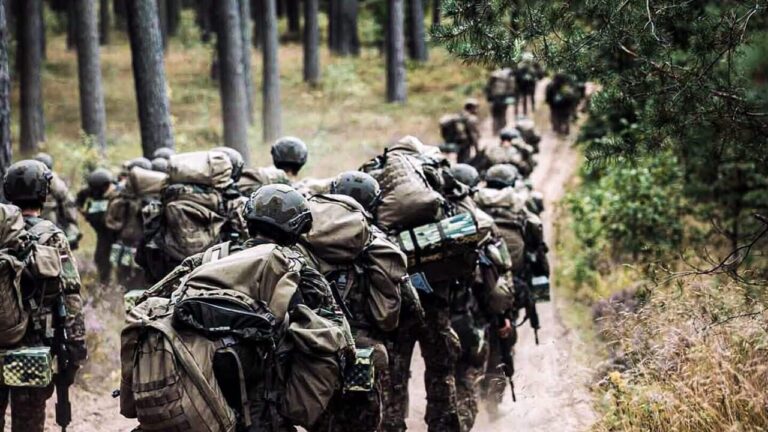
Estonia is changing the way it plans to defend itself against a possible Russian attack, bringing a significant part of its military forces closer to its eastern border and increasing its ability to strike at long distances. The new posture is described by Financial Times. Tallinn is switching to what it calls “active defense”: the objective would no longer be to gain time by retreating while waiting for NATO reinforcements, but to try to prevent a possible aggressor from conquering Estonian territory from the start. The news comes on the same day that German intelligence launched from Berlin one of the most explicit alarms in recent years about the Russian “shadow war”.
What Estonia is really doing on the border with Russia
According to what was reconstructed by Financial Times and reported by the public broadcaster Errthe 1st Estonian Infantry Brigade, the main combat unit of the Tallinn army, will be permanently relocated from Tapa to Johvi, about 50 kilometers from the border with Russia. New military facilities are already under construction.
The brigade commander, Colonel Tarmo Kundla, said: “We must start from the border and win from the first battles.” The Estonian armed forces intend to defend the territory starting from the border, rather than giving up space to slow down the enemy advance.
A second piece concerns Narva, the Estonian city directly overlooking Russia, separated from Ivangorod by the river of the same name. A structure capable of hosting up to 1,000 soldiers is planned here: around 200 permanently and another 800 in the event of a crisis. It is considered one of the most sensitive points on NATO’s eastern flank. Although the concern illustrated at Financial Times from the Estonian military and intelligence leaders is not primarily that of a large-scale invasion in the short term, it is feared that a limited operation may be attempted in the future to test the Alliance’s ability to react. And Narva itself is indicated by Estonian interlocutors as one of the hypothetical scenarios.
Missiles that can hit up to 300 kilometers
Tallinn is building a deep strike capability, one of the central elements of the new doctrine. According to the Ftin the last year Estonia has signed contracts for nine American Himars systems and nine South Korean Chunmoo systems, with ammunition capable in some configurations of reaching around 300 kilometers. The range has an obvious geographical significance: St. Petersburg is approximately 260 kilometers from Estonia. The plan presented to the British newspaper envisages that, in the event of a Russian attack, Estonian forces will be able to strike military targets across the border from the early stages of the conflict.
Military spending also grew rapidly. The Tallinn government has increased defense investments in 2026 to 5.4% of GDP and had already approved a plan that includes further billions for air defense, drones, electronic warfare and deep attack capabilities.
The role of NATO and Italy in Estonia
Estonia has been a member of NATO since 2004 and its territory is already an integral part of the Alliance’s military deployment on the eastern flank. A multinational battlegroup led by the United Kingdom and with French participation is deployed in Tapa. Furthermore, Estonia does not have its own fighter force equivalent to that of the major allied powers: the surveillance and defense of its airspace is supported by the NATO Baltic Air Policing mission, which also operates from the Amari base.
undefined
Since 1 August 2026, the Italian Eurofighters of the NATO task force have been operating from the Siauliai base, in Lithuania, with the task of monitoring and protecting the airspace of all three Baltic republics: Lithuania, Latvia and Estonia. The Ft it also reports that the United Kingdom intends to increase its presence in the country from around 800 to 1,200 men by next April and that new drone attack capabilities have been introduced in the exercises.
Moscow’s response: “We monitor the situation”
The Kremlin has made it known that it is following Estonian movements. Asked about the information published by the Financial Times, spokesman Dmitry Peskov said there should be no doubt that the Russian Defense Ministry and other relevant services have the necessary means “to adequately monitor and assess the situation at the borders.” ANSA.it
Moscow has repeatedly denied it wants to attack NATO countries. Vladimir Putin has reiterated in recent days that Russia has no intention of attacking other states, contesting Western assessments of possible future aggression.
Germany’s alarm: “Russia already in a shadow war”
Speaking before the parliamentary committee that monitors the security services, the head of the Bnd Martin Jager said that the confrontation with Moscow had taken on “a new, more dangerous dimension” and that no other country currently represents an equally direct and concrete threat to Germany. Jager speaks openly of “shadow warfare”: sabotage, clandestine operations, cyberattacks, disinformation and attempts at intimidation that remain below the threshold of conventional war.
The case cited several times is that of Leipzig airport, where an attack with a drone loaded with explosives was foiled last August. In this case it is not just the evaluation of the services: the German federal government has officially attributed responsibility for the operation to Russia, defining it as a hybrid attack. Moscow has always denied the accusations.
Sinan Selen, head of the BfV internal security service, also spoke about Russia’s willingness to resort to sabotage and assassination, arguing that the German authorities have already achieved some results in countering these operations.
Why Estonia is afraid that the war in Ukraine will end
From the Estonian point of view, as long as the war in Ukraine continues, a huge share of Russian military forces remains committed to the front. According to Tallinn officials interviewed by Financial Timesa possible ceasefire could instead allow Moscow to move men, equipment and production capacities currently absorbed by the conflict towards the Baltic.
A senior Estonian intelligence officer summed it up to the British newspaper with a particularly clear phrase: “We are now afraid of the end of the war.”