

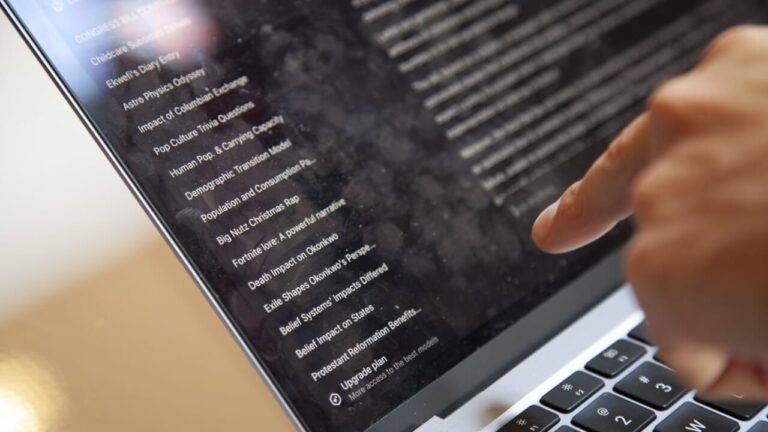
When they have a doubt, they search on the Internet. And they increasingly question artificial intelligence, which in the children’s responses comes closer to their parents as a point of reference: 57% say they turn to AI, compared to 58.6% who ask mum and dad. A closeness that shows how chatbots have entered the daily lives of teenagers, from homework to personal advice.
It is one of the results of the 2026 data from the scientific observatory on digital education of Social Warning – Movimento Etico Digitale APS, elaborated on the basis of approximately 20 thousand students between 11 and 18 years old met during the 2025/2026 school year. A photograph of the experiences declared by the children involved, from which a request to adults also emerges: more than half would like more rules and guidance in the use of technology.
Artificial intelligence also enters into confidences
The first place, when there is a question to answer, remains the Internet, indicated by 90% of kids. But AI has already carved out a space for itself that goes beyond research and study: reported uses include searching for information, at 70.9%, and help with homework, at 55.5%, but also personal advice, at 33.2%, and simple conversation, at 14%.
The comparison with parents therefore concerns the choice of who to ask when faced with a doubt: it does not measure how much children love adults nor does it demonstrate that they attribute to their answers the same trust reserved for a chatbot.
According to Gregorio Ceccone, digital pedagogist and coordinator of the Observatory, one of the reasons for this use of AI emerges in class meetings: some students say they prefer it to an adult because they don’t feel judged when they ask a wrong question. A signal which, in the pedagogist’s reading, also calls into question the way in which errors and insecurities are dealt with at school and in the family.
Furthermore, domestic dialogue on digital appears limited: only 18.8% say they often talk about it with their parents, while almost 45% rarely or never do so. Less than half, 47.9%, report having explicit rules about the use of technology at home.
The telephone before the age of ten and social media in bed
Access to your personal smartphone starts early. Seven out of ten children already have it by the age of 11 and 42.5% receive it before the age of ten. Before the age of 15 the share reaches 92.8%.
Once it arrives, the phone accompanies a good part of the day. 74.6% declare use of at least three hours daily, with 37.9% exceeding five hours. More than seven in ten take it to bed at night and check it in the morning before even getting up.
For many, reducing time online is complicated: 52.2% say they have tried without fully succeeding. 21.5% report feeling agitated when they cannot use social media. These are behaviors and sensations declared by the students, which indicate a difficulty in managing the device without constituting, in themselves, a diagnosis of addiction.
Another data concerns school: 62.1% declare that they have not addressed the responsible use of the Internet, artificial intelligence and social media in class. Yet 54.8% would like more rules and more support.
Meanwhile, the use of AI coexists with various fears. 46.3% are worried about its possible improper use, 41.9% fear that it could be used against humans in the future. This is followed by the security of personal data, indicated by 39.7%, and the loss of jobs, at 34.9%. A scenario that reflects the fears that are gathering globally over a type of technology that seems to be developing at dizzying speed.