

The most important word is also the one that is missing. In the new draft of the Cop31 climate agreement in Antalya, Türkiye, there is no explicit reference to abandoning fossil fuels. And the European Union says no together with the United Kingdom, Norway, 32 African countries and some island states. No cover decision, the most political text, was approved and therefore the United Nations summit ended in substantial failure. Without a new final draft, negotiations will have to be suspended and will resume at the next climate conference, scheduled for next year in Ethiopia.
After two weeks of negotiations and over 42 hours of discussions beyond the official deadline, COP31 in Antalya, Turkey, found itself faced with a clash that blew up the final document. At the center of the controversy is once again the future of fossil fuels: the new compromise proposal presented on the night between Saturday 21st and Sunday 22nd November by the Turkish-Australian presidency did not contain any explicit commitment to abandoning oil, coal and gas, the main causes of the emissions that fuel global warming.
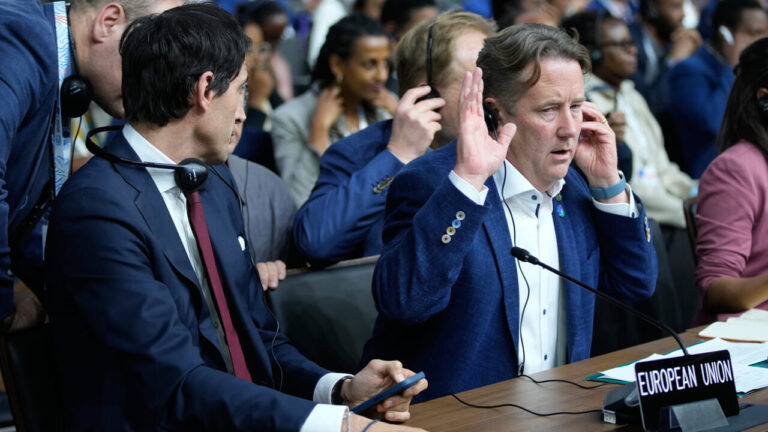
The reaction of European countries was very harsh. The French Minister of Ecological Transition Monique Barbut accused the presidency of having presented a text that represents a step backwards compared to the commitments already made. German Environment Minister Carsten Schneider called the proposal “unacceptable”. Ireland, which holds the rotating presidency of the European Union, has warned that the chances of reaching an agreement are diminishing by the hour. “We will not support a decision or an act that does not even mention fossil fuels, which are the main driver of climate change” said the Irish Environment Minister, Darragh O’Brien, speaking on behalf of the 27 member states of the European Union during the COP31 plenary. “We will not accept any backward steps, nor a conference that greenwashes fossil fuels.”
The steps backwards
The third draft of the so-called Cover Decision, the political document intended to collect the results of the conference, was released on the night between Saturday 21st and Sunday 22nd November. The text represents the Turkish presidency’s attempt to reach a compromise between European requests and the positions of the main hydrocarbon producing countries, in particular those of the Arab Group and Russia. But the compromise, at least for the moment, isn’t working.
The breaking point concerns a commitment that seemed to have been acquired three years ago. At COP28 in Dubai in 2023, United Nations countries recognized for the first time the need to start a transition to progressively abandon fossil fuels in energy systems, accelerating interventions this decade to achieve climate neutrality by 2050.
The new Antalya draft instead limits itself to generically referring to the document approved in Dubai, without explicitly resuming its commitment on fossil fuels. A formulation that does not satisfy the European Union and numerous Latin American and Pacific countries, which ask to include an unequivocal reference to abandoning fossil fuels in the final document. On the other side are the large hydrocarbon producers, led by Saudi Arabia, who continue to oppose any explicit wording.
Further complicating the negotiations is the proposal to accelerate the development of technologies for the capture, use and storage of carbon dioxide, indicated by the acronym Ccus. These are systems that allow us to intercept part of the CO2 produced by industrial activities, and then reuse or store it, preventing it from reaching the atmosphere. These technologies are also supported by the oil and gas industry, which considers them a tool for reducing emissions without completely abandoning the use of hydrocarbons.
The push for electrification
The proposal does not lack some concrete objectives. The main one is the one supported by Turkey: increasing the share of electricity in global final energy consumption to 35% by 2035, accompanying this change with a greater use of clean sources. Electrification of transport, heating and industrial processes can help reduce emissions, but the outcome also depends on how the electricity is produced. In fact, the text does not contain the restriction requested by the European Union in favor of electricity produced from renewables and nuclear: if the greater demand is satisfied with coal or gas-fired power plants, the climate benefits may be much more limited.
The text also contains reference to the objective of limiting global warming to 1.5 degrees compared to the pre-industrial era, a particularly important request for small island states, threatened by rising sea levels.
The open questions
Two other questions also remain open. The first concerns the climate financing that industrialized countries, historically responsible for most of the emissions accumulated in the atmosphere, have committed to guaranteeing to developing countries to address the effects of climate change. The European Union had already made it clear that it did not want to make new financial commitments during this conference, limiting itself to confirming previous ones. The second controversy concerns the timetable of the next reports from the IPCC, the United Nations’ intergovernmental panel of experts on climate change. The draft recognizes the importance of reports from the IPCC, the United Nations Intergovernmental Panel on Climate Change, but does not explicitly establish that all the necessary studies must be available before the next global assessment in 2028. This is the process through which the progress made by governments towards the commitments made to contain global warming will be assessed. The European Union, together with industrialized and least developed countries, called for the scientific reports to be ready in time to allow a full evaluation. Russia, the Arab Group and India had opposed this approach. Also on this point the document is therefore limited to a general reference to the role of the IPCC.