

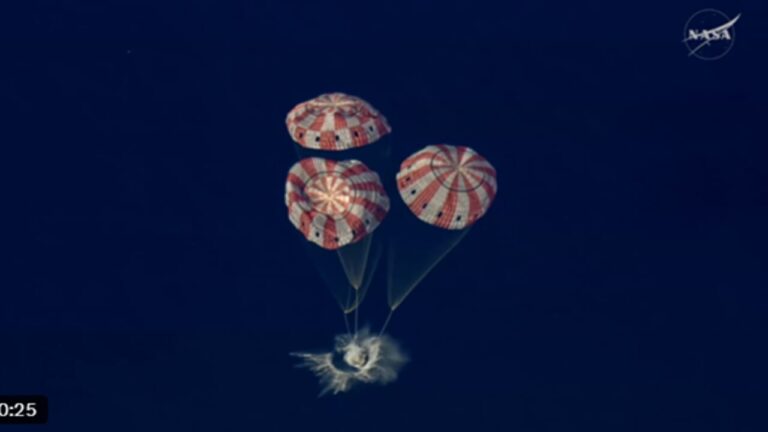
Mission accomplished. After ten days spent beyond Earth’s orbit, the Artemis II space mission ended with a spectacular re-entry at the end of a journey that led the crew to explore the far side of the Moon. The Orion capsule landed in the Pacific Ocean at 5.07 pm local time (2.07 am in Italy), off the coast of San Diego (California), crowning a journey of 694,481 miles and marking a new record: the distance reached by Apollo 13 in 1970 was surpassed.
Artemis II did not land on the Moon or enter lunar orbit, but it broke Apollo 13’s distance record and marked the longest distance humans have ever traveled from Earth, when the crew reached 252,756 miles (about 406,771 kilometers).
Welcome home Reid, Victor, Christina, and Jeremy! 🫶
The Artemis II astronauts have splashed down at 8:07pm ET (0007 UTC April 11), bringing their historic 10-day mission around the Moon to an end. pic.twitter.com/1yjAgHEOYl
— NASA (@NASA) April 11, 2026
33 times the speed of sound
In the most touching scene of the mission, the tearful astronauts asked permission to name two craters on the Moon after their spacecraft, Orion, and after Carrol Wiseman, the late wife of the commander, Reid Wiseman. In addition to Wiseman, the four crew members are pilot Victor Glover, Christina Koch, and Canadian Jeremy Hansen. Returning to Earth, the four passed through the atmosphere traveling at “Mach 33”, or 33 times the speed of sound, a speed never recorded since NASA’s Apollo missions in the 1960s and 1970s. According to NASA, the spacecraft reached a maximum speed of approximately 39,690 km/h.
The Orion capsule, nicknamed Integrity by astronauts, landed on autopilot. During the journey, Artemis II astronauts studied parts of the far side of the Moon never before seen by the human eye (areas of the lunar surface that were in shadow during the Apollo missions) and also witnessed a spectacular 53-minute solar eclipse.
The perfect ditching
The astronauts were recovered by US Navy helicopters, which brought them to the ship almost two hours after splashdown. Victor Glove and Christina Kock were the first to look out of their helicopter and sat on the edge of the door for a while. Commander Reid Wiseman and Jeremy Hansen did the same on another helicopter. Meanwhile the chief administrator of NASA, Jared Isaacman, went to greet them. All four were smiling and all managed to walk, albeit with an uncertain pace, to reach the on-board infirmary, where they underwent the usual medical checks.
A success
Despite the rich scientific spoils, there was no shortage of setbacks: both the capsule’s drinking water and propellant systems had valve problems. Perhaps the most glaring inconvenience was the constant malfunction of the bathroom. Despite this, the mission was a success and demonstrated that the critical systems of the Orion spacecraft, such as the life support system and propulsion, are capable of carrying humans to the Moon.
Artemis II may have splashed down, but our photos and videos from the mission are still rolling in! Keep an eye on the latest: https://t.co/rzM1P0QbOl pic.twitter.com/HahXb0gCYC
— NASA (@NASA) April 11, 2026
Attention was particularly focused on the capsule’s heat shield, which had to withstand thousands of degrees of temperature during re-entry. On the spacecraft’s only other test flight, in 2022, with no one on board, the outer shield had charred.
“What a trip! We’re all fine”
“What a trip! We’re fine, four crew members healthy,” the mission commander said at the reentry control center. The mission was dotted with several firsts in addition to the records broken: Victor Glover is the first black man to orbit the Moon, Christina Koch is the first woman. Jeremy Hansen is the first Canadian astronaut to make the journey.
The next stage of man’s approach to the Moon is expected next year, when the Artemis III mission will see astronauts practice docking their capsule with one or two lunar modules orbiting the Earth. Artemis IV will attempt to land a two-person crew near the Moon’s south pole in 2028. “We really hoped, deep in our hearts, that we could make the world stop, even for just a moment, and remember that this is a beautiful planet and a truly special place in our universe, and that we should all appreciate what we have been given,” the commander said.
Trump: “Spectacular, the next step is Mars”
US President Donald Trump witnessed the landing of Artemis II live. The White House resident was at a Maga event in Virginia and had a television set up for himself and his guests. “Congratulations to the great and talented crew of Artemis II. The entire journey was spectacular, the landing was perfect, and as President of the United States, I couldn’t be more proud! Can’t wait to see you all at the White House soon. We’ll do it again and then, next step: Mars!”, Trump wrote on Truth after the Orion splashdown.