

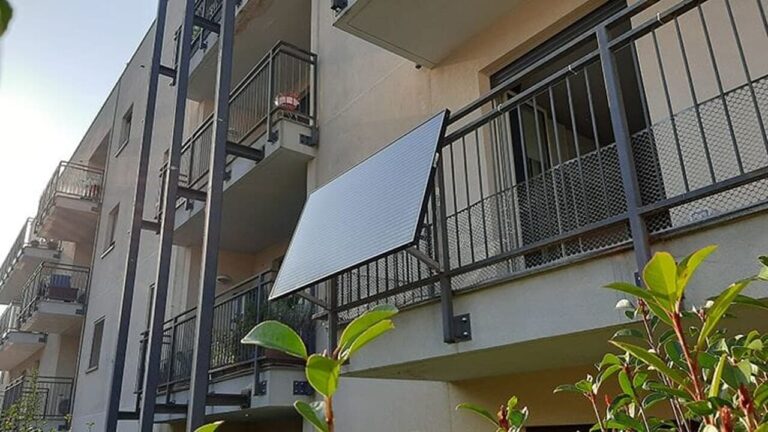
Balcony photovoltaics have become one of the most advertised energy products in recent months. The promise is simple: hang one or two panels on the railing, connect them to the home’s electrical system and immediately reduce consumption taken from the grid. A less expensive and less demanding solution than a system installed on the roof, particularly interesting for those who live in condominiums and do not have their own surfaces. But how much do you really save? And above all: after how many years will the initial expense be recovered?
The answer depends on four elements: system power, balcony exposure, quantity of energy produced and percentage that can be consumed directly while the panels are working.
Plug and Play
The first point to clarify concerns the definition of Plug and Play system. In Italy, systems with a nominal active power not exceeding 350 watts, complete and ready to be connected to a dedicated socket, fall into this category.
For systems above 350 watts, the intervention of a qualified installer, the declaration of conformity, the single-line diagram and the operating regulations may be necessary. The cost of the brackets, the dedicated line or socket and installation must therefore be added to the price of the kit. A system made up of two panels, with a total power close to 800 watts, remains a small photovoltaic system and can benefit from a simplified procedure.
A kit of around 800 watts can cost around 600 euros, but the final cost can increase depending on the characteristics of the balcony and the home’s electrical system.
How much does a panel mounted on the balcony produce
An 800 watt photovoltaic system installed in favorable conditions can produce around 900 kilowatt hours per year. But this is a value that generally presupposes good exposure, absence of shadows and adequate inclination of the panels.
On a balcony the situation is often different. The modules are installed almost vertically on the railing and can be partially covered by the shade of the upper floor, the buildings opposite or the trees. Orientation is crucial. A south-facing balcony will have very different results than one facing east, west or, in the worst case, north. The city where the property is located also affects production.
This is why there is no one-size-fits-all amount of energy. Assuming approximately 600 kilowatt hours per year for a vertically mounted 800 watt system may be a realistic example under fair conditions, but is not a guaranteed average. In some cases production may be higher. In the presence of significant shadows or unfavorable exposure it could instead be much lower.
The problem of energy produced when no one is home
Total production is only part of the calculation. The decisive element is self-consumption, i.e. the percentage of energy used directly by the home when it is generated. Small balcony systems are often installed without a battery. The electricity produced must therefore be consumed immediately by the refrigerator, router, air conditioner, washing machine, dishwasher or other appliances in operation.
If the energy produced is greater than the home’s instantaneous consumption, the excess is fed into the grid. With the simplified procedure, however, the owner renounces remuneration for the energy injected. It does not mean that the energy is materially wasted: it is used by the electricity grid. The owner of the plant, however, receives no compensation for that production.
The problem is particularly evident in homes that remain empty during the day. In the middle of the day, when the photovoltaic system reaches its highest power, only the refrigerator, the router and a few devices on stand-by can be turned on. A substantial part of the energy can therefore be fed into the grid for free, while the family continues to consume, especially in the evening, when the panels are not producing.
How much you save with low self-consumption
Let’s consider a small 800 watt system costing a total of 600 euros and capable of producing 600 kilowatt hours per year. In an empty house during daylight hours, for example, a self-consumption of 30% can be assumed. Of the 600 kilowatt hours produced, only 180 would be used directly by the family. The remaining 420 would be placed on the network without remuneration.
Assuming a value of avoided energy equal to 25 cents per kilowatt hour, the annual saving would be around 45 euros. With an initial investment of 600 euros, the simple payback time would be around 13 years.
How much changes when programming household appliances
The result improves significantly when the family manages to increase self-consumption. Washing machine and dishwasher can be programmed during central hours. In summer the air conditioner can directly use a significant part of the energy produced. The same goes for those who work from home or use electric boilers, heat pumps and other appliances during the day.
Assuming we bring self-consumption to 70%, 420 of the 600 kilowatt hours produced each year would be used directly. The saving would become around 105 euros per year and the simple payback time would drop to around 5.7 years. In short, on balance the real savings do not only depend on how much energy the panels produce, but above all on how much can be used when it is produced.
It is also good to remember that photovoltaic only reduces a part of the bill. The fixed marketing quota remains unchanged even if withdrawals from the network decrease. And in some contracts it can exceed one hundred euros per year, while in others it is less. Installing a balcony panel therefore does not eliminate the need to control your light supply. A very high fixed quota can reduce the effect of the savings obtained with photovoltaics, especially when annual consumption is low.
The tax deduction can shorten the turnaround time
Even small photovoltaic systems intended for domestic consumption can, in the presence of the required requirements, be included among the interventions eligible for the Home Bonus. In 2026 the deduction is equal to 50% for interventions on the main home and 36% for other homes, within the limits and conditions established by law.
However, the benefit is not automatic for any kit purchased online. It is necessary to keep the documentation, make the payment with the correct methods and comply with any required obligations. The deduction is also recovered over the years through a reduction in Irpef and presupposes that the taxpayer has sufficient fiscal capacity.
Pay attention to railings, wind and condominium rules
Economic convenience is not the only element to evaluate. One or two panels mounted on the railing constitute a surface exposed to the wind and must be fixed with suitable systems. Before installation it is necessary to check the resistance of the structure, the risk of falling, electrical compliance and the presence of any landscape or municipal restrictions.
In condominiums, installation serving a single home does not necessarily require prior authorization from the assembly. However, it cannot compromise the safety, stability of the building or architectural decoration. When common parts are affected, it is also advisable to inform the administrator, who can ask for clarification on the installation methods and safety measures adopted.
Dossier is the investigations section of The Vermilion. If you want to support our journalistic work and subscribe, visit our shop window by clicking here.