

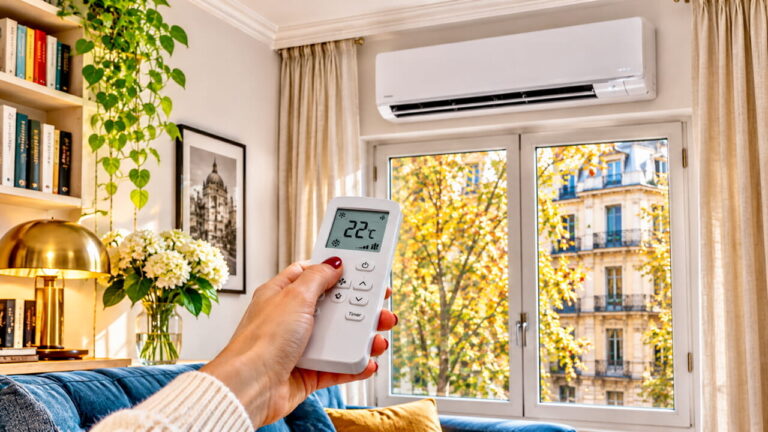
The heat that Ornella Vanoni sang about in the Sixties is no longer a musical suggestion: with the increase in periods characterized by high temperatures, theair conditioning it has become a widespread presence in Italian homes. If until a few years ago it was considered a luxury for a few, today it is perceived by many families as a fundamental resource for well-being. This is confirmed by Istat data: in 2024, 56 percent of Italian families had at least one air conditioning system.
You just need to look back to understand how much the situation has changed. In 2001, only 10.7 percent of households had an air conditioner in their home. In 2006 the market was already booming, with a turnover of around 1.3 billion euros. The growth continued in the following years: in 2021 almost one in two families (48.8 percent) had an air conditioning system, while 32.6 percent had a system capable of heating and cooling the rooms. In 2024, the share of families equipped with air conditioning systems rose to 56 percent, while those in possession of a hot/cold appliance reached 40.4 percent.
Record heat and consumption: what to do in autumn
According to an analysis by the CNR, thesummer 2026 it was the hottest in Italy since 1950. “The heat maps, which represent a monthly ranking of average temperatures from 1950 to today, show for the first time the hottest July and August consecutively,” said Lorenzo Arcidiaco, Cnr researcher.
The heat has naturally had repercussions on consumption: last July 15, electricity demand reached a peak of around 58 GW, an increase of 4.5 percent compared to the maximum recorded in 2025. The growing diffusion of heat pumps, which allow a system to heat rooms in winter and cool them in summer, contributes to driving the sector.
The air conditioner therefore becomes an emergency, but haste can be a bad advisor and lead to making mistakes: choosing an appliance that is too powerful or, on the contrary, undersized; decide only based on price; neglecting energy efficiency, which is essential for reducing waste and optimizing consumption. For these reasons, autumn, immediately after the hottest months of the year, represents a favorable time to purchase and install an air conditioner. The period offers more time to plan spending, compare offers and evaluate the features of the different models.
Costs and diffusion in Italy: all the numbers
An analysis by Facile.it reveals that, in the summer of 2026, the use of a class A+ dual split air conditioner, turned on for eight hours a day, would have resulted in an estimated bill expense of 146 euros in total. The trend in energy tariffs also weighs on the total which, according to the estimates considered, in the same period would have been 4 percent higher than in summer 2025.
However, the actual cost may vary based on various factors: energy efficiency and power of the appliance, hours of operation, set temperature, characteristics of the home and cost of electricity. Assuming a constant absorbed electrical power of 1,500 watts and a tariff of 0.28 euros per kilowatt hour, the operating cost would be approximately 42 cents per hour, equal to 3.36 euros for eight hours.
From the Sicilian heat told in “Gioia mia” (2025), the film by Margherita Spampinato, to the Istat numbers a reality emerges: Sicily is the Italian region where air conditioners are most widespread. In 2025, 72.2 percent of families had a cooling appliance, ahead of Puglia (69.7 percent) and Veneto (68.5 percent).
How to choose the right air conditioner
At the other extreme – not surprisingly – is Valle d’Aosta (6.6 percent). Beyond territorial differences, air conditioning can protect from the heat, especially the elderly and fragile people during heat waves. However, it is advisable to use it correctly: experts recommend setting the thermostat between 24 and 26 °C.
The choice of the ideal air conditioner depends on several factors, starting from the number of rooms to be air conditioned. A monosplit system is made up of an internal unit connected to an external unit and is suitable for cooling a single room. The dual split system, on the other hand, allows you to connect two internal units to a single external unit, while multisplit systems allow you to cool multiple rooms.
It is better to invest in the energy class
Another aspect to evaluate is the energy class. With frequent use, it may be convenient to choose high-efficiency models, such as those in class A+, A++ or A+++, checking the classification shown on the energy label. The transition from an A+ to an A+++ class can reduce consumption and the cost of the bill: in some cases, savings can reach up to 49 percent based on the models compared.
In any case, it is advisable to choose a model equipped with inverter technology, capable of regulating the compressor power based on the actual cooling or heating needs, thus optimizing consumption. Among the additional functions to consider there are also dehumidification, useful for improving the comfort of the rooms, and the sleep mode, which adapts the operation of the appliance during the night hours.
In addition to choosing the model, it is important to adopt some good habits to use the air conditioner efficiently. In this regard, Enea has created a handbook with ten measures designed to improve home comfort, reduce energy consumption and limit environmental impact.
Hunt for the installer: until 50% is deducted
Concessions can also affect the convenience of the purchase. In 2026, deductions are foreseen for those who install a heat pump air conditioner, provided that the intervention complies with the technical specifications and the conditions established by law. For the Ecobonus, for example, it is necessary to respect the criteria relating to the replacement of the existing system.
For subsidized interventions on the main residence, the deduction is 50 percent, via Home Bonus or Ecobonus, while for other properties it drops to 36 percent. Recovery takes place in ten annual installments. In 2027 the rates are expected to fall to 36 and 30 percent. To learn more about the Ecobonus requirements, Enea makes a section available online frequently asked questions.
Be careful about spending: what is the necessary budget
Once you have chosen the air conditioner, it is a good idea to evaluate the installation costs and the company to entrust the intervention to. But what are the expenses to take into account? And what aspects should you consider before purchasing? Responding to Dossier The Vermilion is Alessio Perrucci, CEO of Climaconvenienza.it: “For a standard monosplit, installation costs approximately 300-500 euros, VAT included and appliance excluded. The price depends on the layout of the home, the distance between the internal and external units, the length of the pipes and the accessibility of the system. It is essential to request preventive advice to clarify the costs and any additional expenses”.
Regarding the choice of installer, Perrucci recommends contacting a company specialized in air conditioning. “Energy companies mainly deal with the sale of energy and often offer air conditioners as an additional service, sometimes combined with a supply contract. A specialized company can instead accompany the customer in choosing the product and correctly sizing the system, considering the rooms to be air conditioned and the needs. If the offer also includes the supply of electricity or gas, it is a good idea to evaluate the conditions”.
Air conditioner: why it is better to install it in autumn
A further aspect to consider concerns the payment methods: is it better to pay immediately or resort to financing? “There are deferred solutions, even in three or four zero-interest instalments. For traditional financing, however, it is essential to check the Tan, the APR and the total amount to be repaid”, explains the CEO of Climaconvenienza.it.
But what are the risks to avoid? “The primary mistake is choosing only based on price. The air conditioner must be sized correctly and installed by qualified professionals. F-gas certifications are required for systems with fluorinated gases. Also pay attention to the R290 refrigerant, with low climate impact but highly flammable, which requires specific safety precautions. Before purchasing it is therefore important to check the qualifications of the installer, the interventions included and the conditions of assistance”.
Dossier is the exclusive subscription investigative section of The Vermilion. If you want to support our journalistic work and subscribe, Click here.