

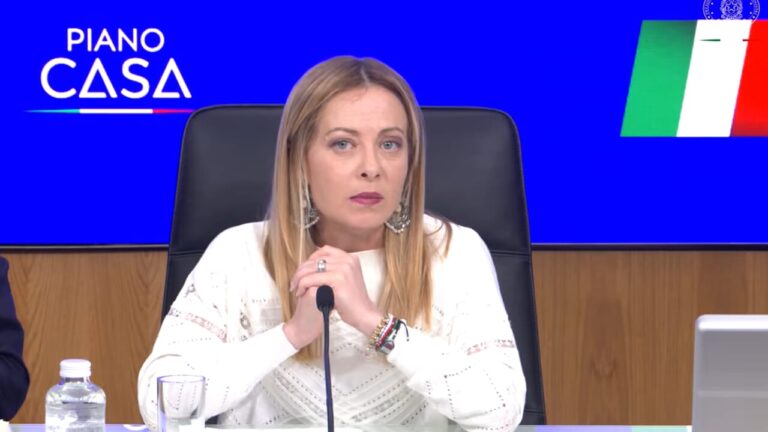
A 10 billion housing plan to which private investments can be added. On the eve of May 1st, Prime Minister Giorgia Meloni revealed in a press conference the government’s project to meet the housing emergency. The FdI leader gathered the Council of Ministers to relaunch government action with measures that try to respond to some issues that are very dear to Italians. In addition to the issue of high energy prices, the executive promises investments in construction, in particular social construction, so as to keep the promise made by the Prime Minister: “100 thousand houses at controlled prices in 10 years, net of public housing”.
Excise duties, the government saves the discount: extension from 1 May. Higher cut for diesel: how much will a full tank cost
The interventions
Until the eve of the Council of Ministers, everyone was tight-lipped: “We are still working on it this evening, we are still working on it even in these minutes, I don’t want to give figures”, said the leader of the League Matteo Salvini. Such caution was motivated by the sensitivity of the housing issue. A dossier dear to Meloni as well as other members of the executive: “It addresses one of the priorities most felt by citizens, the issue of housing. The possibility of access for everyone to an asset at affordable costs”, declared the prime minister in a press conference.
The government’s housing plan is based on three pillars of intervention, to which is added an intervention on flash evictions. The executive aims to recover public housing, concentrate national and European resources on social housing and involve private investments. As we said, this action plan is accompanied by a crackdown on the occupation of homes. “We intervene in the eviction enforcement notification procedures, we cut the time for executions, we introduce the accelerated and emergency procedure to obtain the enforcement title for the release of the property through the courts. We take care of freeing houses that are illegally occupied to return them to their legitimate owners, also to increase the availability of housing on the market”, explained the Prime Minister.
The House Plan
In the latest public finance document, approved on 22 April, there was talk of a “financial allocation of 970 million euros” for the housing plan. A gift inherited from the budget laws of 2023, 2024 and 2025. But other resources have been intercepted from European funding sources, such as 1.1 billion from cohesion funds
“The first pillar aims at the recovery and maintenance of the so-called public housing, we will make available around 60 thousand homes that are in such conditions that they cannot be delivered”, declared Meloni. 1.7 billion euros have been allocated for the interventions, to which 4.8 billion (maximum) will be added which come from urban regeneration programs which can be distributed to the municipalities via Prime Ministerial Decree and only after the green light from the ANCI.
For the redevelopment of housing that is vacant because it is unusable, the aim is to carry out works at a relatively low cost. There is talk of renovating around 60 thousand public housing units which require interventions of a minimum of 15 thousand to a maximum of 20 thousand euros.
“The second pillar is a concentration and simplification of all national and European resources on social housing, approximately 3.6 billion euros, which will be managed by an Invimit fund”, added the prime minister.
“The third pillar is a tool that represents an innovation and aims to also involve robust private investments with the aim of responding to the ‘grey band’ of the population. We are not thinking about public funds, but private ones. The State ensures the private sector simplifications, fast procedures, the appointment of an extraordinary commissioner for investments of over 1 billion. But the private sector will have to allow 70 subsidized housing units out of 100 homes, at least 33 percent of the market cost”, assured the Prime Minister. The government also provides discounts on notarial documents.
To meet its commitments, the State will rely on the support of investment funds, public and private entities, as well as the possible participation of institutional investors such as Cassa Depositi e Prestiti.
undefined
By gray segment of the population, Meloni explained, we mean those who are too wealthy to access public housing, but are not wealthy enough to enter the free residential real estate market. “The real estate market has recorded a notable increase in prices. This is explained by the mortgage effort index, i.e. how much of your net salary you have to use to pay the mortgage. When this index reaches 33 percent, the banks believe that the person may encounter difficulty in paying the mortgage. It is over 47 percent in Milan, 36 percent in Rome. Milan and Rome are among the European cities where a young person has the most difficulty in buying a house”, explained the Prime Minister.
Support for separated parents
A ”rent support” is coming for separated parents” who leave the house, between 400 and 500 euros, in order to ”have a roof under which to meet your child at least on the weekend”. This was announced by the Minister of Infrastructure Matteo Salvini, illustrating the measures contained in the housing plan, during the press conference
which follows the CDM. The resources allocated amount to sixty million
euro for the three-year period 2026-2028.
“What I have in mind for which we are putting out tenders is a contribution of between four and five hundred euros per month for a year for parents who, after separation or divorce, leave home because the other spouse remains in the house, often continue to pay the mortgage or rent, even though the other spouse remains in the house, and have evidently run out of resources and are out of the market”, explained Salvini.
“In many contexts these four or five hundred euros a month make the difference
also to have a roof under which to meet your child at least
over the weekend,” he added. With this intervention ”we hope to be able to help fifteen thousand separated parents in the three-year period”, estimates Salvini. “I say parents because they can be fathers and they can be mothers. It is obviously up to colleagues to look at the statistics after a separation or divorce for those who in ninety percent of cases remain in their place of residence where they stay with their children.”
The president of Confedilizia Spaziani Testa commented with satisfaction on the measures presented by the executive: “The housing measures launched by the government are going in the right direction. On the one hand it was urgent to intervene to recover the over 60 thousand public housing units that were not assigned because they needed major renovations. On the other hand, it is important to activate a structural plan to create accessible housing for all those who do not have sufficient incomes to face the buying, selling or renting market”. Finally, Spaziani Testa added that the choice to restore trust to private owners through a simplification of eviction procedures, strongly requested by Confedilizia, is very appreciable, so as to encourage the expansion of the offer of rental homes and the consequent reduction in rents”.
How the halved cost of notaries works
Meloni also promised a “halving of the cost of notaries”. As? “Rent to buy” and “cohousing” in the real estate sector are “institutions which the notary has been dealing with for over ten years, and for whose diffusion for greater and better use”, therefore the National Council of the professional category “is ready to provide a contribution, so that they have a concrete development and become effectively accessible to citizens”.
The notaries themselves explained this in a note after the approval of the housing plan in the Council of Ministers. The “rent to buy consists of a rental contract for the house with a periodic rent in view of the subsequent purchase, a mechanism that should have facilitated access to the property for those who did not have liquidity or who did not have the immediate possibility of resorting to bank credit but, to take off and be successful among citizens, today requires the revision of some operating mechanisms”, including “the fiscal discipline, currently complex and penalizing”.
While “cohousing can offer numerous advantages, such as the reduction of land consumption through the use of a single house by mononuclear families, a significant contribution to urban regeneration through the eco-sustainable redevelopment of existing real estate, a notable reduction in living costs, greater safety, better assistance and an increase in social interaction, benefits which translate into a positive impact on the quality of life of the elderly, simultaneously contributing to the creation of a more cohesive and supportive society”.
Finally, the Notary has given “the willingness to reduce the fees, given the great social relevance of the plan, regarding the intervention of private individuals in the implementation of the so-called third pillar concerning the entry of private individuals into subsidized housing where controlled purchase prices or rents are foreseen, to meet the housing needs of citizens”, ends the note.